Short answer
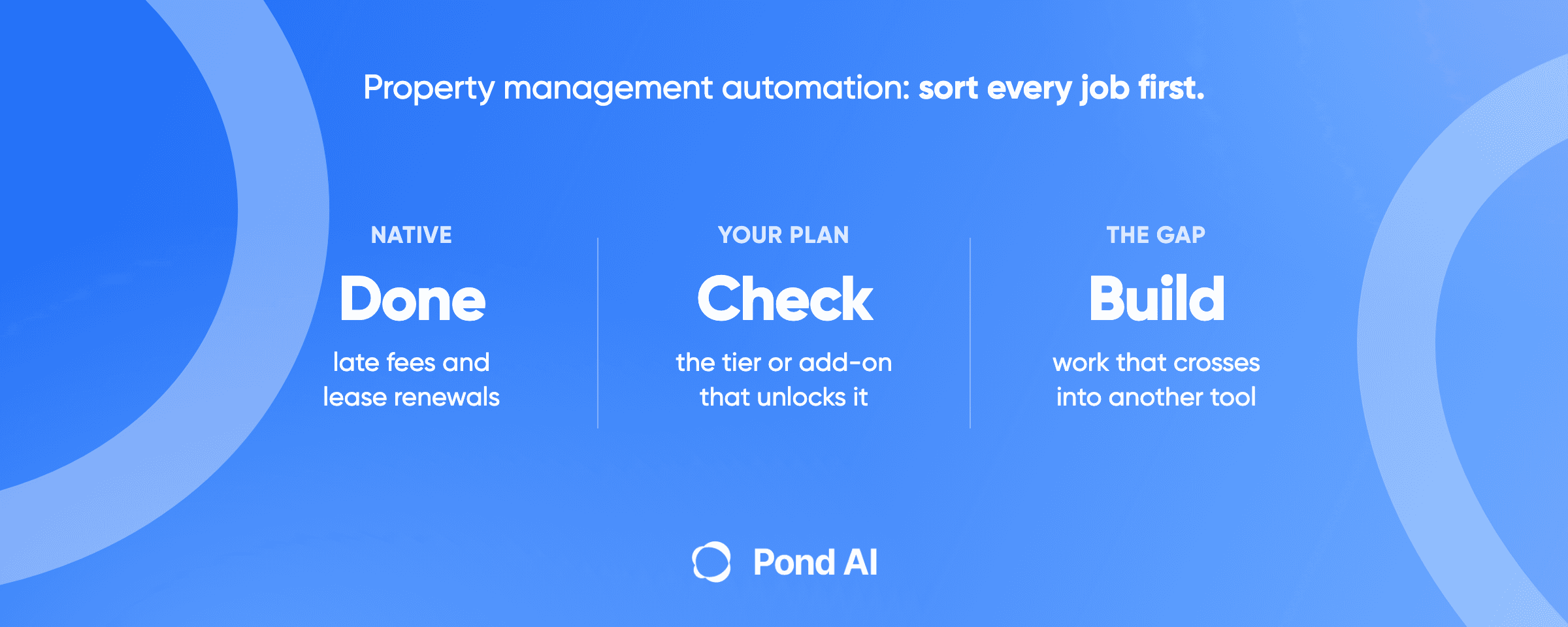
Property management software already runs the money and paperwork loop on its own: late fees, autopay, bank matching, owner distributions and lease renewals. Some vendors also sell AI agents, on higher plans or as paid add-ons, that answer tenant messages after hours or run maintenance. What it leaves to you is work that crosses into another tool, or that needs judgment a rule cannot hold. Those jobs need a build, and a build starts from what counts as done.
Disclosure: Pond publishes this blog and builds custom AI agents. Every plan name and price below is the vendor's own, read on October 23, 2026, in US dollars.
Which property management jobs does your software already do?
Seven jobs are worth sorting. Each one below shows what the software does natively, what it leaves to you, and whether it needs a build. The same split for sales software is in Pond's guide to CRM workflow automation.
The sort, at a glance:
- Native, no build: late fees and returned payments, lease renewals.
- Half-done, build only the cross-tool part: rent reminders and autopay, owner statements and distributions.
- Check your plan and add-ons first: maintenance intake and dispatch, bank reconciliation and vendor bills.
- Weigh the add-on fee against a build: showings, 1099s and inspections.
1. Late fees and returned payments
- Software does: AppFolio lists "Automated Late Fees" and "Late Fee Waivers". Buildium says "Apply fees and trigger notices automatically when payments fail." DoorLoop says "Collect rent online by card or ACH and apply late fees automatically."
- Left to you: a tenant who disputes a fee. TenantCloud's own automation guide lists "Using manual review for dispute resolutions" as work to keep manual.
- Build it? No. Use the native feature.
2. Rent reminders and autopay
- Software does: AppFolio lists "easy auto-payment setup" for residents. Buildium describes reminders, notices and follow-ups "based on real-time activity."
- Left to you: reminders in the channel your team actually reads. That is a cross-tool job.
- Build it? Only for the cross-tool part. Orchestration outside the platform is the work a Zapier expert, n8n consultant or Make developer does.
3. Maintenance intake and dispatch
- Software does: AppFolio's Maintenance Performer can "reply to residents, analyze images, troubleshoot, prioritize emergencies, and dispatch work to the right technician." AppFolio's pricing table marks it "Available with add-on" on Core, Plus and Max. DoorLoop's Maintenance Ops Agent "runs maintenance from work order to bill" and sits on its Multiply plan.
- Left to you: getting alerts and tickets into the rest of your stack, such as a team chat or a shared inbox. That is a cross-tool job.
- Build it? Maybe. If your plan or an add-on gives you an agent, try it first. If not, this is a well-bounded build.
4. Owner statements and distributions
- Software does: AppFolio lists "Automatic true-up on distributions." DoorLoop says "Automate owner distributions and track owner contributions by property."
- Left to you: accounting that lives outside the platform. In a February 2025 Reddit thread, the original poster, an AppFolio operator, calls the accounting "completely unworkable with credit cards" and says AppFolio will "refuse to offer an alternative Quickbooks integration." A reply from a Rent Manager user wagers it is user error. Treat it as one operator's experience.
- Build it? If the gap is a connection to your accounting tool, it is an integration. Pond's CRM integration services guide covers how to scope one.
5. Lease renewals
- Software does: AppFolio's renewal tool lets you set "a default offer that automatically updates lease dates, rent amounts, and status upon the current lease expiration." DoorLoop's Lease Renewal Agent "carries renewals from first outreach to signature."
- Left to you: a tenant who pushes back on the offer.
- Build it? No, unless your plan has neither feature.
6. Bank reconciliation and vendor bills
- Software does: AppFolio matches bank transactions "via our Plaid integration," and its Accounting Performer "Automates 5 of 8 standard month-end close steps" (an add-on on Core, included on Plus and Max). Buildium lists Bank Reconciliation Rules on all three plans and AI Bill Scan as an add-on on Essential and Growth, included on Premium.
- Left to you: matching a vendor bill to the order behind it. Pond's guide to purchase order automation covers that three-way check.
- Build it? Sometimes. Check the plan tier before you scope anything.
7. Showings, 1099s and inspections
- Software does, at extra cost: Buildium lists Showings Coordinator "powered by Tenant Turner" (starts at $41 per month, varying by unit tier, with a $25 setup fee on Essential that is waived on Growth and Premium), 1099 e-Filing "powered by Nelco" at $50 per batch plus $4.50 per form, and property inspections "powered by HappyCo" (a $99 setup fee and $40 to $95 monthly on Essential, included on Growth for three years and then $0.40 per unit, and included on Premium).
- Left to you: paying the add-on fees.
- Build it? Compare the fee with the scope of a build. For commercial portfolios, a Building Engines survey run with BOMA International, reported in a February 2024 post, found "About 37% of property teams believe certificate of insurance (COI) management is ripe for automation." Building Engines' own report on the survey says it covered "over 230 commercial property professionals." It is a vendor survey, so treat it as a direction, not a measurement.
Which plan includes which automation?
Prices are each vendor's published figure, read on October 23, 2026. Where a page does not state a billing basis, this guide says so. Nothing here is a quote.
AppFolio
- Core plan: "Starting at" $1.49 per unit per month, with a minimum spend and a 50-unit minimum. Includes Realm-X Assistant and Messages and standard Stack integrations. Its card lists no API.
- Plus plan: "Starting at" $3.20 per unit per month. Adds Realm-X Flows, Maintenance Scheduling and Automated Billing, a read-only API and the Accounting Performer for bill entry and financial close.
- Max plan: "Starting at" $5.00 per unit per month. Adds Leasing CRM, Leasing Signals, a read/write API and the Accounting Performer with Budgeting, on top of Plus's Bill Entry & Continuous Financial Close.
- Performer add-ons: the Leasing and Maintenance Performers are marked "Available with add-on" on Core, Plus and Max, with no add-on price shown. The page lists a Resident Messenger Performer as coming soon, as an add-on. The Accounting Performer is an add-on on Core and included on Plus (as "Bill Entry & Continuous Financial Close"); Max includes that Performer and adds "Budgeting."
- Not stated: the billing basis. The page says to contact AppFolio for details.
Buildium
- Essential: "starting at" $62 a month, for portfolios of up to 40 units. The price rises with unit count: the page's calculator shows $80 a month at 40 units. No Workflow Automations or Reporting Automation.
- Growth: "starting at" $192 a month. Adds Workflow Automations and Reporting Automation.
- Premium: "starting at" $400 a month. Adds the Open API.
- Billing basis: the headline figures are monthly-billing prices. The page's calculator loads on Monthly and shows the same $62, $192 and $400 a month. A prepaid annual plan is cheaper, at $671, $2,076 and $4,334 a year in the same calculator (toggle labeled "Save 10%").
DoorLoop
These are the yearly-billing prices. DoorLoop's page says annual billing costs less than monthly, so a monthly plan costs more.
- One: $2.50 per unit per month, $1.50 per unit above 100, with a $199 monthly minimum. Includes "Unlimited users, unlimited document storage and full API access."
- Connect: $4.00 per unit per month, $299 minimum. Adds the Receptionist Agent.
- Multiply: $5.00 per unit per month, $399 minimum. Adds the Maintenance Ops Agent and the Lease Renewal Agent. A Rent Collection Agent and a Prospect Agent are marked Coming Soon.
Yardi Breeze, TenantCloud and Rent Manager
- Yardi Breeze: residential starts at $1 per unit per month with a $100 monthly minimum, "Based on annual agreement." Breeze Premier is $1 per unit per month with a $400 monthly minimum, and its feature list adds "Automate move-in and move-out workflows to reduce risk." Its pricing pages state no API terms, so ask before you plan a build on it.
- TenantCloud: its Pro plan is $60 a month, or $50 a month billed annually. It adds Bank Reconciliation and a Separate Owner Portal. Business starts at $100 a month.
- Rent Manager: no published price. Its pricing page lists Basic, Plus and Premium bundles with no prices and no per-bundle button, only "Get Quote" buttons above and below the list.
Can you build on top of your software? API access by platform
A build that reads or writes your data needs API access, and API access is gated by plan.
- AppFolio: read-only on Plus, read/write on Max. Its developer site shows a sign-in screen to a visitor who is not logged in, so the reference is not public.
- Buildium: "To take advantage of the Buildium Open API you must have a Premium Subscription." Access uses account-level API keys, and Premium comes with a free sandbox account for testing.
- DoorLoop: full API access on every plan, One included, plus Zapier.
- Rent Manager: "The API provides both “read” and “write” access to your database." The page does not say which plan includes it. Its pricing page lists an "MCP Connector" in the Premium bundle only.
Pond's API integration page covers this kind of work. The practical point is the plan: if your tier has no write access, a build can read your data and alert you, but it cannot change anything in the platform.
Are AI agents inside the software closing the gap?
For after-hours messages, yes, on some plans and as paid add-ons. Check your plan and its add-ons before you scope a build for it.
- DoorLoop: its Receptionist Agent "answers tenant texts, calls, and portal messages around the clock automatically" and is the added feature on Connect. DoorLoop says "Agents start out needing your approval on everything," and logs each action in plain language.
- AppFolio: its AI page says the Realm-X Performers use agentic AI to "independently observe, interpret and act on signals from your data" and work "even after hours." Its pricing page marks the Leasing Performer and Maintenance Performer as "Available with add-on" on Core, Plus and Max, so those two cost extra on every plan, and it lists a Resident Messenger Performer as coming soon, as an add-on. The Accounting Performer is an add-on on Core and included on Plus and Max.
- Yardi Breeze Premier: lists a "24/7 maintenance call center" add-on, so "emergency maintenance requests will be handled even when your office is closed." It also lists RentCafe Chat IQ, a Breeze Premier add-on that answers prospect questions. The page does not describe the call center as AI.
These are vendor descriptions that nobody tested for this guide. A build still makes sense in three cases:
- Your platform has no agent.
- The agent has to act in a tool the platform does not touch.
- Your policies need judgment the platform's settings cannot hold.
Pond's guides to AI receptionists for law firms and missed-call text-back cover the phone side of that work, and the pattern carries to a property office.
If the job needs an agent rather than a rule, Pond's guides to AI agent integration and to hiring an AI automation consultant cover the build.
What is still worth leaving manual?
TenantCloud's guide lists three jobs it keeps for people: "Using manual review for dispute resolutions", "Handling on-site inspections for complex repairs" and "Completing manual vendor negotiations for large contracts." ButterflyMX's automation guide carries a section titled "What should remain under human control." Pond's view matches: a person should review the result and decide, even when software does the work.
How do you get a gap built?
Start with what counts as done. Pond's guide to writing a task brief names five fields: "what counts as done, what evidence has to be attached, what is out of scope, what you pay for and what you do not, and the deadline." A gap you cannot describe that way is not ready to build.
Then pick a route.
- A scoped custom build. Per Pond's agent development page, "You send the spec and the acceptance test, Pond agrees the scope with you on a call, and you get a quote for that scope before any build starts." Use this for anything larger or ongoing.
- A one-off Task. A well-specified build can go on Pond's AI Workforce Marketplace as a Task. Task Solvers compete on your brief, and the Task Poster reviews the finished submissions and pays the ones accepted. Pond charges 10% on top of the reward pool you set, per its data extraction guide, and unaccepted submissions are not paid, per its pay-for-results guide. The Tasks page has the Create Task button.
If your list has jobs your software leaves to you, write one line on what counts as done for each. Then book a 30-minute Custom Agent Consultation to "map out a custom AI agent for your business."
Frequently asked questions
What property management tasks can be automated?
Seven jobs: late fees, rent reminders and autopay, maintenance intake and dispatch, owner distributions, lease renewals, bank reconciliation and vendor bills, and add-on jobs such as showings and 1099s. Most are native on at least one platform. Check the plan tier and any add-on before you plan around any of them.
Does AppFolio have an API? Which property management software has one?
AppFolio has a read-only API on Plus and a read/write API on Max. Buildium's Open API needs a Premium subscription. DoorLoop includes full API access in every plan, and Rent Manager offers read and write access without stating the plan. On Yardi Breeze, ask the vendor.
What does property management software cost?
It depends on the vendor, the plan and the unit count. As of October 23, 2026, AppFolio lists "starting at" $1.49 to $5.00 per unit per month, DoorLoop $2.50 to $5.00 on yearly billing, and Buildium $62 to $400 a month on monthly billing. This is a list of published figures, not a ranking. AppFolio and DoorLoop state minimums, so get a quote.
Can an AI receptionist answer tenant calls after hours?
On some plans and add-ons, yes. DoorLoop's Receptionist Agent on its Connect plan answers tenant texts, calls and portal messages around the clock. AppFolio sells its Leasing and Maintenance Performers as add-ons on Core, Plus and Max, lists a Resident Messenger Performer as coming soon, and its AI page says Performers work "even after hours." Both are vendor descriptions. Test one on real tenant messages, with approvals on where the vendor offers them, before you rely on it.
Will AI take over property management?
Not on what the vendors sell today. They sell agents for defined jobs. DoorLoop's agents start out needing approval on everything and log each action in plain language, and AppFolio sells its Leasing and Maintenance Performers as paid add-ons for named jobs. TenantCloud's own guide keeps three jobs for people: dispute resolution, on-site inspections for complex repairs and large vendor negotiations.
What happens when your software cannot do a job?
Write down what counts as done, then choose a route: a scoped custom build quoted before work starts, or a one-off Task where you pay only for accepted work. Either way, you start from the acceptance test, not from the tool.