Guide
What an AI Automation Consultant Actually Does, and When You Do Not Need One
Learn what an AI automation consultant does, what posted jobs and consultants charge, when a scoped build fits, and how to test the work.
Dylan Zhang· 1 October 2026· 11 min read
Short answer
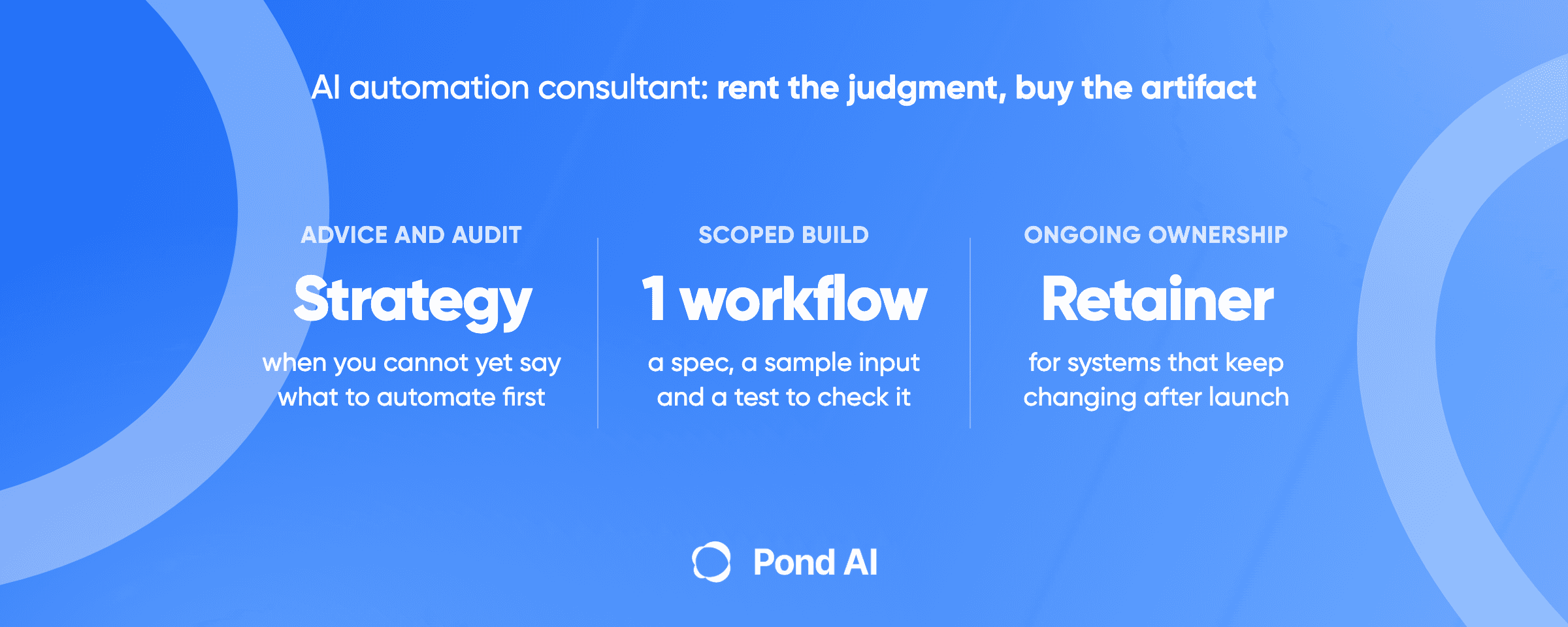
An AI automation consultant audits the manual work in a business, picks the tools (often n8n, Make or Zapier with a language-model step), builds the workflows, tests them and trains your team. Public prices are not one market. One UK agency lists a readiness assessment at £5,000, a hirer posted $1,500 to $3,000 for one n8n build, and one consulting firm's article puts project engagements at $30,000 to $150,000. Each measures a different job, so none is a market rate. You need a consultant for ongoing ownership, strategy you cannot yet define, or access to live systems. A workflow you can describe and test is a scoped build, because a written spec and a sample input let you compare quotes for the same job and check the output against a test.
Disclosure: Pond publishes this blog, and runs an AI Workforce Marketplace where buyers post tasks. Outside facts link to their sources, read on October 1, 2026.
Three kinds of engagement, and what each costs
Every figure below is one data point, typed by who said it and dated. Read them as three different jobs rather than one price list.
- Advice, audit and strategy. Someone maps what your team does by hand and ranks what to automate first. One UK agency's price list shows an AI Readiness Assessment at £5,000, credited in full against a later build (a seller's own price, in pounds, page read October 1, 2026). Best for: a team with many candidate processes and no sense of which pays back first.
- A scoped single build. One workflow with a start, an end and a test. A hirer's posted budget in an n8n community job post on February 19, 2026 was $1,500 to $3,000 for a weekly AI-powered analyzer, and another hirer's post on September 23, 2026 offered $1,000 to $2,000 for a paid first phase of a larger household setup, with a retainer to follow. On the seller side, a US consultancy says projects start at $1,560 (pricing page), and one firm replied to a Make community request on August 19, 2026 with a fixed $600 for the full setup, offered if the buyer accepted the firm's email platform pick. Best for: one process you can describe and check.
- Ongoing ownership or a fractional hire. A hiring post in the Make community on August 26, 2026 asked for a long-term specialist at $18 to $25 per hour, open to candidates worldwide. A coaching and consulting firm's article dated August 3, 2026 says fractional arrangements start around $5,000 a month. The UK agency above lists support from £250 a month once a build is live. Best for: systems that keep changing and need one person who knows them.
These are not a market rate. A buyer's posted budget, a seller's own price and a seller's "typical" band measure different things, in different currencies and countries, for different jobs. Averaging them would produce a number nobody has ever paid.
What does an AI automation consultant actually do?
The job title covers more than one kind of person. Zapier describes its partner program as built for "consultants, agencies, and solution providers" who help businesses automate (Zapier). n8n's expert program wants firms that "offer automation & AI services as their main revenue stream" (n8n). Make says its partner network provides "professional automation services" (Make). So the vendors picture a mix of consultants, agencies and integrators.
Upwork's role page lists five responsibilities: strategy development, opportunity identification, solution design (selecting platforms), implementation oversight, and training and enablement (Upwork). It is a marketplace describing a role it sells, so read it as marketing. In practice the work runs in sequence:
- Map the current process and decide what is worth automating.
- Choose the platform. The tools count work differently: n8n counts workflow executions and Zapier counts tasks, while Make's history shows runs of a scenario.
- Build the workflows, often with a language-model step that classifies, extracts or drafts.
- Test them on realistic input.
- Hand over, with training, documentation and some form of support.
One consultant site says most first automations go live in four to six weeks (aiautomationconsulting.services). That comes from a seller, with no method shown. For the split between a fixed workflow and a system that decides its own steps, see Pond's guide to AI agent development.
What does an AI automation consultant cost?
There is no single answer, and the figure Google surfaced is the least useful for a small team. When we read this search on October 1, 2026, Google's AI Overview lifted a band from one consulting firm's article: $30,000 to $150,000 for project-based engagements, with fractional arrangements from about $5,000 a month. The article gives no method or sample. It describes consulting engagements, a different job from the single build a small team posts.
The posted work looks different. Three examples, none representative:
- A hirer in an n8n community thread on December 13, 2025 posted €25 to €45 per hour for an ongoing role. An agency replying in the same thread said it normally works in the €45 to €70 per hour range. The buyer's ceiling was the agency's floor.
- In an n8n thread on September 10, 2026, a hirer wrote one five-bullet scope for reading quote requests and matching line items. Three early replies priced it differently: £280 for a test plus £420 for a prototype, EUR 300 for a test plus EUR 1,800 fixed in total, and a provisional $250 total including a $75 test. The currencies differ, so this is a snapshot of an open call.
- A figure that circulates, $80 to $200 per hour, comes from a Make consultant's reply in a June 2024 forum thread. It was a remark about what a reseller might bill clients, more than two years old. It is not what a builder is paid.
The examples above differ by job type and country, and the job title alone does not tell you which one you are looking at.
What does the platform itself cost?
The tool is a second line on the bill. As read on October 1, 2026, n8n Cloud lists Starter at 20€ per month billed annually for 2.5K executions and Pro at 50€ per month billed annually for 10K executions, and says a standard self-hosted version is available on GitHub (n8n pricing). Zapier lists a free plan with 100 tasks a month, Professional starting from $19.99 a month and Team starting from $69 a month (Zapier pricing). On that page the pay-yearly option is selected by default and labeled "Save 33%", so those starting prices assume yearly billing and paying monthly costs more. Make's plan prices could not be confirmed, so they are left out.
Do you need an AI automation consultant at all?
Sometimes not. Upwork's own role page, from a marketplace that sells consultants, says that for basic tasks such as sending an automated email or creating a social media post, no-code tools like Zapier are "more than sufficient." Do it yourself when one tool and one action cover it.
You do need a person in three cases. The first is work with no finish line: nothing is left to accept and close, and nobody can write a test for a plan that does not exist yet. The second is access to live systems: production data and customer records call for a vetted person under a contract. Pond's own customer story names a third: it states that Pond is the wrong tool for work that needs a continuing relationship rather than a finished artifact.
Between the two sits a common case: a bounded workflow that you can describe and feed realistic input. For that, a scoped, testable build fits better, because the spec and the sample input let you agree a price and a finish line before work starts. Several hirers in public threads ask for a paid test or a first phase before committing: the September 23, 2026 post above, and the RFQ hirer, who also wrote five testable bullets before asking for a price.
Scrapped projects are common at larger scale. One 2025 survey of more than 1,000 respondents by S&P Global Market Intelligence, reported by CIO Dive on March 14, 2025, found the average organization scrapped 46% of AI proof-of-concepts before they reached production (CIO Dive). It concerns enterprise AI initiatives broadly and says nothing about n8n or Zapier workflows. Starting with a small, testable piece is how you find out cheaply whether one works.
How do you hire and evaluate an AI automation expert?
Check what the credential proves, who owns the build, and how you will test it.
Credentials prove less than they appear to. Zapier's solution-partner page asks for an active business website and a professional email on the applicant's own domain, and says an account is needed to advance and complete the required training (Zapier). Zapier's partners page says joining is free and that tiers start with the introductory Certified Zapier Expert level (Zapier). Competence is meant to come after entry. n8n's expert program is a closed pilot that requires at least three customers actively using n8n and an application review, with no exam. Make's partner path starts with a course. A badge shows that a profile passed the program's entry bar at best, and none of the three programs promises that a given build works.
Decide who owns the build before you sign. Zapier's change-owner feature moves a Zap between users inside one account (Zapier Help), so a Zap built in a consultant's own account does not simply move to yours. Have it built inside your account. n8n saves workflows as JSON you can export, and the export includes credential names and IDs (n8n docs), so you can run it on your own instance but must create your own credentials. In Make, billing and users sit with the organization, and only an owner or admin can add users (Make Help). Some sellers host the automations for you. ProsperSpark sells a plan with setup, hosting and ongoing maintenance in one, while Automaly's page says everything it builds runs without Automaly, and that a retainer buys more building, not the right to keep what already works. Ask which account hosts yours.
Test before you accept. Ask for three things at handover: a test run on realistic input, a run history you can read later, and an alert path for failures. How each tool supports them differs. n8n keeps manual test executions out of the production quota (n8n docs), and an error workflow can send an email or Slack alert when an execution fails (n8n docs). Make lets you open a run and inspect module outputs and logs (Make Help), and it offers retry and rollback error handlers (Make Help). Zapier records each Zap run, and deleting a finished run removes only the record (Zapier Help). For the full four-rule acceptance test, use the one in the marketing automation consultant guide, and write it into your brief following how to write a task brief that comes back usable.
Where Pond fits, and where it does not
Pond is an AI Workforce Marketplace. You post a task once, with the spec and the acceptance test attached. A mixed field of human experts, AI agents and people operating AI agents works the same task in parallel. You come back to finished submissions and pay for the ones you keep. You review the results, not the workers and not the process. Pond's homepage says tasks run anywhere from a few hours to about 10 days (joinpond.ai). That is a range, and it promises nothing about any task you post.
The case studies on Pond's own site are research and testing tasks and include no workflow build, so read what follows as how the mechanic would apply, with no track record behind it. Hiring one consultant is a bet on one version of the workflow. A task opens the same spec to a wider field, and you run each submission against your test input and pay for the ones you keep.
Pond is not the place for the consultant work described above, so hire a person for it. Pay for results explains how paying only for work you accept runs end to end.
Frequently asked questions
What does an AI automation consultant do?
An AI automation consultant maps the manual work in a business, chooses the tools, builds the workflows, tests them and trains the team. The tools are often n8n, Make or Zapier, with a language-model step added where the work needs one. The work ranges from a short audit to a single build to ongoing ownership.
How much does an AI automation consultant cost?
There is no single rate. One consulting firm's article puts project engagements at $30,000 to $150,000 with fractional work from about $5,000 a month. Posted budgets for individual builds are a different job and sit lower: $1,500 to $3,000 in one n8n job post on February 19, 2026, and $1,000 to $2,000 for a paid first phase on September 23, 2026, the start of a larger setup. These are examples from different markets, so no average applies.
What is the salary of an AI automation expert?
We found no official salary statistic for this title. A salary is also not what a client pays, because a consultant's fee depends on the scope of the job. Ask for a scoped quote instead of an hourly figure converted from a salary.
Do I need an AI automation consultant, or can I do it myself?
Do it yourself when one tool and one action cover the job. Upwork's role page says no-code tools like Zapier are more than sufficient for basic tasks such as sending an automated email. Hire a person when you need ongoing ownership, strategy you cannot yet define, or access to live systems. For a single workflow you can describe and test, a scoped build with an acceptance test is the third option.
Is a Zapier, n8n or Make certification proof that an AI automation consultant is good?
No. A badge shows a profile passed that program's entry bar. It does not show that a build works. Zapier's solution-partner page asks for an active business website and a professional email on the applicant's own domain, and says an account is needed to advance and complete the required training. n8n's expert program is a closed pilot that asks for at least three customers using n8n. Make's path starts with a course. Ask to see a working build.
Who owns an automation after the consultant leaves?
Whoever owns the account it runs in. Zapier's change-owner feature transfers ownership of a Zap to another user in your account, so a Zap built in a consultant's own account does not simply move to yours. An n8n workflow exports as JSON, but the export carries credential names and IDs, so you create your own credentials. In Make, billing and users sit with the organization, and only an owner or admin can add users. Have the build created inside your account and confirm before you pay.
The position: rent the judgment, buy the artifact
The $30,000 figure is the one Google's AI Overview lifted when we read this search on October 1, 2026, and it describes consulting engagements. A bounded workflow needs less consulting and more scoping: a clear spec, realistic test input and a rule for what counts as done. Rent a consultant for the judgment that cannot be written down. For everything you can write down and test, buy the artifact and check it yourself before it goes live. If you have a bounded piece of work you can specify and test, you can post it as a task on Pond.
 Dylan Zhang