Short answer
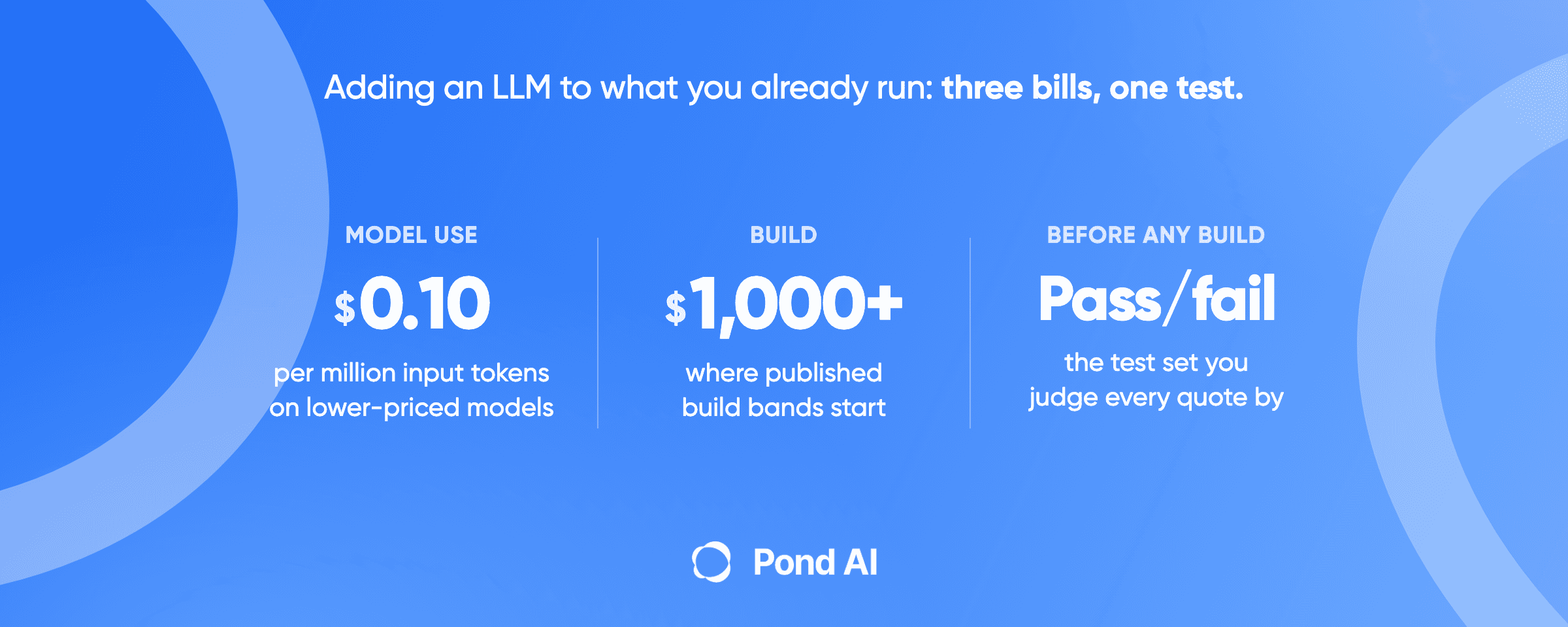
Generative AI integration services add a large language model (LLM) feature to a product or workflow you already run: a step that summarizes, classifies, extracts fields, drafts text, or answers from your own documents. It is not a rebuild, and it is not an AI agent. You pay three bills: model usage, build labor, and run and upkeep. In the illustration below, the model bill on the lower-priced models is small next to the build quotes. On October 13, 2026, OpenAI listed gpt-6-luna, and Anthropic listed Claude Haiku 5.5, at $0.10 per million input tokens and $0.50 per million output tokens. Published build bands start around $1,000 for a chatbot project on Upwork's hiring page, and the agency bands cited below run into six figures, such as SmartExe's $40,000 to $120,000 for an internal AI assistant. Write the pass/fail test before anyone builds, and judge every quote against it.
Pond publishes this article and runs an AI Workforce Marketplace where a Task Poster posts work and Task Solvers complete it. Every outside source below was read on October 13, 2026.
What does it mean to add an LLM to a product or workflow?
An LLM feature is one model call inside a product or process people already use. Text goes in, the model returns a result, and your own code decides what happens next. This page covers six feature types:
- Summarize. In: a long document, ticket thread or call transcript. Out: a short summary in a fixed format. The test: reviewers check a sample against the source for missing or invented facts. How it fails: a fluent summary of something the source never said. Cost driver: input length.
- Classify. In: a message, ticket or record. Out: one label from a fixed list. The test: accuracy on a labeled set from your own data, against a threshold agreed in advance. How it fails: confident labels on cases the list never anticipated. Cost driver: volume. Anthropic's pricing page, linked in the cost section below, describes Claude Haiku 5.5 as built "For high-volume, latency-sensitive tasks such as classification, extraction, and routing".
- Extract. In: an invoice, form, contract or email. Out: named fields in a fixed shape. The test: every output parses against a declared schema, and values match a checked sample. OpenAI's Structured Outputs guide says the feature makes responses adhere to a supplied JSON Schema, and that a model may still refuse a request for safety reasons, so the code needs a refusal branch. How it fails: a plausible value in the wrong field. Cost driver: document length and volume.
- Draft. In: a request plus context. Out: text a person edits and sends. The test: a reviewer grades a sample against a written rubric. How it fails: the right tone around a wrong fact. Cost driver: review time per draft.
- Search your own documents (RAG). In: a question. Out: an answer built from passages retrieved from your document store and handed to the model with the question. The test: questions with known answers and known source documents. How it fails: the wrong passage, or instructions hidden inside a retrieved document. Cost driver: document store meters as well as the model.
- Chat on your own data. In: a conversation. Out: answers grounded in your records. The test: the search set plus scripted conversations. How it fails: an answer drawn from records the user may not see. Cost driver: the same retrieval meters, plus per-user permission checks.
When the model decides and acts across tools on its own, updating records or sending messages, the job is an agent build with different tests. Pond's guide to connecting an AI agent to the systems you already run covers that job.
What does generative AI integration cost in 2026?
We found no primary measurement of build time for an LLM feature, so this page gives no hours estimate.
Bill 1: model usage
Vendors bill per token, a small chunk of text. The list prices below are per 1 million tokens, input then output, standard processing, read October 13, 2026:
- OpenAI (API pricing), its "Flagship models" table, short-context prices: gpt-6-luna $0.10 input and $0.50 output; gpt-6.1-sol $2.00 and $10.00; gpt-6-astra $10.00 and $50.00. Batch processing, for requests that can wait, is half the standard rate for all three. Prompts past the short-context limit bill at the table's higher long-context rates.
- Anthropic (pricing), the first four rows of its model pricing table: Claude Haiku 5.5 $0.10 input and $0.50 output for prompts up to 100,000 tokens; Claude Sonnet 5.5 $2 and $10; Claude Opus 5.5 $4 and $20; Claude Fable 5.1 $10 and $50. The page states "All prices are in USD".
- Google. This page prints no Gemini prices. If a quote uses Gemini, ask for the date its price was read.
Both pages also list other models, some priced higher than these rows and, on OpenAI's page, some lower, so check the exact model a quote names. Within OpenAI's flagship table, gpt-6-astra's input price is 100 times gpt-6-luna's.
Each vendor counts tokens with its own tokenizer, so the same text can bill a different number of tokens on each. Counts also shift between one vendor's model generations. Anthropic's pricing page says Claude 4.7 and later models use a newer tokenizer that "produces approximately 30 percent more tokens for the same text than earlier models", meaning Anthropic's own earlier Claude models.
Searching your documents adds meters. OpenAI lists file search storage at $0.10 per GB per day with 1 GB free and a file search tool call at $2.50 per 1,000 calls on its Responses API, and says "Tokens used for built-in tools are billed at the chosen model's per-token rates."
An illustration, not a typical bill. Inputs chosen for the example: 10,000 items a month, each about 1,500 input tokens and 300 output tokens, so 15 million input and 3 million output tokens. The example applies one token count to both vendors, so each pairing compares per-token prices only. At October 13 list prices:
- At $0.10 and $0.50 (gpt-6-luna or Claude Haiku 5.5): $1.50 plus $1.50, so $3.00 a month.
- At $2 and $10 (gpt-6.1-sol or Claude Sonnet 5.5): $30 plus $30, so $60 a month.
- At $10 and $50 (gpt-6-astra or Claude Fable 5.1): $150 plus $150, so $300 a month.
- gpt-6-luna on batch processing: $1.50 a month.
- If each item were also a hosted file search call on the Responses API, 10,000 calls add $25 in call fees before storage and tokens.
At $60 a month the model bill comes to $720 a year, less than the lowest project band in the build quotes below. At $300 a month it comes to $3,600 a year, inside the $1,000 to $5,000 band Upwork lists for a chatbot project.
Bill 2: build labor
- Marketplace rates. Upwork's AI developer hiring page says "Hiring an AI developer generally costs $30-$150 per hour on Upwork, depending on project scope and complexity." It lists a chatbot or virtual assistant project at $1,000 to $5,000, scoped as a custom chatbot with intent recognition, a Slack, Teams or website integration, and training data preparation and testing.
- In-house salary. The U.S. Bureau of Labor Statistics reports that "The median annual wage for software developers was $135,980 in May 2025." That is an employee wage, not a billing rate.
Bill 3: run and upkeep
Rate limits, spend caps and model retirements keep costing after launch, and each is covered under what breaks. For retirements, the defense is a test set you can re-run.
Why do quotes for the same AI integration job disagree?
Each seller prices a different scope, and none shows how its figure was measured. Four sellers' published bands, read October 13, 2026, each a seller's own:
- Macrocoderz (guide): "We price integration from $4,500 for one well-defined capability. Most integrations land between $6,000 and $18,000".
- SmartExe (cost article): a simple AI feature or chatbot at $10,000 to $50,000, and an internal AI assistant or document automation at $40,000 to $120,000. The Google AI Overview for "ai integration services" repeated the simple-feature band on October 13.
- Aegis Softtech (LLM integration article): a proof of concept at $25,000 to $75,000.
- Qwestyon, which prices in pounds (guide): AI connected to one system, such as a helpdesk or CRM, at £2k to £6k (about $2.5k to $7.5k by its own conversion), and a production integration, one workflow across two or three systems, at £8k to £30k.
Hourly bands spread as wide. A roundup of generative AI agencies written by Bamboo Agile, which ranks itself fourth, shows hourly bands running from under $25 up to $100 to $149.
Macrocoderz also names what moves the number: "data quality and access, the number of systems involved, how much a wrong answer costs (which decides review and testing effort), and only then the model." Ask each seller to write down the data work, systems and review effort its quote covers.
What goes in the scope before anyone writes code?
Eight lines. A seller who cannot fill them in is quoting a guess.
- The feature type. One of the six above, for one workflow.
- The input data. Where it comes from, whether a sample or export exists, and who may see it. OWASP's entry on sensitive information disclosure advises "Limit access to sensitive data based on the principle of least privilege." The model sees only what your code hands it: the prompt, retrieved passages and tool results. Permission design belongs in the scope.
- Where the output lands. A screen, a database field or another system, and what code checks it first.
- Who sees a wrong answer. A staff reviewer or a customer. This decides the review effort.
- The pass threshold. A measurable bar on a test set, written before the build.
- Ownership. Upwork's hiring advice: "Define ownership of source code, prompts, models, datasets, and documentation".
- The model plan and endpoints. Which vendor, tier and API endpoints, and what each keeps.
- Spend and failure handling. An alert, a hard limit, retries and a fallback.
How do you test an LLM feature before it ships?
With an evaluation set: cases from your own data, expected outputs, and a pass threshold. OpenAI's evals guide says evals "test model outputs to ensure they meet style and content criteria that you specify". Anthropic's testing guide says a successful LLM application "starts with clearly defining your success criteria and then designing evaluations to measure performance against them."
The bar has to be a number. Anthropic's weak example is "Safe outputs". Its strong one: "Less than 0.1% of outputs out of 10,000 trials flagged for toxicity by the content filter." Upwork says the same for hiring: "Agree on success metrics (accuracy thresholds, response times, or error rates) before work begins".
- Use your own cases, awkward ones included. Macrocoderz tells buyers to expect "an evaluation set built from your data, with thresholds agreed in advance".
- Check shape mechanically. For classify and extract, schema-valid output is a pass or fail a script can count.
- Grade the rest with a rubric. Summaries and drafts need a person and a sample size you can afford to review.
- Re-run it on every model change. Anthropic advises "thorough testing of your applications with the new models well before the retirement date."
What breaks after launch?
Five failures recur in vendor and standards documentation. Each one is a build item, and switching models removes none of them.
- Prompt injection. OWASP's LLM01 entry describes prompts that "alter the LLM's behavior or output in unintended ways", which for document search includes text inside a retrieved file. It says RAG and fine-tuning "do not fully mitigate prompt injection vulnerabilities."
- Unchecked output. OWASP's LLM05 entry says to "Treat the model as any other user, adopting a zero-trust approach". Output that feeds a page, database or another system is untrusted until code validates it.
- Wrong answers that sound right. OWASP's LLM09 entry lists RAG as a mitigation for misinformation, alongside cross-verification and human oversight. RAG helps with wrong answers and does not close injection.
- Rate limits and spend caps. OpenAI's rate limits guide sets limits at the organization and project level rather than per user. A 429 with the code slow_down means "Your request rate increased too quickly." A spend alert "Sends a notification; API traffic continues", while a hard spend limit makes affected requests fail.
- Model retirement. Anthropic's deprecations page promises "at least 60 days' notice before model retirement for publicly released models". OpenAI's deprecations page lists models to be removed on April 1, 2027, with six months' notice. Each retirement is a migration.
Where does your data go?
To the model vendor, under that vendor's terms for your plan and endpoints. On October 13, 2026:
- OpenAI. Its data guide says "As of March 1, 2023, data sent to the OpenAI API is not used to train or improve OpenAI models (unless you explicitly opt in to share data with us)." Abuse monitoring logs are kept for up to 30 days by default, and Zero Data Retention controls "are subject to prior approval". Files and vector stores are kept "Until deleted", so a document search build changes the retention answer.
- Anthropic. Its privacy center says API inputs and outputs are deleted "within 30 days of receipt or generation", with exceptions such as flagged usage policy violations, kept for up to 2 years. Its Commercial Terms state "Anthropic may not train models on Customer Content from Services."
For any other vendor, read its own data terms for the plan and endpoints you will use.
Ask whoever builds the feature which plan, which endpoints and which contract, and get the answers in writing.
Who does this work: your engineer, a freelancer, an AI integration company, or a task?
- Your own engineer. Fits a feature whose live system holds sensitive records, such as production customer data, or one that needs weekly tuning by someone accountable. The anchor is salary.
- A marketplace freelancer. Fits a defined build with a named owner afterward. Write ownership of code, prompts and test data into the contract.
- An AI integration company. Fits work across several systems, a compliance review, or one accountable firm. For agent and automation builds, see Pond's page on AI agent development costs and its guide to AI automation consultants.
- A task. Fits a slice you can specify and test on synthetic data, for a live system that holds no sensitive records. Covered next.
Wiring a CRM (CRM integration services) and building automation workflows (Zapier, n8n and Make experts) are different jobs.
Where Pond fits, and where it does not
You post a task with the brief and test set attached, fund a reward pool, and a mixed field works the same brief in parallel: human experts, AI agents, and people operating AI agents. Pond's explainer on paying only for work you accept states the rule: "You review finished submissions and pay the ones you accept. The rest are not paid."
What fits: the testable slice. A defined LLM feature, a written test set with a pass threshold, and synthetic sample data written for the brief.
- Data. Use no real records, including ones with names and other identifying fields removed: a redacted record is still a customer's record, and free text carries identifiers that removing fields misses.
- The guide's rules. Pond's agent integration guide, linked above, sets the rule: "Never put a credential, access token, internal URL or real customer record in a brief or anywhere a contributor can see it." The same guide says the task route "fits only an integration with systems that hold no sensitive records", and that "If you have no one to read the code, or the system holds sensitive records, hire an engineer or a contracted integrator instead."
- Submissions. Task Solvers build against the synthetic data and submit the evidence the brief asks for, such as the code and a recorded run of the test set. You, the Task Poster, accept the submissions that pass.
- Code review and deployment. Before anything is built or run on your side, have an engineer read the code, its outbound calls, its dependencies and its build scripts, as the same guide advises. Then deploy it on your own infrastructure and connect the live system and credentials yourself.
A classifier that tags public product reviews already published on your site by theme, built and tested on synthetic reviews written for the brief, is the shape.
What does not fit. Ongoing ownership of a production feature. A feature whose live system holds sensitive records, such as a ticket classifier for a helpdesk full of customer messages: the same guide's rule sends that case to an engineer or integrator, and calls Pond the wrong tool "for anything requiring access to sensitive internal systems". Open-ended discovery, because, as Pond's task brief guide puts it, "if you cannot write what done looks like, there is no bar to review against, and posting produces a bad experience for everyone."
On October 13, 2026, Pond's public tasks page showed two build tasks: "Build a YC Launch Monitor Slack Bot" (103 Task Solvers joined, $400 in total rewards) and "Build a Real-Time Social Listening Tool for X" (68 Task Solvers joined, $200). Both were marked Expired. The second was posted on August 22, 2026 by Dylan Zhang, Pond's founder and CEO, who is also this article's author. Each asked for a tool rather than a change to the poster's own product. The X brief accepted a web app, a ChatGPT custom GPT or plugin, an API or script that plugs into an LLM interface, or an existing third-party tool, and listed a "Natural language query interface powered by an LLM or NLP layer" among its requirements. Neither followed the pattern above of synthetic data with the Task Poster deploying the result: the X brief accepted a hosted app or access credentials as delivery, and the YC brief had Task Solvers monitor live sources (YC's directories, X and LinkedIn) rather than synthetic data. No completed LLM integration on Pond is cited here. Treat posting the slice as a route to try, judged on your own test set.
Frequently asked questions
What is the cost of using generative AI?
On October 13, 2026, OpenAI's flagship table listed gpt-6-luna at $0.10 per million input tokens and $0.50 per million output tokens, and gpt-6-astra at $10 and $50. Anthropic listed Claude Haiku 5.5 at $0.10 and $0.50 and Claude Fable 5.1 at $10 and $50. In an illustration of 10,000 items a month, the model bill ran from $1.50 a month on batch to $300 a month. Build quotes depend on seller and scope: Upwork lists chatbot projects at $1,000 to $5,000, Qwestyon prices AI connected to one system at £2k to £6k (about $2.5k to $7.5k by its own conversion), and Macrocoderz starts at $4,500 for one capability.
How do I integrate an LLM into my application?
Pick one feature type for one workflow: summarize, classify, extract, draft, search your documents, or chat on your data. Write the test set and pass threshold first. Then build the call, validate the output in code, add retries and a spend limit, and re-run the test set before launch and on every model change.
What is an LLM pipeline?
The steps around a model call: retrieve the relevant data, build the prompt, call the model, validate the output against a schema or rules, and log the result. OWASP advises treating model output as untrusted, so validation is not optional.
How much do AI developers charge?
Upwork's AI developer page lists $30-$150 per hour on its marketplace. One agency-written roundup shows agency bands from under $25 to $149 an hour. An in-house hire is a salary instead: the BLS reports a median annual wage of $135,980 for software developers in May 2025.
Does RAG stop hallucinations?
It helps without solving them. OWASP lists retrieval-augmented generation as a mitigation for misinformation, by "retrieving relevant and verified information from trusted external databases", alongside cross-verification and human oversight. It also says RAG does not fully mitigate prompt injection, so a retrieved document can still carry instructions the model follows.
Is my data used to train the model?
Not by default on the OpenAI and Anthropic APIs. OpenAI says API data has not been used for training since March 1, 2023, unless you opt in, and Anthropic's commercial terms say it may not train on customer content. For any other vendor, read its own data terms for the plan and endpoints you will use.
On the lower-priced models, the build costs more than the model
In the illustration above, a feature handling 10,000 items a month cost $3.00 in model fees at gpt-6-luna or Claude Haiku 5.5 list prices. At gpt-6-astra or Claude Fable 5.1 prices, the same volume cost $3,600 a year, inside Upwork's chatbot project band, so the model tier is a budget decision too. On any tier, the data work, the review effort for wrong answers and the upkeep when a model is retired are what a seller has to size. A written test set is what lets a seller size all three. It makes quotes comparable, and it turns a migration into a re-run. Write it first.
If the feature can be built on synthetic data written for the brief and judged on that test set, and its live system holds no sensitive records, post it as a task on Pond. Connect the live system yourself after you accept a result and an engineer has read the code.