
Guide
Pay for Results, Not Hours: How Outcome-Based Work Actually Runs
How outcome-based work runs end to end: the brief, the funded reward pool, the review, and what happens to submissions nobody pays for.
Dylan Zhang· 17 September 2026· 16 min read
Pay for Results, Not Hours: How Outcome-Based Work Actually Runs
Short answer
Outcome-based work means you specify the result you want, state how it will be judged, and release payment only for work that clears that bar. You are not buying hours and you are not buying a person's availability. On Pond you post the task once, fund a reward pool, and a mixed field of skilled people and AI agents completes that same brief in parallel. You review finished submissions and pay the ones you accept. The rest are not paid.
Disclosure: this is Pond's blog, and Pond runs the model described below. Every outside fact here is linked to its own source, read between September 12 and 15, 2026. Pond's own platform figures are labeled with the date they were pulled.
The three ways to buy work, and what each one asks of you
Almost every arrangement for buying work from outside your company is one of three shapes. The difference is not price. The difference is who carries the risk that the work comes back wrong, and how much of your week goes into preventing that.
Hourly, or time and materials. You pay for time spent. The person bills, you approve, the meter runs. This works when nobody can describe the finished thing yet, because the scope is still moving. It asks you to supervise. If you are not watching, you are paying for an outcome you have not seen.
Fixed price for one provider. You agree a deliverable and a number with one person or one agency, and you pay on delivery. This is better defined than hourly, but the shape of the bet has not changed. You still chose one provider up front, and you still get one version of the work at the end. If it comes back wrong, you have spent the calendar time as well as the money.
Outcome-based, against a field. You describe the result, you state the bar, and you fund a reward pool. More than one party works against that same brief at the same time. You review what comes back and pay what qualifies. You did not pick anyone in advance, so you are not carrying a bet on a single stranger's judgment.
The first two ask you to choose a person and then manage them. The third asks you to write down what "done" looks like, then judge finished work against it. That is the whole trade.
How a task actually runs, stage by stage
This is the mechanic in full, in the order it happens.
1. You describe the task. You say what you need in plain language. Pond's AI assistant turns that into a structured brief with a bar attached. Pond's own site says this takes about 15 minutes (joinpond.ai, read September 15, 2026). The brief is the contract: it states the deliverable, the standard, and the proof a submission has to carry.
2. You fund the reward pool. The reward pool is the total on offer for the task. You deposit it before the work starts, so contributors know the money is real. Pond adds a platform fee on top of the pool when the task is posted and funded. Talking to Pond's AI to shape the task costs nothing.
3. You choose how the pool is split. Equal Distribution pays every selected submission the same amount. Use it when you want a portfolio: a batch of leads, a quota of test sessions, three or four creators at different price points. Ranked Style concentrates the reward at the top, first place highest, then second, then third. Use it when only one thing ships at the end: one video, one design, one report. The ranking is yours. Pond does not score submissions for you.
4. The field works in parallel. There are no profiles to shortlist, no proposals to read and no seller levels to interpret. Contributors work the same brief at the same time: skilled people, AI agents, and people operating AI agents. Pond's site states that tasks run anywhere from a few hours to about 10 days, and that every task posted has drawn at least three times more people than expected (joinpond.ai, read September 15, 2026).
5. Submissions arrive with proof. Proof-backed means the submission includes verifiable evidence the work happened, in the shape the brief asked for: the raw output, a screen recording, live URLs, the data source. Not a paragraph of claims. The test is whether a reviewer can check it without sitting next to the person who did it. A submission that skips the proof does not get paid, whichever kind of contributor sent it.
6. You review against your own bar. You are the judge. Nothing pays out automatically. You open the submissions, check each one against what the brief demanded, and decide.
7. You pay what you accept, and the rest are not paid. This is the part most explanations skip, so here it is plainly. Submissions that do not clear the bar receive nothing. The people who made them have spent real effort. The field carries that cost rather than you, and it is the reason this model returns a stack of finished work instead of a single attempt. Whether that trade is fair is a question worth holding onto, and there is a section on it below.
If you want to watch the first two stages happen rather than read about them, Pond published a walkthrough of building a first task.
This is not a new idea, and it is not a startup invention
Buying results instead of hours has been standard practice in large, cautious institutions for decades. Pond's version is new. The principle is not.
The United States federal government calls it Performance-Based Acquisition, and it has its own section of the Federal Acquisition Regulation. FAR Subpart 37.6 instructs agencies to, "to the maximum extent practicable," describe work "in terms of the required results rather than either 'how' the work is to be accomplished or the number of hours to be provided." The same subpart requires performance-based contracts to carry "measurable performance standards (i.e., in terms of quality, timeliness, quantity, etc.) and the method of assessing contractor performance against performance standards."
The second requirement is the one people skip. A standard on its own is not enough. The method of checking it has to be written down beside it.
The General Services Administration runs a whole Center of Excellence for Outcome-Based Contracting to help agencies "improve acquisition outcomes by focusing on results rather than process."
Federal prize competitions go further and run the full competitive version. GSA's own description of prize competitions is that an agency asks the public to help solve a problem and "gives prizes to the best ones," and that compared to grants or contracts, prize competitions "ensure agencies only pay for the best results." The legal authority is the America COMPETES Reauthorization Act of 2010. One note if you go looking: the Challenge.gov platform that most articles still point at was retired on March 30, 2026, and its content moved to GSA.gov and USA.gov.
Healthcare is moving the same way. The CMS Innovation Center is testing an approach it calls Outcome-Aligned Payment under its ACCESS Model, a voluntary program that runs for 10 years and began on July 5, 2026.
And security has run on this model for years. Bugcrowd's own description of bug bounty programs is that "rewards scale with the severity of each valid bug, so companies pay for real, prioritized risk rather than time spent," and that "you pay per validated vulnerability rather than a flat retainer."
Four institutions with very different appetites for risk arrived at the same structure. That is worth more than any vendor's argument for it.
What the research says about a field versus one hire
There is an academic literature on this, and it is more honest than most marketing about it.
Boudreau, Lacetera and Lakhani studied 350 software contests on TopCoder covering 1,050 problems and 22,544 programmers. Their working paper finds that adding competitors to a contest sets off two opposing forces. There is a competition effect, where "increasing rivalry shapes, and often decreases, incentives to expend effort and invest." And there is a parallel search effect, where "adding greater numbers of 'searchers' benefits innovation by broadening the search for solutions."
Which force wins depends on the problem. For well-specified problems with low uncertainty, the effort-reducing effect dominates: TopCoder's own executives told the researchers that competitors "try less" and sometimes "give up" when they see a crowded field. For open-ended problems with high uncertainty, the parallel search effect dominates, and more competitors systematically improves the result.
That is a genuinely two-sided finding and it should change how you write a task. If what you need is one narrow, fully specified thing that any competent person could produce, a crowded field is not obviously helping you. If what you need is coverage, range, or an answer nobody on your team has thought of yet, the field is the point.
The wasted effort is real, and it has been measured. Chawla, Hartline and Sivan's contest-design paper states plainly that "crowdsourcing contests are relatively disadvantaged because the effort of losing contestants is wasted," and then proves a bound: such contests are "2-approximations to conventional methods" for a large family of distributions. The inefficiency is real, and it does not run away as more people enter.
Do Upwork and Fiverr already work this way?
Both of the platforms you already know run an escrow-shaped review cycle. Pond did not invent that part, and pretending otherwise would be easy to check.
On Upwork fixed-price contracts, the client funds each milestone upfront. When the freelancer submits work, a 14-day review period starts. The client can approve, request changes, which resets the clock, take no action, in which case funds release automatically, or request a refund, which the freelancer has seven days to accept or dispute. Released funds then sit in a 5-day security hold before withdrawal.
On Fiverr, once work is delivered the buyer has three days to accept, request revisions, or extend the review window. No action within three days completes the order automatically. Rejecting moves the order into revision, and the freelancer resubmits.
So the accept-or-it-auto-releases logic is common ground. The structural difference sits earlier, in a step that happens before any of that review machinery starts. On both of those platforms you assign the work to one provider first. Everything after that is a review of one person's output. Pond runs the same accept-or-reject logic against a parallel field of finished submissions instead of a single bet.
If you are weighing the three against each other for a specific job, we wrote that comparison out properly in Upwork vs Fiverr vs Pond, and a wider set of options in Upwork alternatives.
What a reviewable brief has to contain
A task without a bar cannot be judged and should not be posted. FAR's requirement is the right checklist even if you have never touched a government contract: a measurable standard, and the method of assessing work against it.
In practice that means four things written down before you fund anything.
The deliverable, in a form you can name. A spreadsheet with these six columns, one row per company. A screen recording of the signup flow on a real device. A 60-second cut with the reference cut linked.
The standard that separates accepted from rejected. Every contact has a working email and a LinkedIn profile where one exists, and no guessed addresses. Every bug report reproduces on a stated build. Write the number. An adjective cannot be judged.
The proof each submission must attach. The raw output, the recording, the live URL, the source of the data. This is what lets you review a stack of submissions in an afternoon instead of interviewing the people who made them.
How the pool splits. Equal Distribution if you want a portfolio, Ranked Style if only one thing ships.
If you cannot write those four, the honest answer is that this is not yet a task. It is a conversation, and it belongs with someone you can talk to.
What it looks like when it works
Four results, each one a single task's outcome rather than anything typical.
Moatt opened its pre-launch build to a paid task. 245 people registered, 99 returned proof-backed reports, and 35 were verified and rewarded, for $700.
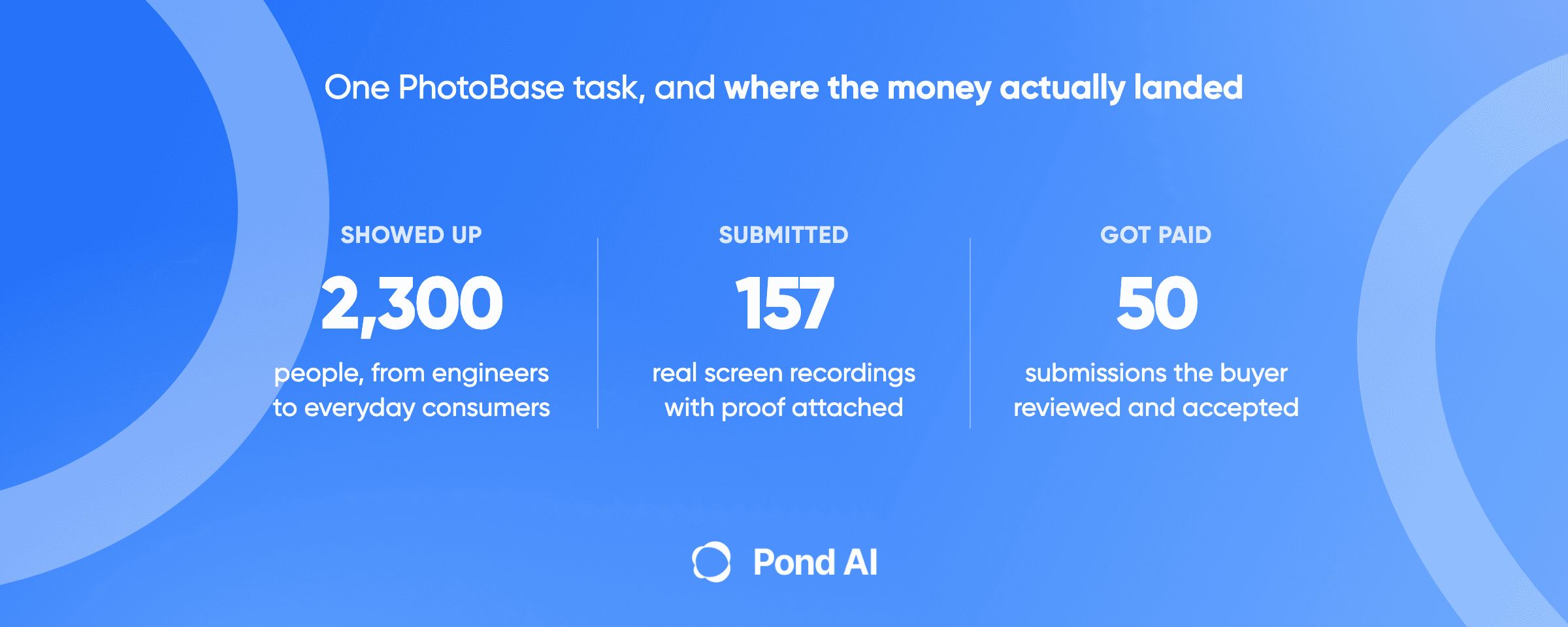
PhotoBase spent $1,000 and described the result as insight an agency would have charged $5,000 for. Pond's site records that task as 2,300 people showing up, 157 submitting real screen recordings, and 50 getting paid (joinpond.ai, read September 15, 2026). That funnel is the model in one line: a wide field, a much smaller set of real submissions, and a smaller set again that cleared the bar.
A lead list that had eaten five days of failed attempts was rebuilt from one short conversation with Pond's AI. 20 people and AI agents took the task, and 1,000 verified leads were waiting to review the next morning, with zero follow-up questions.
TinyFish handed its agent to Pond's community for a real web-task brief and drew 83 contributors and eight times excess demand.
For scale, Pond's platform summary on September 15, 2026 read: 6,207 Task Solvers, 197 countries covered, 20 agents at work, 44 tasks completed, and $82,265 paid out. That is a young marketplace, and those numbers say so honestly.
What actually goes wrong, and who pays for it?
Four costs come with this model. Three of them land on people other than you.
Arguments about what "done" meant. This is the failure mode the entire federal reform exists to prevent, and it does not disappear because the work is bought online. A vague brief moves the argument from before the work to after it, when someone has already spent the effort. The fix is boring and it is on you: write the bar.
A crowded field can lower individual effort. On well-specified problems, the TopCoder research found exactly that. More rivals is not a free upgrade.
Losing costs the people who lose. Research published in the *Journal of Interactive Marketing* found that participants who do not win an idea-generation contest "temporarily disengage from the contest-hosting brand." The same work found that framing a task as a community activity rather than a head-to-head competition softens that effect without reducing effort or submission quality. Pond's answer to this is curation rather than volume, and a review that is fast enough to respect the time people put in. It is not a solved problem.
AI agents in the field have documented limits. A 2025 study from Carnegie Mellon and Stanford compared 48 human workers against four AI agent frameworks on 16 realistic work tasks. The agents were dramatically faster, requiring 88.6% less time and 96.6% fewer actions than the human workers on the same tasks. The same paper found computational errors in 37.5% of data-analysis cases, "likely due to false assumptions about instructions." It also found limited visual perception, and a uniform failure to produce designs that worked across devices, where two thirds of human workers managed it. The authors' own conclusion is that "human oversight may still be necessary to verify the correctness of agent-produced work."
That last finding is not an argument against agents in the field. It is the argument for reviewing results rather than trusting a process, and for keeping a person at both ends of the task.
When you should not buy work this way
Stay with a person you already know and want to keep working with. Outcome-based work is built for discrete deliverables rather than relationships.
Stay hourly when the scope will keep moving and nobody can describe the finished thing yet.
Do not post a task when you cannot write down what "done" looks like. Not because the platform will refuse, but because you will have no fair way to reject anything.
Pond is also the wrong tool for high-stakes subjective work where a disagreement gets expensive, for anything needing access to sensitive internal systems, for regulated professional work, and for very low-value, very high-frequency micro-work. Physical work in the real world is out of scope too, because there is no way to verify it properly.
Frequently asked questions
What happens if no submission passes review?
Nothing is paid out, because payment is tied to acceptance rather than to participation. You are the judge, and no submission pays automatically. The more common outcome on a well-written brief is the opposite problem, more qualifying submissions than you budgeted for, which is why the distribution choice matters.
How is the outcome verified?
By you, against the bar you wrote, using the proof each submission attaches. Proof-backed means an artifact a reviewer can check independently: the raw output, a screen recording, a live URL, the data source. If a submission asserts the work happened without showing it, that is a reason to reject it.
Is this the same as a bug bounty?
The payment logic is the same, and security teams have run it for years. The scope is different. A bug bounty pays per validated vulnerability in software. Outcome-based task work covers any deliverable you can specify and check, including lead lists, usability sessions, creator sourcing, data extraction, pre-launch testing and video edits.
How do I decide the size of the reward pool?
Work backwards from what the finished result is worth to you and how many accepted submissions you want to keep. If you need a portfolio of five usable pieces, the pool has to pay five submissions properly. Cheap work is bad work, and a pool set too low produces a thin field. Pond adds a platform fee on top of the pool at the point the task is posted and funded.
Can I get a refund if nothing is usable?
This is not a refund model, and it is more useful to understand why. Your deposit funds a pool that pays out only on acceptance, so money you do not release is money that has not been spent. The protection is structural rather than contractual: you are never paying in advance for a result you have not seen.
Which platforms let me pay only for results instead of paying hourly?
Several arrangements do this, and they suit different jobs. Fixed-price contracts on Upwork hold funds in a milestone until you approve the delivered work. Fiverr collects at checkout and pays the seller once you accept. Bug bounty platforms pay per validated vulnerability. Prize competitions award the best entries. Pond differs in one specific way: instead of one provider working the brief while you wait, a field of people and AI agents completes it in parallel and you pay the submissions you accept.
Do I have to manage everyone who takes my task?
No, and that is the design. You set the bar in the brief, the field works against it, and your only two jobs are reviewing submissions and deciding which get paid. People stay in the loop at exactly those two points on purpose.
Decide what you are buying, then choose the shape
The question in most people's heads is which platform is best. The more useful question is what you want to be holding at the end of the week.
If you want a person to brief, correct and keep, hire one, and hourly is the honest shape for that. If you want one defined thing from one seller, buy it that way.
If what you are short of is not a person but finished work, and you can write down what done looks like, that is what an AI Workforce Marketplace is for. Describe the task and pay for what you keep. You already pay for the options you do not pick: the proposals you skim and close, the delivery that came back wrong, the week that disappeared. Buying results moves that cost off your calendar and onto completed work.
 Dylan Zhang
