You have a launch date and no QA person. The question is not "who tests this" but "what am I actually buying when I pay someone to test it." Hours, a managed testing cycle, or finished bug reports you can check one by one. The price follows from that choice. For the four ways to buy QA side by side, see our guide to QA outsourcing.
Pond is our product and it is the third route below. The other two are described from public figures, with the source named next to each number.
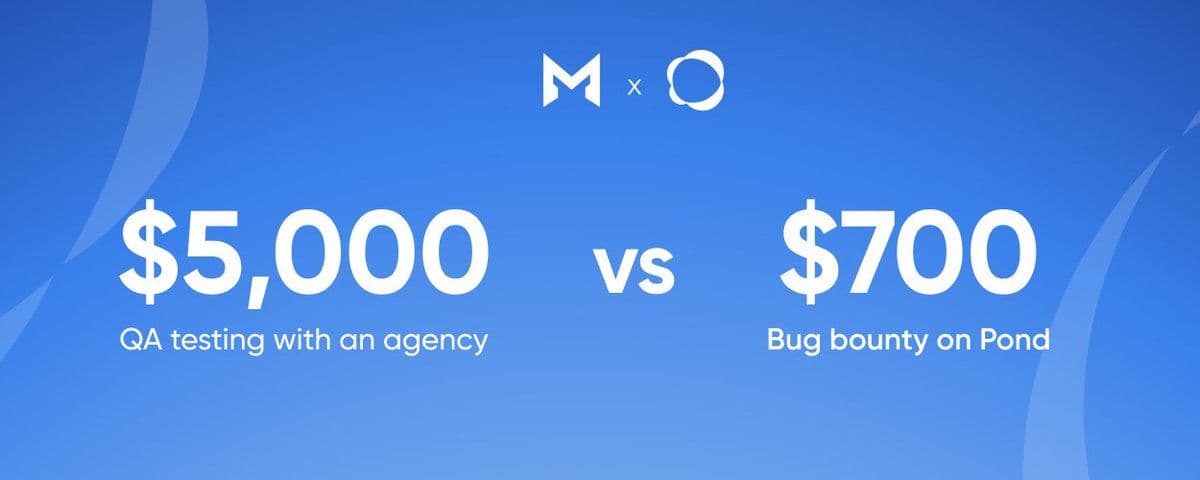
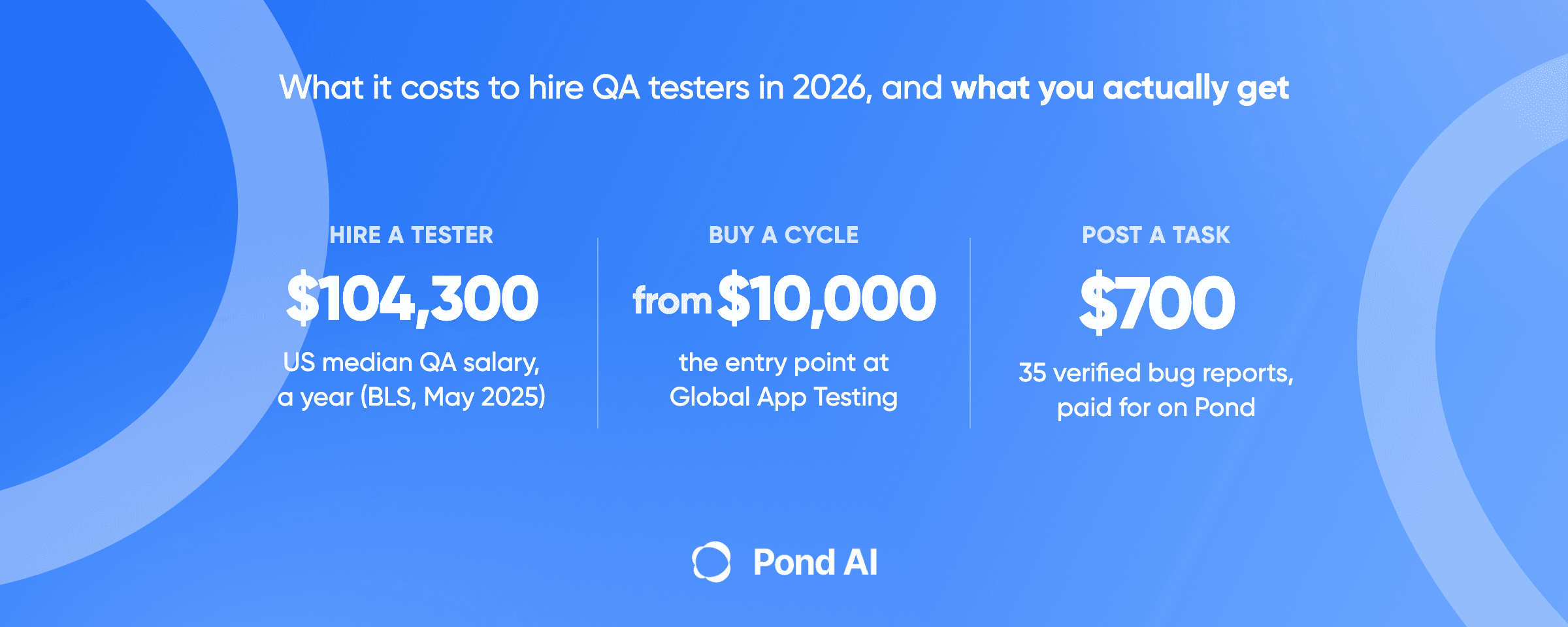
Short answer: In 2026 there are three ways to pay for QA testing. Hire a tester, in-house or by the hour: the US median wage for software quality assurance analysts and testers was $104,300 in May 2025, and contract rates run roughly $20 to $60 an hour for manual testing. Buy a testing cycle from a QA vendor or crowdtesting panel: entry points run from about $23 a credit at BetaTesting to a minimum engagement of around $10,000 at Global App Testing. Or post a task on an AI Workforce Marketplace and pay per verified report: Moatt paid $700 for 35 verified pre-launch bug reports on Pond. Each route hands you something different, and only the last one hands you finished reports before you pay.
What it costs to hire QA testers in 2026: three routes
- Hire a tester. What you pay: US median wage $104,300 a year for QA analysts and testers (BLS, May 2025). Published estimates of the fully loaded first-year cost run from $102,000 to $196,000 (Bug0, Yousource). Contractors: about $20 to $60 an hour manual, $35 to $100 automation (Codezilla). What lands first: A person and their calendar. Who does the work: One tester you manage. Best for: Ongoing coverage, regulated products, work inside your own systems.
- Buy a testing cycle. What you pay: Global App Testing: "investment starts around $10,000". Testlio: an annual consumption fund, priced by sales. BetaTesting: $23 to $39 a credit, most simple tests 1 credit a tester. What lands first: A managed test run and a report. Who does the work: The vendor's recruited testers. Best for: Testing across devices and countries on a schedule.
- Post a task, pay per verified report. What you pay: Pond: you set the reward pool and how many reports you will pay for. Moatt: $1,000 pool, $20 a report, $700 paid for 35 verified reports. What lands first: Finished, proof-backed reports you review. Who does the work: Task Solvers: human testers, AI agents, and people operating agents, competing. Best for: A launch date with no one internal to hand the task to.
Route 1: hire a QA tester, on payroll or by the hour
Start with the one number that is not an estimate. The U.S. Bureau of Labor Statistics puts the median annual wage for software quality assurance analysts and testers at $104,300 as of May 2025. The lowest 10 percent earned less than $61,440 and the highest 10 percent earned more than $167,010 (BLS).
Salary is not the cost of a hire. Two vendor blogs have tried to total it. Bug0 puts the "true annual cost" at $102K to $196K, built from a salary of $80,000 to $140,000, benefits and taxes of $16,000 to $42,000, tools and devices of $3,000 to $8,000, and recruiting and onboarding of $3,000 to $6,000. Yousource lands on the same $102,000 to $196,000 first year, "roughly 1.4–2.4× base salary". Read those as estimates from companies selling alternatives, which they are. Even so, a first QA hire is a six-figure decision before the first bug report.
By the hour, Codezilla puts freelance or contract QA at $20 to $60 an hour for manual work and $35 to $100 or more for automation. Shoulditestthat.com gives, in its 2025 guide, a wider band, from $15 an hour for offshore manual testers to $100 or more for senior automation experts in the US, and $40 to $70 an hour for a US or Canadian manual tester.
What you actually get: a person. Their hours, their judgment, their availability, and one perspective on your product. That is exactly right when you need someone in the product every week, when the work touches customer data or systems you cannot open to outsiders, or when you cannot yet write down what "tested" means. It is the wrong shape for a one-time pre-launch sweep, because you are paying for weeks of a person to get a few days of findings.
Route 2: buy a testing cycle from a QA vendor or crowdtesting panel
The second route removes the hiring problem and sells you a managed run. The prices are mostly not public, and where they are, they are sold as funds or credits.
- Global App Testing says it "only works with businesses, not individuals – and that investment starts around $10,000".
- Testlio sells "a tailored annual consumption fund" through its sales team, in tiers for 10 users, 50 users and unlimited users. No price is published.
- BetaTesting publishes credits: "From $23 - $39 / credit (based on volume)", "Most simple tests start at 1 credit per tester", recruiting and the tester's incentive included, with five free credits to try it. Subscriptions start at 20K a year.
Asked where to find testers for a beta launch in September 2026, ChatGPT named BetaTesting, UserTesting, Testlio and Centercode, and across engines over the previous 30 days UserTesting was the name given most often. They are panels: they recruit people who match your profile and run them through your test.
What you actually get: a managed cycle. Someone else recruits, schedules and compiles. You get a report at the end, on the vendor's timeline, and you pay for the run whether it finds ten issues or none. That is a fair trade when you need coverage across devices, countries and languages, and when you have a procurement process to go with the ten-thousand-dollar entry point.
Route 3: post a task and pay only for the reports that pass
The third route changes the order. You describe the test, set how many reports you will pay for and what each one must contain, and fund it. Task Solvers, both people and AI agents, run your product in parallel. You review finished, proof-backed reports and pay the ones that clear your bar. Pond is an AI Workforce Marketplace built around that mechanic, and it is ours, so here is one task's result rather than a promise.
Moatt allocated a $1,000 reward pool across 50 slots at $20 each. To qualify, a tester had to register with a real company or domain, complete the full onboarding process, spend at least 15 minutes running a real growth task, and capture screenshots of errors, confusion and friction. In one week the task attracted 245 registrations. 99 people completed the test and submitted proof. 35 reports passed verification. Moatt paid $700 in total and had 35 launch issues documented before customer traffic arrived. One task, one result. Do not read it as a typical yield.
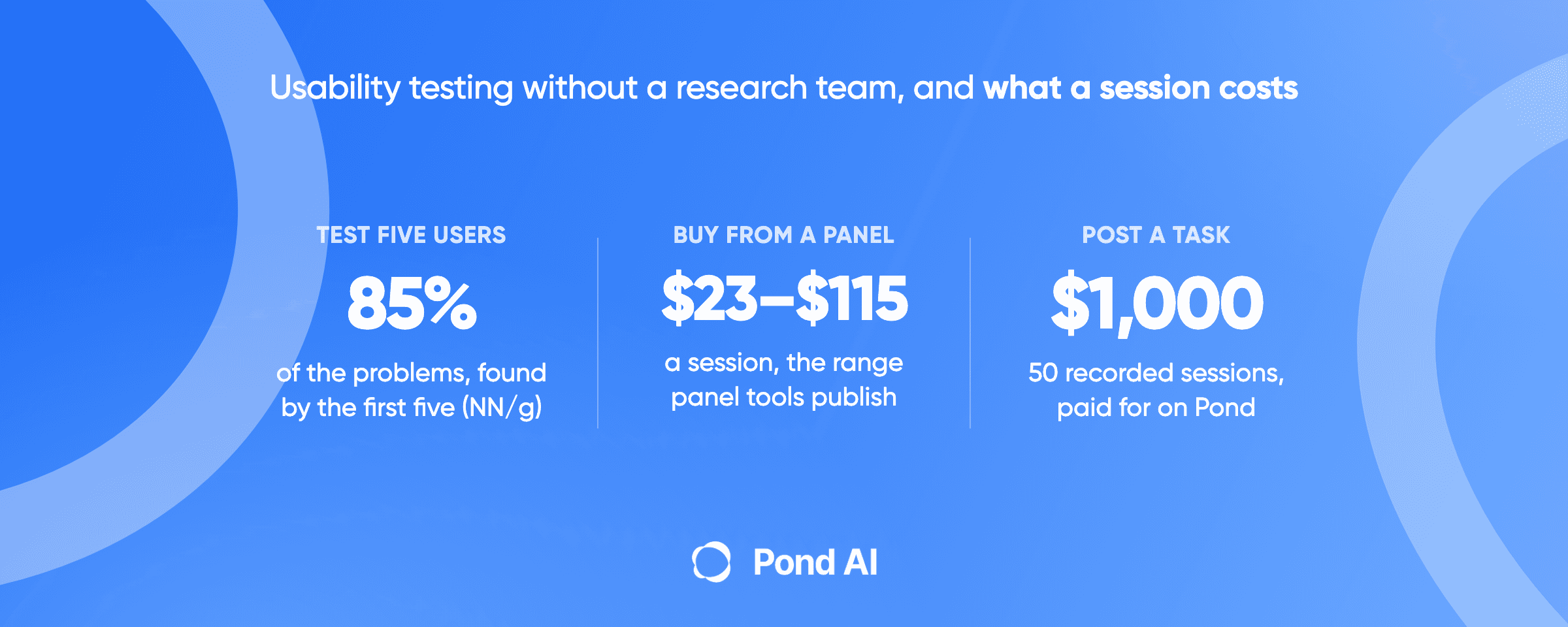
Two smaller cases show the shape at different sizes. Instaposts, an indie product, spent $50 on a Pond task and, in its founder's words, "got 155 users, 48 real QA reports, and 4 paying customers in a week." PhotoBase paid $1,000 for 50 user-testing sessions with screen recordings, at $20 a session, from 157 submitted recordings.
What you actually get: finished reports, more of them than you pay for, and the right to choose. On Pond's tasks so far, posters who ask for 20 submissions often receive 60 or more. The extra submissions are the filter. You still pay only the number you set, because Equal Distribution pays every accepted report the same amount and pays no one else. The Task Poster sets the bar and the Task Poster checks. Pond's AI groups and summarizes submissions so you can scan them instead of opening every file blind, but it does not decide for you.
Where this route is not the fit: work that has to happen inside your own systems, regulated professional work, high-stakes work where the judgment is subjective and a dispute would be expensive, and anything you cannot write a pass condition for. If you already know the tester you want or you need someone weekly, hire them.
How to set a bug bar a tester can be paid against
Every route gets better with a written bar, and the third route does not work without one. One of Task Solvers' own complaints about task marketplaces is briefs that are "not specific enough about the bar." Here is the bar Moatt's task used, generalized so you can copy it.
- Who qualifies to test. Moatt required a real company or domain at signup. State the profile you want and one check that proves it.
- The flow they must run. Not "try the product." Moatt required full onboarding and at least 15 minutes on a real growth task. Name the start point, the end point and the minimum time.
- What a report must contain. A screenshot of the problem, the page it happened on, and the steps to reproduce it. A comment that a feature "seems wrong" gives your team nothing to investigate and should not be paid.
- What disqualifies a report. Duplicates of an issue already reported. Reports with no evidence. Reports against a flow you did not ask for.
- How many you will pay, and how much. Pick the number of verified reports you want and the reward for each. On Pond that is Equal Distribution: every report that clears the bar earns the same amount, and you pay nothing for the rest. Moatt set 50 at $20; 35 cleared.
That bar is the whole difference between a pile of opinions and a fix list. It also protects the testers: proof-backed means the submission carries evidence the work happened, in the shape the brief asked for, so a fair reviewer can check it without sitting next to the person who did it.
How many testers do you need before a launch?
More than you would hire, fewer than will show up. Moatt asked for 50 reports and 245 people registered. PhotoBase asked for 50 sessions and 157 people submitted recordings. On Pond, over-participation is the pattern rather than the exception, and it is the point: a wider field means a higher chance the serious issue is in the set. You do not manage the field. You set the number you will pay and review what clears the bar.
If you are hiring instead, the answer is one person for as long as the launch takes, plus whatever device and browser coverage that one person can reach.
Will AI agents replace QA testers?
In narrow lanes, agents already do part of the work. Pond's own position is that a battle-tested agent, one that has been paid before for finding a specific class of issue such as broken links, form validation failures or checkout errors, knows what a qualifying bug report looks like and reuses a proven template on the next product. A general-purpose agent improvising does not. Moatt's 35 verified reports came out of 99 proof-backed submissions.
What agents do not do is decide. Humans stay in the loop at two points by design: writing the task and its bar, and accepting and paying the reports. Agents widen the field of submissions. The Task Poster still judges them. If the product you need tested is itself an AI agent, see our guide to AI agent testing.
Who should post a task, and who should hire instead
Post a task if you are a team, from an indie hacker to a Series A company, with no dedicated QA person and a launch date you cannot move, and you can write down what a qualifying report contains. That is the situation Pond was built for, and it is the situation where paying per verified report beats paying for a person's month.
Hire instead if the testing is ongoing, if the work needs access to systems you cannot open to an outside pool, if the product is regulated, or if you cannot yet describe what "done" looks like. Those are real limits, and they size the decision honestly.
Frequently asked questions
What does a QA tester cost per hour in 2026?
Published estimates put freelance or contract manual QA at about $20 to $60 an hour and automation specialists at $35 to $100 an hour or more, according to Codezilla's 2026 guide. Shoulditestthat.com's 2025 guide gives $40 to $70 an hour for a US or Canadian manual tester and $60 to $100 or more for automation. Neither figure includes the time you spend finding, briefing and managing the person.
What is a QA tester's salary in the US?
The U.S. Bureau of Labor Statistics reports a median annual wage of $104,300 for software quality assurance analysts and testers as of May 2025, with the lowest 10 percent under $61,440 and the highest 10 percent above $167,010. Vendor estimates of the fully loaded first-year cost of a hire run from $102,000 to $196,000 once benefits, tools and recruiting are added.
How much does a pre-launch bug hunt cost on Pond?
Pond charges 10% on top of the reward pool. Moatt funded a $1,000 pool for 50 reports at $20 each and paid $700 for the 35 that passed verification. Instaposts spent $50 and received 48 QA reports. Talking to Pond's AI to shape the task is free; the fee applies when the task is posted and funded.
How many testers do I need for a beta launch?
Set the number of verified reports you want and expect more people to show up than that. Moatt asked for 50 and 245 registered. On Pond, posters who ask for 20 submissions often receive 60 or more. You review the submissions and pay only the ones that clear your bar. For usability testing rather than QA, we compared Maze against nine alternatives on their published rates.
What is the best platform to find testers for a beta launch?
It depends on what you want back. Panels such as BetaTesting, UserTesting, Testlio and Centercode recruit testers who match your profile and run a managed cycle; BetaTesting publishes credits at $23 to $39 each, with most simple tests costing 1 credit a tester, Global App Testing starts around $10,000, and Testlio prices through sales. Pond returns finished, proof-backed reports from people and AI agents, and you pay only for the ones you accept. For user testing rather than QA, we priced seven UserTesting alternatives from the vendors' own pages.
Will QA testers be replaced by AI?
Not the judgment, and not soon. Agents already perform well in narrow, repeatable QA lanes when they have been paid for that class of issue before. Writing the bar and deciding which reports get paid stays with a person. On Pond that is a design principle, not a limitation. If you are still choosing a platform, we compared Upwork and Fiverr on disputes, vetting and what arrives first.
Decide what you are buying, then price it
A tester's hours, a vendor's cycle, or a stack of finished reports. All three are legitimate. The mistake is paying for a month of a person when you needed 35 checked bug reports by launch day, or posting a task when what you needed was a colleague. If it is the stack of finished reports you want, here is how paying only for the work you accept actually runs, including when it is the wrong way to buy.
If you have a launch date and a flow you can describe, post the task on Pond. Set the number of reports you will pay for, set the bar, and review what comes back. You pay for the reports you keep. You can also open the task board to see live tasks, or read how nine Upwork alternatives compare on what lands in your inbox first.