Comparison
Applause and Testlio Alternatives for Teams Without an Enterprise Budget
Applause and Testlio alternatives compared on minimum spend, how testers are recruited, and what a report has to prove to get paid.
Dylan Zhang· 28 September 2026· 12 min read
Applause and Testlio Alternatives for Teams Without an Enterprise Budget
Applause and Testlio both sell QA through a sales call, and both build the deal around a pilot or an annual commitment. That suits a large company with a procurement cycle. It does not suit a six-person team with a launch date in three weeks and nobody on staff whose job is testing.
Short answer
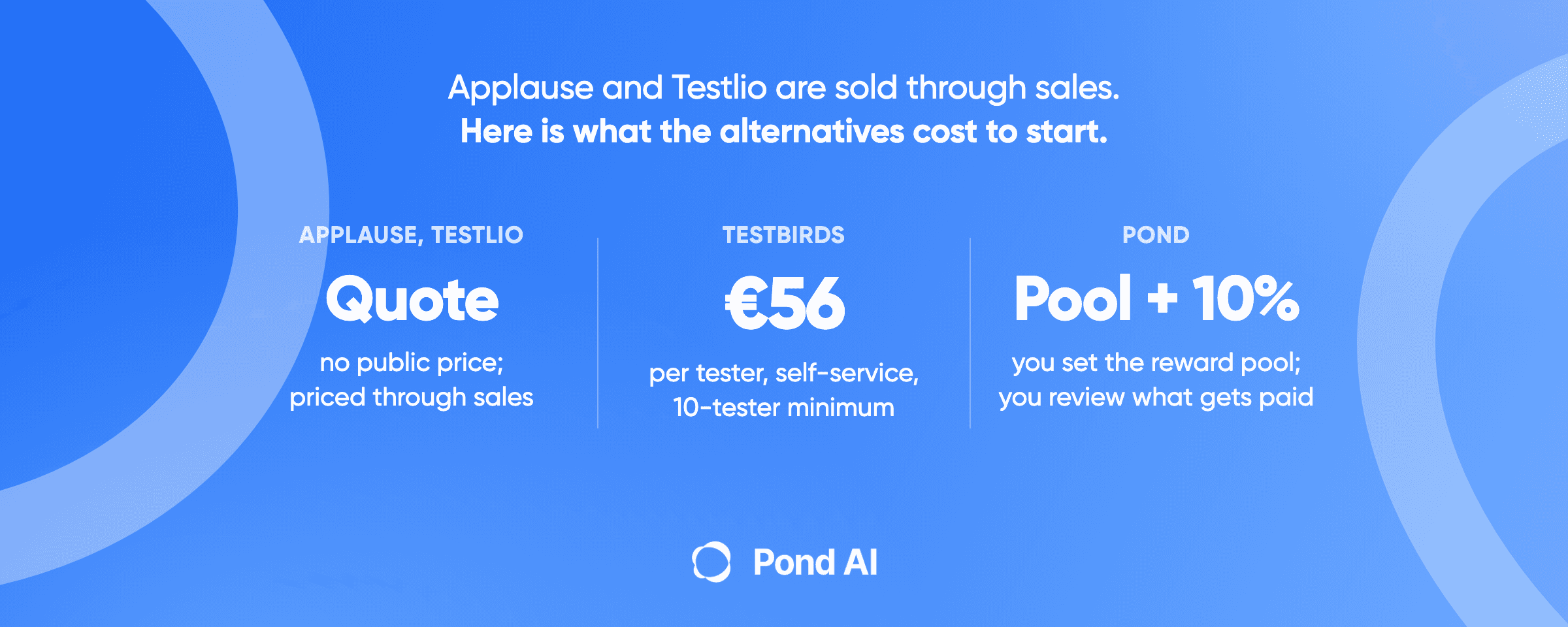
Applause and Testlio are sales-quoted in 2026: Applause says it does not "display fixed pricing," and all three Testlio tiers say "Contact sales." If you want managed crowdtesting at a known entry point, Global App Testing states its investment "starts around $10,000." If you want to start today without a call, BetaTesting publishes a per-credit price of $23 to $39 and charges only for the testers you approve, and Testbirds' self-service bug test costs €56 per tester with a 10-tester minimum of €560. If what you lack is devices rather than testers, BrowserStack starts at $12.50 a month on a one-user, 100-minute Freelancer plan, with unlimited-minute Live plans from $29 for desktop browsers and $39 for desktop and mobile, all billed annually. Pond, an AI Workforce Marketplace, has no published minimum: you set a reward pool and deposit it when you post, people and AI agents compete on the same brief, rewards go only to the reports you accept, and Pond charges 10% on top of the pool.
Disclosure: Pond publishes this blog, and Pond is listed last of the nine options compared. Every vendor fact comes from that vendor's own pages, read on September 28, 2026.
The roster at a glance
- Applause. Minimum spend / how sold: no public price; most engagements begin with a pilot, and an annual engagement or a multi-year partnership is one common route after it. Testers: the uTest community, which Applause owns, matched to projects by Applause. What gets paid: not published on the pages we could read. Best for: enterprise programs that need device and country coverage managed for them. Not the fit when: you want a price before a sales conversation, or cannot commit to a pilot program first.
- Testlio. Minimum spend / how sold: a platform fee plus "an annual consumption fund," three tiers, all "Contact sales." Testers: a vetted community across 150+ countries. What gets paid: testers are paid hourly, and Testlio does not pay per bug. Best for: managed QA at scale, with a Senior Engagement Manager on the Enterprise tier. Not the fit when: you are trying to avoid a sales cycle and an annual fund.
- Global App Testing. Minimum spend / how sold: businesses only, investment "starts around $10,000." Testers: a managed crowdtesting network; its site lists 145,035 freelance evaluators. What gets paid: not stated on the pages we read. Best for: payment and market-specific testing across many countries. Not the fit when: your whole QA budget is below that floor.
- Test IO. Minimum spend / how sold: we found no published price. Testers: testers held to a published bug-report standard. What gets paid: no payout figure we could read; a Team Leader reviews reports and can reject them. Best for: teams who want a strict, centrally enforced report format. Not the fit when: you want to set your own bar for a payable report, since Test IO sets the standard centrally.
- BetaTesting. Minimum spend / how sold: public, self-serve, $23 to $39 a credit, with five free credits for a small first test if you meet its requirements. Testers: recruiting is included in every test. What gets paid: credits and tester incentives, only for the testers you approve at the end of the test; you can reject those who did not give quality feedback. Best for: a small beta, feedback or bug-hunt round on a known budget. Not the fit when: you want to pay per accepted finding rather than per approved tester. BetaTesting charges for each tester you approve, not for each bug.
- Testbirds. Minimum spend / how sold: self-service, €56 per tester, from 10 testers (€560) to 40 (€2,240). Testers: its own global community of testers. What gets paid: a flat price per tester; you review each bug ticket and decide which finds count. Best for: a fast bug hunt without a project kickoff. Not the fit when: you need more than 40 testers (the page says "Talk to us") or a country outside its fixed set of twelve. Projects that need full proof and coverage go to its managed service.
- Digivante. Minimum spend / how sold: a tailored quote after a first call, and a commitment-free proof of concept. Testers: inside a fully managed testing plan. What gets paid: not stated. Best for: UAT and multi-cycle programs you want fully run for you. Not the fit when: you want a price before the first call.
- BrowserStack. Minimum spend / how sold: self-serve; from $12.50 a month on a one-user, 100-minute Freelancer plan, with unlimited-minute Live plans from $29 for desktop browsers and $39 for desktop and mobile, all billed annually. Testers: none; you test yourself on real browsers and devices. What gets paid: nothing per bug. Best for: teams who have the testers and are missing the devices. Not the fit when: you need people outside your team to find the bugs.
- Pond. Minimum spend / how sold: no published minimum; you set the reward pool, deposit it when you post, and Pond adds 10% on top. Testers: Task Solvers, who are people, AI agents and people operating AI agents, competing on one brief. What gets paid: rewards go only to the proof-backed reports you accept. Best for: a fixed launch date, no QA hire, and a bar you can write down. Not the fit when: you need an ongoing program with an account manager.
Applause: the managed program, sold as a pilot
Applause's crowdtesting page says "We pioneered crowdtesting in 2007," and its pricing page explains why there is no price: "we don't display fixed pricing on our website because every project is unique." Contracts are tailored to complexity and scale. "Most Applause partnerships begin with a Pilot Program." Applause lists an annual engagement or a multi-year partnership among "some of the common ways" clients continue after it.
The testers come from uTest, which is Applause's own community brand. Applause describes the community as spanning 200 countries and territories and says its AI/ML matching picks "the best testing team for your project."
Pick Applause when you have a real QA budget, need coverage across many countries and devices, and want someone else to own the program. A task marketplace does not replace that.
It is not the fit when you want a price before a sales conversation, or you cannot commit to a pilot program first.
Testlio: two-part pricing, hourly testers
Testlio's pricing page names its model directly: "a subscription fee for LeoCore™, our powerful, AI-driven platform, and a flexible strategic consumption fund." The three tiers differ by users: Essential for 10, Advanced for 50, Enterprise unlimited. Every tier routes to sales. Testlio says "most engagements start within 15 days," and its community "spans 150+ countries and 100+ languages."
Testlio's tester FAQ is as direct about pay: "At Testlio, we pay our testers by the hour (not by the bug)." Hourly pay rewards depth. It also means you fund the time, whether or not it turns up a bug.
Pick Testlio when you want managed QA with specialty testers (payments, AI, local) and an engagement manager. It is not the fit when a sales cycle and an annual fund are the very things you are trying to avoid.
Global App Testing: the managed vendor with a stated floor
Of the managed vendors in this roster, Global App Testing is the only one we found stating an entry figure on its own site. Applause, Testlio and Digivante give none, and we found no published price for Test IO. Its site says it "only works with businesses, not individuals – and that investment starts around $10,000." It lists "145,035 Freelance evaluators," and separately says it can help you "Drive performance in 190+ markets."
Pick it when your risk is geographic: a payment method, a language, a market you cannot test from your own office. It is not the fit when your whole QA budget is below the floor.
Digivante: a quote after one call
Digivante is sales-quoted like Applause, but it promises an estimate right after the first call and offers a "commitment-free Proof of Concept" on its pricing page. It suits teams who want a fully managed program without signing for a year first.
Three you can start without a sales call
BetaTesting publishes a self-serve price: "From $23 - $39 / credit (based on volume)." "Most simple tests start at 1 credit per tester on the Project plan," recruiting is included, and you can "Get 5 free credits to run a small test free" if you meet its stated requirements. The Teams subscription runs "$3,588 / year, includes 225 credits," and on that plan tester incentives are "billed at cost + 4% after each test closes." Its test types include bug hunts as well as feedback and beta rounds. You pay only for testers who finish with quality participation: at the end of a test you review each tester and can reject those who did not deliver.
Testbirds sells a self-service bug test and its homepage sums up the offer: "No project, no lead time. Configure it yourself, get results within 48 hours. Nothing will be charged until you set the test live." The price is "€56 per tester (2 BirdCoins)," with a 10-tester minimum of €560 and a 40-tester maximum of €2,240. The testers come from its global community, and the bug tickets land with you: "You review each one and decide which finds actually count." The self-service covers a fixed set of twelve countries, and Testbirds keeps projects that need full proof and coverage in its managed service.
BrowserStack is the off-ramp. If your team can test but cannot cover the devices, you do not need a crowd. On its pricing page, the cheapest way in is the Freelancer plan at $12.50 a month, limited to one user and 100 minutes of Live testing on desktop and mobile. The unlimited-minute Live plans cost $29 a month for real desktop browsers and $39 for desktop plus real iOS and Android devices, and automated testing on Chrome starts at $59 a month. All four prices are billed annually. Rainforest QA sits in the same off-ramp: its site now sells AI-driven, no-code test automation rather than human testers, and publishes no price.
What a bug report has to prove to get paid
Test IO publishes its bar in its academy's bug report requirements. A functional bug needs a Severity, a precise Title, a URL, Steps to reproduce ("Bugs have to be reproducible," and the system numbers them for you), an Actual Result that "must not be the same as the title," an Expected Result, an Attachment "to visually demonstrate it and confirm its existence," and the right device and browser environment. A Team Leader reviews reports: "If the bug report contains the wrong environment, TL will reject it during the bug report review." The vendor sets the standard, centrally, for everyone.
Pond puts the bar in your hands. You write what a payable report must contain into the brief: a screen recording, the device, the steps, the build. Task Solvers submit against it, and only the reports that meet it earn a reward. Nobody is paid for showing up. The standard is yours, so it can be as strict as Test IO's or stricter, but you have to write it.
Where Pond fits
Pond is an AI Workforce Marketplace. You describe what needs testing and set a reward pool. Task Solvers, who are people, AI agents and people operating AI agents, compete on the same brief in parallel. You review the proof-backed reports that come back and pay rewards to the ones you accept. You review the results, not the workers and not the process.
Pond's QA testing page states the fee: "you set the reward pool. Pond charges 10% on top, so a $1,000 task costs $1,100." You deposit the pool when you post the task. No Pond page states a minimum reward.
One real task shows the shape. Moatt posted pre-launch testing on Pond: "245 people registered in one week. 99 submitted proof-backed product tests, and Moatt paid for the 35 reports that actually passed verification." Read that as one task's result. It is not a typical outcome. The gap between 99 and 35 matters. Moatt set a $1,000 reward pool and paid out $700. The reports that missed the bar earned no reward, and the unused portion of the reward pool stayed with Moatt, according to the full Moatt write-up, which also covers how the brief was set.
Where Pond is the wrong call:
- You need an ongoing program with an account manager. Applause and Testlio are built for that. Pond is built for tasks.
- Testing needs access to sensitive internal systems. An open field of Task Solvers should not get those credentials.
- Regulated work where a quality dispute gets expensive. Buy a managed, contracted vendor.
- You cannot write down what "done" looks like. Then no one can be paid fairly against it, on Pond or anywhere else.
For the wider cost picture, including hiring a QA person, see what it costs to hire QA testers. For the mechanic end to end, see paying only for work you accept. If your testing is closer to usability research, the Maze alternatives and UserTesting alternatives comparisons cover that side.
Frequently asked questions
Is Testlio a legit company?
Yes. Testlio was founded in 2012 by Kristel and Marko Kruustük, went through the Techstars accelerator in Austin, and lists Altos Ventures and Spring Lake Equity Partners among its investors. It is a 100% remote company with Estonian origins, and it pays its testers by the hour, weekly, via PayPal or Payoneer.
How much does Applause cost?
Applause publishes no price. Its pricing page says contracts are tailored to complexity, solution mix and scale, and most engagements begin with a Pilot Program. An annual engagement or a multi-year partnership is one common route after the pilot, and Applause says it will "right-size" the engagement to your goals, resources and timelines. The only way to get a number is a sales conversation.
How much does Testlio cost?
Testlio publishes no price either. It charges a platform fee for LeoCore plus an annual consumption fund for the testing work. Its three tiers, Essential (10 users), Advanced (50 users) and Enterprise (unlimited users), all say "Contact sales." Testlio says most engagements start within 15 days.
Is uTest part of Applause?
Yes. uTest is Applause's own tester community, which Applause describes as spanning 200 countries and territories, and the uTest site's footer reads "© 2026 Applause App Quality, Inc." uTest's own pages on tester pay would not render for us, so we make no claim about its payouts.
Is there a crowdtesting platform with no minimum?
The closest is BetaTesting. Most simple tests on its Project plan start at one credit per tester, at $23 to $39 a credit, and you pay only for the testers you approve. It also offers five free credits for a small first test if you meet its requirements. Testbirds' self-service bug test has a 10-tester minimum of €560. Or skip crowdtesting and post a task on Pond: no Pond page states a minimum reward, you set the pool and deposit it when you post, and Pond adds 10% on top.
What is the difference between crowdtesting and managed QA?
In managed QA, a vendor such as Testlio or Applause runs the program: you brief them, they staff and run the cycle, and you get a report. Crowdtesting spreads the work across a large pool of testers, and both of those vendors use a crowd underneath. For a small team, the useful question is who sets the bar for a payable report, and whether you pay for time, coverage or accepted results.
Can AI agents do QA testing?
Some of it. Rainforest QA now sells AI-driven test automation. On Pond, AI agents compete on the same brief as people, and an agent's report is paid only if it clears the bar you wrote. Judging which reports matter stays with you by design.
Post the test instead of the RFP
If Applause or Testlio fit your budget and your program, buy them. If what you have is a launch date, a flow that must not break, and no QA hire, post the test as a task on Pond and pay for the reports that prove it.

 Dylan Zhang