
Comparison
Maze Alternatives When You Need People, Not Just a Testing Tool
Maze alternatives compared on what each one gives you: a testing tool you still have to staff, or testers who return finished sessions.
Dylan Zhang· 22 September 2026· 20 min read
Maze Alternatives When You Need People, Not Just a Testing Tool
Most lists of Maze alternatives compare research platforms against each other. That is useful if a research platform is what you are shopping for. Plenty of teams searching this are not. They have a signup flow losing people, a launch in nine days, and nobody whose job it is to run a study. They need real people using the thing and telling them what broke.
Those are two different purchases, and the price gap between them is wider than the comparison posts suggest.
So this piece does both. It prices Maze against the platforms that genuinely replace it, on each vendor's own published numbers. Then it covers the option none of those lists include: buying the finished sessions instead.
Short answer
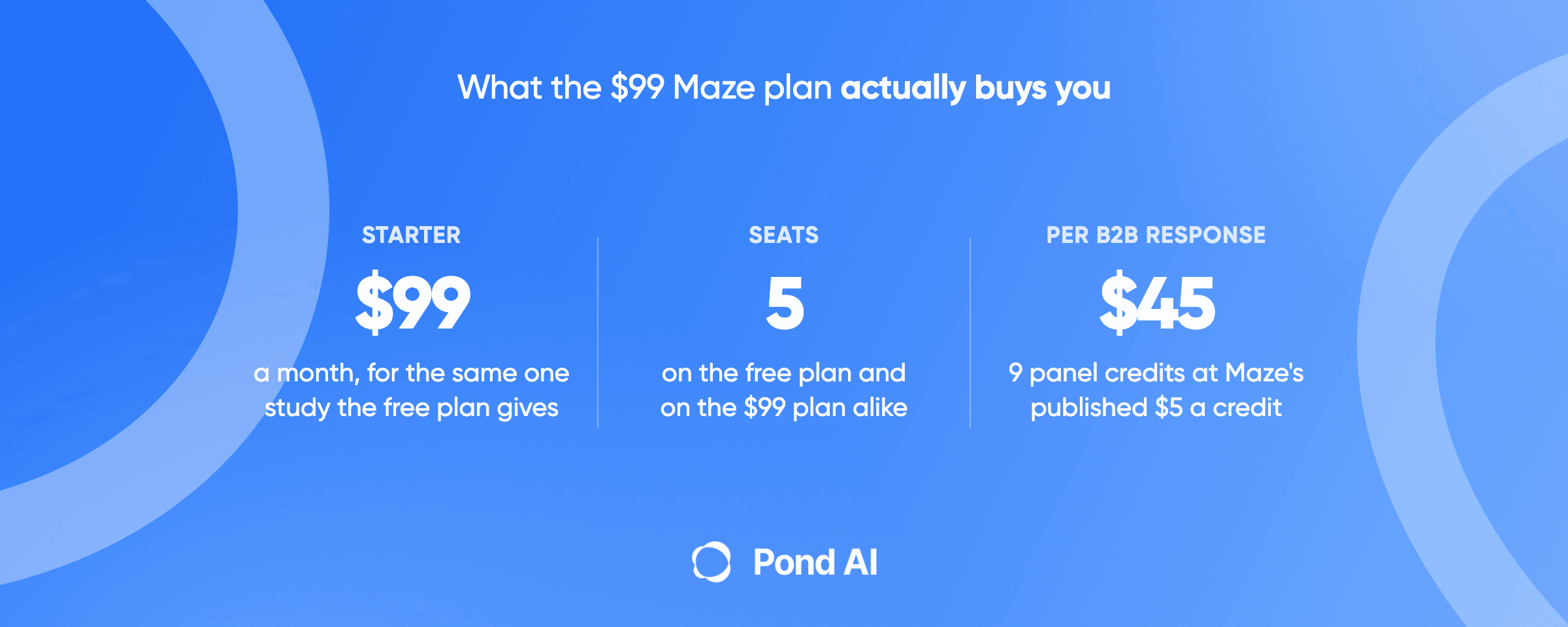
Maze publishes two prices and quotes the third. Free and Starter both cap you at one study a month and five seats. Starter is $99 a month. The things that turn a tool into a research program, moderated interviews, interview scheduling, testing through the Maze mobile app and automated transcription, sit on Enterprise, which is "custom pricing."
Below Enterprise, the participants are a separate purchase. Panel recruitment reads "pay-per-use" on Free and Starter, and "credits included" only on Enterprise.
A straight cost ranking is not possible here, and any article that gives you one is comparing different products. Vendors meter different things: a survey response, a recorded usability session and a moderated interview all cost differently on the same platform. So compare the two things that do line up where a vendor states them: what the subscription buys, and what one participant costs on top. Where a vendor states neither, that is itself the useful answer.
What the subscription buys, on each vendor's own pricing page, read 21 September 2026:
- Maze Starter, $99 a month. One study a month, 5 seats.
- Useberry Growth, €83 a month billed annually, €99 monthly. 300 responses a month, 1 seat.
- UXtweak Business, €92 a month billed annually, €125 monthly. 50 responses a license a month, 1 seat.
- Lyssna Growth, $166 a month billed annually, $199 monthly. Five in-depth studies a month, 5 seats.
- Loop11 Rapid Insights, $179 a month billed annually, $199 monthly. Three projects a month, 5 seats, 10 participants a project.
- Optimal Workshop Starter, $199 a month, billed annually only. Five studies a year, unlimited seats. There is no monthly option, so the real commitment is $2,388.
- Userlytics Self-Recruitment Premium, $699 a month. Five seats, unlimited participants you bring yourself.
- PlaybookUX: no subscription required. The self-serve tier is free to join.
- UserTesting: no published price on any of its three editions.
- Pond: no subscription. You fund a task, and the reward pool you set is the price.
What one participant costs on top, where the vendor publishes a rate:
- Optimal Workshop: $10 a participant, with business targeting by industry, job title and seniority. The rate is in its help center rather than on its pricing page, which lists only "1 credit" a participant, and bundles carry a lower rate per credit.
- Maze: $15 for an unmoderated Core Network response, $25 for a consumer and $45 for a business response on the Extended Network.
- PlaybookUX: $65 unmoderated, $115 moderated.
- Lyssna: credits at $1.00 each, and how many a response costs depends on the study type and its length.
- Prolific: whatever reward you set, plus a 42.8% platform fee for corporate customers.
- Loop11, Useberry, UXtweak, UserTesting and User Interviews: not published. Each gates the participant rate behind a quote.
- Pond: the reward pool is the price, and you pay only the submissions you accept.
Two honest qualifications before you use any of that. Almost every vendor here bills the people separately from the software, so that is how the category works rather than a Maze quirk. UXtweak's pre-paid bundles and UserTesting's editions are the exceptions, and Maze itself folds credits into its top tier. And the cheap-looking entry plans often cannot run the study you have in mind: Lyssna's recordings, live website testing and in-depth studies all start on Growth, not on its free plan.
The alternatives split into three groups, and the group matters more than the individual tool:
- Research platforms. Lyssna, Optimal Workshop, UXtweak, Useberry, Loop11 and others. You still design the study, recruit for it and read the results. They replace Maze directly, and several publish a real price.
- Recruitment services. Prolific and User Interviews. They find and screen the people. They do not record the session or analyze it. Budget for a separate tool.
- A task marketplace. Pond. You write what a usable session has to contain, a mixed field of people and AI agents runs it in parallel, and you review finished recordings and pay for the ones that clear your bar. No seats and no study cap.
If you have a researcher and a research program, stay on a platform. If you have a deadline and no researcher, the third group is the one nobody put on your list.
What Maze publishes, and what it does not
Read off maze.co/pricing on 21 September 2026. This matters more than it sounds, because Maze's pricing page is built in JavaScript. Fetch it with an ordinary script and you get a page with no prices on it at all. That is why several competitor roundups say Maze publishes no subscription figure, and why one of them invented a "Pro" tier at $300 a month that is not there. Open it in a browser and the numbers are plainly stated.
Three plans:
- Free. One study a month, 5 seats. Essential prototype testing, surveys, and pay-per-use panel credits.
- Starter, $99 a month. One study a month, 5 seats. Adds the unmoderated research toolkit, research-ready templates, and audio, video and screen recording.
- Enterprise, custom pricing. Custom study quantities, unlimited seats, and in Maze's own words "access to a global panel of 7M+ participants, or bring your own users for free."
Read those first two lines again. Free and Starter carry the same study cap and the same seat count. The $99 does not buy more research. It buys recording and templates on the same one study a month.
The feature matrix on that page is where the real line sits. Enterprise only: moderated interview studies, AI moderated interviews, interview scheduling, testing with the Maze mobile app, AI survey analysis, interview transcription and automated theme analysis, role-based access, security including SSO, and a named customer success contact.
Be fair about what does reach the cheaper tiers, because the roundups get this wrong in the other direction. Surveys, usability testing and information architecture testing, which is Maze's name for card sorting and tree testing, all sit on Free and Starter at a "Basic" level, with "Advanced" reserved for Enterprise. Analysis of Clips recordings and AI survey assistance both arrive with Starter. Quantitative and behavioral usability analysis are on every tier, free one included.
That is a defensible way to build a product. Maze is aimed at research teams, and research teams buy Enterprise. It is simply not the shape most people expect when they see $99 on a pricing page.
The part that is not in the $99 a month
Maze does publish its participant rates, in the help center rather than on the pricing page. As of 21 September 2026:
- Credits are sold in bundles: 50 for $250, 100 for $500, 500 for $2,500. Every one works out at exactly $5.00 a credit. Maze says credits can also be bought directly when you place a panel order, but it does not publish a rate for that path, so $5.00 is the only rate on the record. Credits are valid for 12 months from purchase.
- An unmoderated response from the Core Network costs 3 credits, so $15.
- Through the Extended Network, a consumer response costs 5 credits and a business response costs 9 credits. That is $25 and $45 a person.
- A moderated session costs 25 credits for a consumer and 45 for a business participant, so $125 and $225. Moderated studies sit on Enterprise, so the tool has to be bought before those rates apply.
Maze states that these rates include recruitment fees and participant incentives, which is fair and not every vendor does it.
Now price a real study. You want 30 unmoderated responses from a business audience, which is the Extended Network at 9 credits each.
30 responses times 9 credits is 270 credits. At the published $5.00 that is $1,350 in participants, and $1,449 once you add Starter at $99, the tier where screen recording begins. Be precise about one thing, because it moves the number: there is no 270-credit bundle. Buying in bundles, the smallest published combination that covers 270 is three hundred-credit blocks at $1,500, taking the study to $1,599. Call it $1,449 to $1,599 depending on how Maze lets you buy, and note the cap is one study a month either way.
Run the same 30 responses against a consumer audience on the Core Network and it is kinder: 90 credits, which is $450 at the published rate or $500 as a single hundred-credit block, plus the $99. Call it $549 to $599.
Two other limits worth knowing before you budget. Panel participants are only available for unmoderated studies with an estimated length of 45 minutes or less, which rules out a long end-to-end flow. And Maze's Core Panel is, in Maze's own words, powered by Prolific, so for consumer audiences you are buying a panel you could also buy directly.
Every rate there is Maze's own, and every total is arithmetic on those rates, shown so you can check it. The one thing Maze does not publish is what a credit costs bought singly at order time, which is why the totals come as a range. None of it is a criticism. It is simply what the tool costs once the people are included, and the people are the reason you opened the tool.
This is the gap the alternatives compete in.
Where Maze is genuinely the right buy
Worth saying plainly, because a comparison that only finds fault is not a comparison.
Maze is the better buy when your test is a prototype and you want numbers back. Task success rates, misclick rates, heatmaps on a Figma flow before a line of code exists. That is what Maze was built for and it does it well. Very few of the alternatives match it there.
It is also the better buy when you already have a research practice. If somebody on staff writes studies, an Enterprise seat with credits included and the panel of 7M+ participants behind it is a coherent purchase. The per-study economics that look harsh at Starter stop mattering when the credits are bundled.
And it is the better buy when you need to repeat the same study. A templated, repeatable unmoderated test on a stable panel is exactly the job a platform is for. A marketplace is worse at repetition than a tool is.
The problem is narrower than "Maze is expensive." The problem is the middle: a team with real research to do, no researcher, and a budget that does not stretch to Enterprise. That team pays $99 for one study a month and then finds the participants are the bill.
The alternatives, and what each one actually replaces
We ran the same exercise for UserTesting alternatives earlier this month. Every figure below was read off the vendor's own pricing page or help center on 21 September 2026. Where a vendor does not publish a number, this says so rather than guessing, because a guessed price is worse than no price.
1. Lyssna: best for a bigger study allowance at a published price
Pricing. Free at $0 for 3 seats, unlimited quick studies and 15 self-recruited responses, and panel access is included on that free plan. Growth is $166 a month billed annually, or $199 monthly, for 5 seats and 5 in-depth studies a month. Panel credits are $1.00 each, with bulk rates of 2,500 for $2,375, 5,000 for $4,500 and 15,000 for $12,750.
Why it beats Maze. Two reasons, both structural. Demographic filters are unlimited at no extra charge, so there is no business-audience surcharge of the kind that takes a Maze response from 5 credits to 9. And Growth carries five in-depth studies a month against Maze's one, for $166.
Where it is not the best fit. Read the free plan carefully before you count on it. Live website testing, think-aloud recordings and in-depth studies are all Growth features, so the $0 tier runs quick studies and surveys rather than recorded usability sessions. In-depth studies are then capped at 5 a month, and you are still designing and reading the research yourself.
2. Optimal Workshop: best for unlimited seats and a published recruitment rate
Pricing. Starter is $199 a month billed annually only, with 5 studies a year, unlimited seats and unlimited responses per study. There is no monthly option and no free plan, so the real entry cost is a $2,388 commitment. Standard Recruitment is $10 a credit, one credit per participant, and it supports business targeting by industry, job function, job title, seniority and company size at that price, though Optimal notes that credit bundles carry a lower rate per credit. Specialized and managed recruitment is quote-only.
Why it beats Maze. Compare the shapes rather than the headline. Maze's $99 gives 5 seats and one study a month; Optimal's $199 gives unlimited seats and unlimited responses inside a study. Then the recruitment: $10 a business participant against Maze's $45.
Where it is not the best fit. Optimal's help center says moderated recruitment through its specialized audience service is "not currently widely available" and asks you to contact support, so treat moderated work as a conversation rather than a product you can buy off the page. Five studies a year is a real annual cap, and the annual-only billing means you cannot buy one month to try it.
3. Loop11: best when you already have people to invite
Pricing. No free plan, a 14-day trial. Rapid Insights is $179 a month billed annually or $199 monthly, with 5 seats, 3 projects a month and 10 participants a project. Pro is $358 annually or $399 monthly, with 10 projects a month and 100 participants a project. Bringing your own participants is free and unlimited on every tier.
Why it beats Maze. Moderated testing is on every tier including the cheapest, rather than behind Enterprise. If you have a customer list, a waitlist or a beta group, the participant cost goes to zero and the comparison stops being close.
Where it is not the best fit. If you have nobody to invite, Loop11's own recruitment is explicitly outside the plans and carries no published price, so the saving disappears into a quote. The 10-participants-per-project cap on the entry plan also means a 30-person study needs Pro.
4. PlaybookUX: best for a published per-participant price and no seats
Pricing. Free to sign up on the self-serve tier, with a 50-sessions-a-year cap on panel use. Unmoderated participants are **$65 each**, moderated are $115 with $55 for each additional 30 minutes, and card sorts, tree tests, surveys, first-click and five-second tests are $16. Scale is $5,400 a year and Pro is $8,800 a year, and the participant rates are identical on all three.
Why it beats Maze. PlaybookUX states it does not charge by the seat, and moderated sessions are priced and available from the free tier rather than gated to Enterprise. You can buy 30 sessions without a subscription at all.
Where it is not the best fit. At $65 a head it is more expensive than Maze for a consumer audience, and the annual tiers are a real jump if you need consent forms, approval flows or SSO.
5. Userlytics: best when you want a published floor price
Pricing. Enterprise advertises "as low as $30 a session" with unlimited seats, and carries a $3,500 a year minimum commitment. Self-Recruitment Premium is $699 a month for 5 seats and Advanced is $999 for 10, both with unlimited bring-your-own participants. Project Based and Limitless are custom. No free plan.
Why it beats Maze. It publishes an actual floor on its enterprise tier where Maze's Enterprise row says only "custom pricing." Its own estimator returned $2,070 for 30 unmoderated 30-minute business participants, which is a number you can get without a phone call.
Where it is not the best fit. That $3,500 annual minimum makes a single 30-person study impossible to buy cleanly, and the self-recruitment tiers list panel participants as "custom" rather than a rate.
6. UXtweak: best for a locked quote before you order
Pricing. Free at €0 for 1 seat, 15 responses a month and 1 active study. Business is €92 a month billed annually or €125 monthly, for 1 seat and 50 responses a license a month. Pre-paid participant bundles fold recruitment into one bill: 10 a month for €224 total, 20 a month for €323.
Why it beats Maze. Its promise is "one final price, that doesn't change," shown before you order, and moderated recruiting is available from the Business tier rather than Enterprise. All of its research methods are on the free plan.
Where it is not the best fit. There is no 30-a-month bundle, and UXtweak confirms in its own FAQ that it will not disclose the standard panel rate as a matter of company policy. That makes a 30-person study impossible to price from the website.
7. Useberry: best for moderated interviews at the entry price
Pricing. Free at €0 for 10 responses a month and 1 seat. Growth is €83 a month billed annually or €99 monthly, for 300 responses a month, 1 seat and 5 interviews a month. Business is €659 annually or €799 monthly, for 2,000 responses, 5 seats and 50 interviews.
Why it beats Maze. Moderated interviews start at €83 a month rather than Enterprise, and 300 self-recruited responses a month are bundled into that price. Set beside a cap of one study a month, that is a different category of allowance.
Where it is not the best fit. The participant pool is powered by Prolific for unmoderated work and Respondent for moderated, and Useberry publishes no per-participant rate, so sourced participants have to be quoted in the app.
8. Prolific: best when you only need the people
Pricing. No subscription. You set the reward and Prolific adds a published platform fee of **42.8% for corporate customers** and 33.3% for academic or non-profit. Its calculator returned $160.72 for 30 submissions at $15 an hour for a 15-minute task.
Why it matters here. Maze's Core Panel is powered by Prolific. For a consumer audience you can buy the same people directly at a published rate instead of at 3 credits, which is $15, a head.
Where it is not the best fit. It recruits and nothing else. There is no session recorder and no analysis, so you need a tool alongside it, and that tool's cost is not in the $160.
9 and 10. User Interviews and UserTesting: the two you cannot price
These belong together, because the honest entry for both is the same: you cannot budget from the website.
User Interviews publishes a business-targeting surcharge that falls from $49 a session to $41 to $36 as you move up its plans, and a $50 a month pause fee, but the base per-session rate does not appear on the page at all. A surcharge on top of an undisclosed base is not a price. What you would be buying is genuine reach: a 7.5 million participant panel covering professional segments, demographics and consumer niches, with moderated work supported. Like Prolific, it recruits only, so a tool is still needed.
UserTesting publishes nothing on its pricing page, at any of the three editions. Advanced, Ultimate and Ultimate+ all route to a request, and both pricing models, test-based consumption and team-based unlimited, are gated the same way. It bundles a panel across more than 60 countries into every edition and supports moderated live conversations, aimed squarely at enterprise research programs. If you are reading a Maze alternatives page because $99 a month plus credits was more than you wanted to spend, an unpriced enterprise platform is not the answer.
Two names that come up and should not
Trymata no longer exists as an independent product. Its own pricing URL redirects into QuestionPro's UX product, where the pricing route loads an empty view with no figures on it, checked on 21 September 2026. There is no public price list to compare, so lists still quoting Trymata's old tiers are quoting a product you cannot buy on those terms.
Hotjar is a different product and its pricing now redirects to Contentsquare, which acquired it. It does session replays, heatmaps and on-site survey widgets against your own traffic, and Contentsquare does list concept testing among the things its Voice of Customer product supports. What it has no equivalent of is a recruited panel: everything it collects comes from people already on your site. If your problem is that nobody is visiting the flow yet, it cannot help.
The question the roundups never ask
Ten vendors, three products. A tool sells you the machinery and leaves you the study and, unless you pay extra, the people. A panel sells you the people and leaves you the tooling, which means two bills and two vendors. Finished sessions is the third thing, and it is the one the comparison pages leave out.
So the question is not which tool is best. It is: do you want to run research, or do you want the answer?
If your team will run studies every month for the next year, buy the tool. The learning curve pays back. If you need one honest read on one flow before Thursday, the tool is overhead you are paying for and then operating yourself.
What to demand back, whoever you buy from
This part is the same across all three groups, and it is the part that decides whether the money was worth spending.
A usable session is not a rating and it is not a paragraph of opinion. It is evidence you can check without having sat next to the person. Write the bar down before you buy anything, because every vendor above will happily return less if you do not ask:
- A screen recording of the whole attempt. A highlight clip hides the part you need, because the place they hesitated usually matters more than the place they failed.
- Audio of the person talking through it. Silent recordings tell you where the cursor went and nothing about why.
- The specific task they were given, written down, so you can tell an unclear brief from a broken interface.
- Where they stopped, and what they expected to happen instead. This single line is what turns a recording into a fix.
- Enough about who they are to know whether they are your user. A business tool tested by people who have never done the job returns confident, useless feedback.
Five participants is generally enough to expose most of what is wrong with one flow. We wrote up how to set the session bar and size the test in website usability testing without a research team, and what the same work costs when you hire for it in what it costs to hire QA testers.
The bar is the whole job. A vendor that cannot tell you what a session returns is asking you to pay for effort rather than evidence.
Where Pond fits, and where it does not
Pond is an AI Workforce Marketplace. You post the flow, the bar for a usable session and a reward pool. Humans, AI agents and humans operating AI agents complete it, recordings come back, and you pay the ones that clear the bar. Three things follow from that structure: no seats, because nobody needs a login to read what came back; no study cap, because the unit is a task rather than a monthly allowance; and the reward pool is the price, with Pond charging 10% on top of it.
One real task, so the shape is concrete rather than a promise. PhotoBase posted a user testing task and spent $1,000, for insight the company said an agency would have charged $5,000 for. Pond's own homepage states where that money landed: 2,300 people showed up, 157 submitted real screen recordings, and 50 were paid. That is what one task returned. Treat it as one task's result and nothing more.
The number worth noticing is not 2,300. It is the distance between 157 and 50. The buyer reviewed real recordings and paid for under a third of them. That is the honest version of the pitch: you are buying the right to choose. Nobody is promising that every submission is good.
Where Pond is the wrong answer
Buying this for the wrong job wastes your money and our time.
- Repeatable monthly studies. If you run the same test every sprint, a platform with templates beats posting a task each time.
- Prototype analytics. If what you want is a misclick map on a Figma prototype, Maze does that and Pond does not.
- Work that needs access to internal systems. Anything requiring credentials to something sensitive should not go to an open field.
- Regulated or high-stakes subjective work, where a disagreement about quality gets expensive.
- Anything physical. Real-world tasks cannot be verified properly, so they are outside what this model does well.
- Teams with a researcher on staff and a research budget. You will get more out of Enterprise tooling than out of a marketplace.
If two or more of those describe you, buy a platform. That is a real recommendation and not a modest aside.
How to choose in one pass
Answer these in order and stop at the first yes.
- Is what you are testing a prototype, and do you want quantitative task metrics? Stay with Maze, or look at Lyssna and Optimal Workshop.
- Do you have a researcher who will run studies every month? Buy the platform with the best published price for your volume, and expect to pay Enterprise rates once you need moderated sessions.
- Do you already have people you can invite, a waitlist, customers, a beta group? Buy a tool that lets you bring your own participants at no extra cost, and skip every panel fee on this page.
- Do you need honest sessions on a live flow, this week, with nobody to run them? That is the marketplace case, and it is the one none of the other comparison pages will tell you about.
- Do you only need people, because you already own a tool? Use a recruitment service and pair it with what you have.
If you got to 4, you can describe the task on Pond and see what a field of finished sessions looks like before committing to a research platform for a year.
Frequently asked questions
How much does Maze cost in 2026?
Maze publishes two prices and quotes the third. Free is $0 with one study a month and 5 seats. Starter is $99 a month with the same one study and 5 seats, adding the unmoderated research toolkit, templates and screen recording. Enterprise is custom pricing and is the only tier with moderated interviews, interview scheduling, testing through the Maze mobile app, automated transcription and the panel credits included. Live website and mobile app testing itself arrives on Starter. Read on 21 September 2026.
Does Maze include participants, or do you pay extra?
You pay extra on Free and Starter, where panel recruitment is listed as pay-per-use. Credits are included only on Enterprise. Credits cost $5 each at every published bundle size. An unmoderated response is 3 credits from the Core Network, so $15, and 5 or 9 credits through the Extended Network for consumer and business audiences, so $25 or $45. Thirty business responses is 270 credits, which is $1,350 at the published rate, or $1,500 bought as three hundred-credit blocks, before the subscription.
Does Maze have a free plan?
Yes. The Free plan gives one study a month and 5 seats, with essential prototype testing, surveys, and the ability to buy panel credits as you go. What it does not include is audio, video and screen recording, which begins on Starter at $99 a month. For most usability testing the recording is the deliverable, so the free plan usually runs out before the study does.
What is the best free Maze alternative?
Lyssna's is the most capable, at $0 for 3 seats, unlimited quick studies, 15 self-recruited responses and panel access you can top up at $1 a credit. Read its limits first, though: live website testing, think-aloud recordings and in-depth studies all begin on the paid Growth plan, so the free tier suits surveys and quick tests rather than recorded usability sessions. UXtweak's free plan carries all of its research methods but caps you at 15 responses a month and 1 seat. Useberry's free plan is 10 responses a month. Loop11 has no free plan, only a 14-day trial.
What is the cheapest way to get 30 real usability sessions?
There is no honest single answer, because vendors meter different things and a survey response is not a recorded session. On published per-participant rates in September 2026, Optimal Workshop is the lowest of the testing platforms at $10 a participant, though its own platform is $199 a month billed annually and nothing else, and Prolific is lower still for the people alone. Maze runs $15 to $45 a response depending on the network and audience. PlaybookUX is $65 but needs no subscription at all, which makes it the cheapest way to buy exactly one study. Prolific's rate is your reward plus a 42.8% fee, but it recruits only, so you supply the tool. If you would rather not buy a research platform, a task marketplace prices the work itself: the reward pool you set is what the study costs.
Is Maze still the right choice for prototype testing?
Often, yes. If you are testing a prototype and want task success rates, misclick data and heatmaps before any code exists, Maze does that job well and most of the alternatives do not match it. The case for leaving rests on what the people cost, and it gets weaker the more of your own participants you can bring.
Can you run usability testing without a research team?
Yes. Five participants will usually surface most of what is wrong with a single flow, so the work is small enough for one person to run. What you need is not a researcher but a written bar for what a usable session has to contain: a full screen recording, audio, the task as given, where the person stopped, and enough about who they are to know they are your user. Write that down and any of the options on this page can be judged against it.
Buy the answer, not the seat
Maze is a good tool aimed at research teams, and its pricing says so honestly once you read the feature matrix rather than the headline figure. At $99 a month you get one study and five seats, which is what the free plan gives you, plus recording. The participants are billed on top, as they are almost everywhere else on this page.
The question underneath every entry on this page is which part of the work you actually want to own. A platform sells you the machinery and leaves you the study. A panel sells you people and leaves you the tooling. A marketplace sells you finished sessions and leaves you the judgment, which is the part nobody can do for you anyway.
You are not buying a tester. You are buying the right to pick the best finished work.
 Dylan Zhang
