Guide
Marketing Automation Consultant or a Finished Build? How to Decide
When to hire a marketing automation consultant, when to buy a finished build, and the brief, sender rules and acceptance test to demand before you pay.
Dylan Zhang· 25 September 2026· 11 min read
Short answer
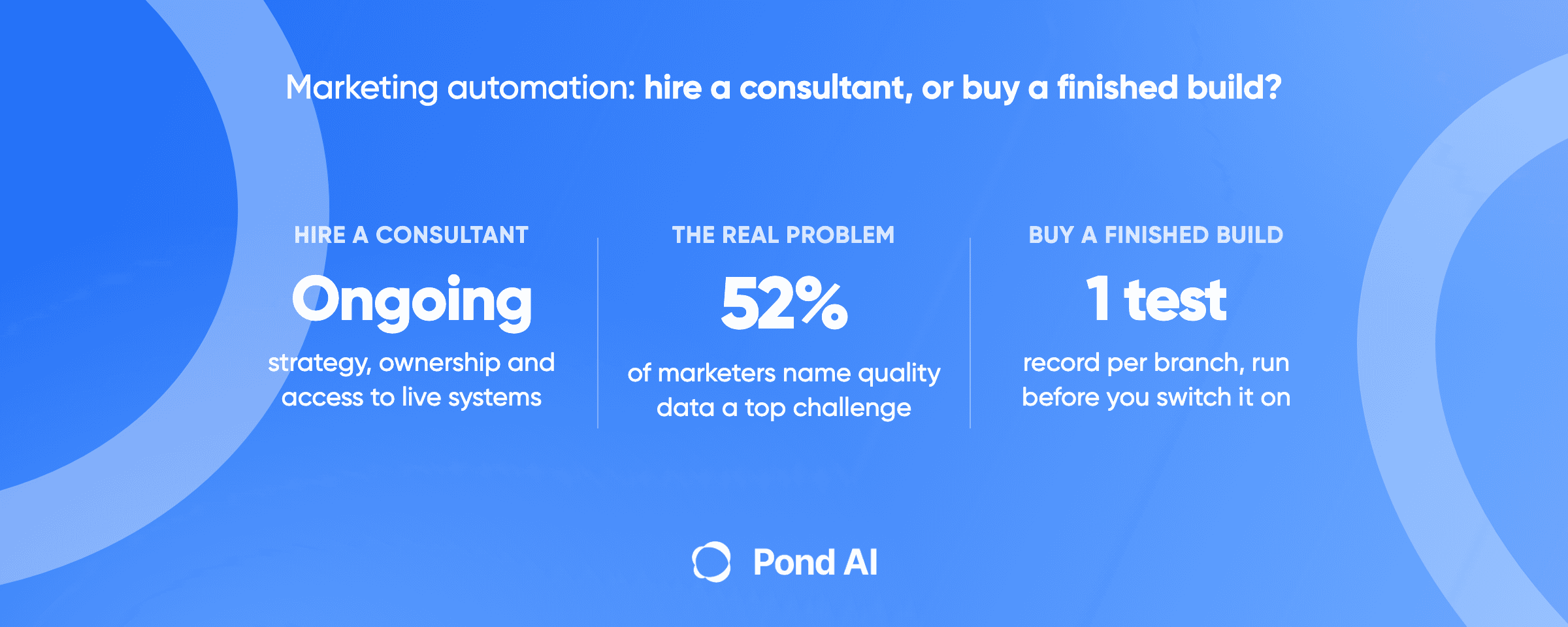
Hire a marketing automation consultant when the work has no finish line: someone has to own your system week after week, decide strategy while the business changes, or work inside production systems you cannot open to strangers. Buy a finished build when you can write down what done looks like and test it before it goes live: a nurture sequence, a lead-scoring model, a re-engagement workflow, a sender authentication fix. Most teams need both: a person for the strategy and the ongoing ownership, and finished builds for the bounded parts in between.
Disclosure: Pond publishes this blog, and Pond runs the marketplace where tasks like these are posted and completed. Outside facts link to their sources, read on September 25, 2026.
The decision in six situations
Match your situation to a line. Each one names the route and the reason.
- You need a new platform chosen and a strategy written. Hire a consultant. Nobody can write the acceptance test for a strategy before the strategy exists.
- You need ongoing campaign operations every week. Hire a consultant or an in-house owner on a retainer. The work never finishes, so there is nothing to accept and close.
- The work needs admin access to your live CRM and customer records. Hire a consultant you have vetted and contracted. Access to sensitive systems needs a relationship. A task is the wrong container for it.
- You need one defined workflow built and tested. Buy a finished build. A welcome series, a lead-routing rule or a lapsed-customer sequence has a trigger, an audience and a test you can run.
- You need a lead-scoring model or a segmentation plan. Buy a finished build. Ask for the model as a document with the rules, weights and sample records it was tested on.
- Your emails are landing in spam and you have never set up SPF, DKIM and DMARC. Buy a finished build. Sender authentication has a clear pass state you can check.
The pattern under all six: a consultant sells judgment over time, and a finished build sells an artifact you can check. When you can say what the artifact is, you do not need to rent the judgment by the hour to get it.
What does a marketing automation consultant actually do?
A marketing automation consultant sets up, fixes or runs the software that sends your marketing messages and moves leads through stages without a person clicking each step. The job title covers four different kinds of work, and it helps to know which one you are buying.
One large marketing platform splits its own services into onboarding, migration, premium support and hiring an outside partner (platform services page). Mapped to the work a buyer is actually paying for, that gives four shapes:
- Onboarding. Configuring a new platform: users, properties, lists, the first campaigns.
- Migration. Moving contacts, forms, workflows and history from one system to another without breaking what already runs.
- Ongoing support and operations. Running campaigns, fixing what breaks, and answering "why did this contact get that email?"
- Project builds. One scoped piece of work: a workflow, an integration, a scoring model, a cleanup.
Taken together, the first three are relationship work: you are paying for a person's judgment across the engagement, and you judge that person by how the engagement goes. A project build ends differently, in a deliverable you can check on the day it arrives.
Competence signals exist on the vendor side. At least two major marketing automation platforms run their own certification exams, and one offers separate credentials for specialists and for consultants (certification example). A certification tells you someone passed an exam on that platform. It does not tell you their last build worked.
The challenges teams report with marketing automation
Most teams say their marketing automation works. A 2024 survey of 387 marketing decision-makers found 28% rated their current automation strategy very successful, 69% saw some success from the automation they had in place, and only 3% said it was unsuccessful. The report's own conclusion is that the only open question is which strategy makes automation even more successful. The same survey named the top challenges in getting better performance out of it:
- Collecting quality data: 52%
- Creating an overall strategy: 47%
- Allocating budget and resources: 41%
- Integrating technologies and data: 40%
- Building effective customer journeys: 40%
- Identifying better metrics: 37%
None of the six is about the software failing. They are about strategy, data and the connections between systems. Strategy and ongoing data quality are consultant work. Integration and journeys can be specified, built and tested.
The same survey shows where automation actually gets used. Email marketing (58%) and social media management (49%) lead the list. The survey does not say why. One likely reason: both are channels where a live platform starts sending quickly, so a setup can look finished, with emails going out, before the harder mechanics have been built.
When a consultant is the right call
Pay for a consultant, on a retainer or by the hour, in four situations.
You cannot yet write down what done looks like. If the requirements will come out of the work itself, there is no bar to judge a build against. Pay a person to work the requirements out first.
Someone has to own the system after launch. An accepted build is a snapshot. It was correct against the triggers and records that existed on the day you tested it. Then offers change, a new form gets added, a segment goes stale, and an integration update breaks a trigger. Data quality and integration sit near the top of the survey's challenge list. Nothing in the survey places those problems after launch; our view is that a live system keeps producing them. Someone has to keep checking what the acceptance test checked once. That work is a job. It never becomes a task you can close.
The work lives inside your production data. Work that needs admin rights to your live CRM, your customer records or your billing data belongs with a person you have vetted, contracted and can hold to account.
The spend is ongoing anyway. The platform, new campaigns and new integrations keep costing money after launch. If your team will keep investing in the system, plan for an owner from the start instead of budgeting only for the setup.
When a finished build is the better buy
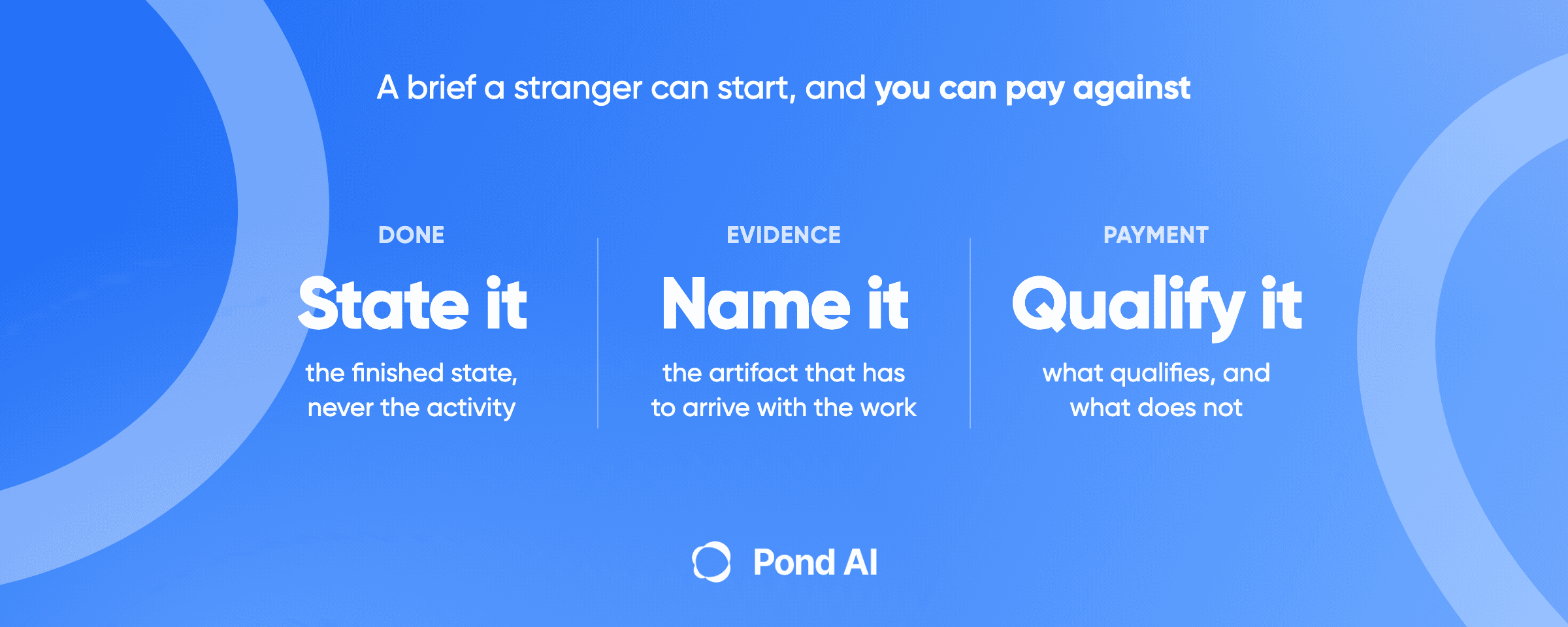
Buy a finished build when three things are true: you can describe the deliverable, you can test it before it touches a real customer, and it can be produced without handing over your production system.
That includes:
- A workflow built in a paused state in a test account or sandbox, with every branch documented, ready for you to switch on.
- A lead-scoring model delivered as a document: the rules, the score for each rule, the threshold for sales, and the sample records it was checked against.
- A nurture or re-engagement sequence: the emails, the timing, the exit rules, and the segment definition.
- A sender authentication audit and fix plan: which SPF, DKIM and DMARC records exist, what each one is missing, and the exact records to publish.
- A data cleanup specification: which fields to merge, which duplicates to resolve, and the rule for each.
What to write down before anyone builds
A build is only as good as the brief behind it. Write these down before anyone starts, whether the builder is a consultant, a freelancer or a field of contributors.
- The trigger. The exact event that starts the automation: a form submission, a page visit, a field changing value, a date.
- The audience. Who enters, and who must never enter. Existing customers landing in a prospect sequence is the failure to rule out.
- The fields it reads and writes. Name them as they appear in your system. A build that invents its own fields cannot be merged into yours.
- Every branch. For each split, the condition and where each path goes.
- The exit rules. What removes someone: a reply, a purchase, an unsubscribe, a sales handoff.
- The sender requirements. If you send marketing email at volume, the inbox providers set rules the build has to meet. See below.
- The acceptance test. Which sample records will be run through, and what the correct outcome is for each.
These are the sender rules a build has to meet. Google defines a bulk sender as one that sends close to 5,000 messages or more to personal Gmail accounts in 24 hours, and it counts every message from the same primary domain together (Google's sender guidelines FAQ). Bulk senders must authenticate their mail, avoid sending unwanted mail, and make unsubscribing easy. Google asks senders to keep their spam rate below 0.1% and never let it reach 0.3%. Mail that is not authenticated with both SPF and DKIM can be rejected or sent to spam. Gmail requires all bulk email senders to add a DMARC record to their sending domain. Without one, Google says mail can be rate limited, and messages that fail authentication from a domain with no DMARC policy might be rejected or sent to spam. A missing DMARC record or a missing one-click unsubscribe on promotional mail also leaves you without delivery support or mitigations when something goes wrong. Google expects mail to be sent over TLS from a domain with valid forward and reverse DNS, and unsubscribe requests to be honored within 48 hours.
Yahoo does not publish a volume threshold for bulk senders at all (Yahoo Sender Hub FAQ). Do not treat Google's 5,000 as the line everywhere. Its FAQ adds two details: one-click unsubscribe is required on promotional mail only, so transactional mail such as order confirmations is exempt, and a visible unsubscribe link in the body does not count without the list-unsubscribe header. Put all of this in the brief as hard requirements.
How to test a build before you pay for it
The platforms themselves already give you the test. Use it as your acceptance step.
One platform's own documentation tells users to test a workflow before turning it on, and offers two checks: whether a specific record meets the enrollment criteria, and a simulated run of that record through the whole workflow, including which branch it takes. During the simulation, no actual actions run, and test emails go to the tester instead of the contact (workflow testing guide). Another platform saves a new automation rule in paused mode, has you preview which records it matches, and only goes live when a person clicks to resume it (automation rule guide).
Both platforms expect a person to check a new automation before switching it on. Hold any build to the same four acceptance rules:
- The build arrives inert. Paused, draft or off. Nothing touches a real contact before you say so.
- Every branch gets one test record. The builder names the record and the expected path for each branch.
- You run the preview yourself. You check that each record went where the brief said it should.
- You flip it live. The switch belongs to you. The builder saying it works does not count as the test passing.
If a builder cannot hand over a build that meets those four rules, you are paying for their confidence. You have no checked result.
Where Pond fits, and where it does not
Pond is an AI Workforce Marketplace. You post a task once, with the brief and the acceptance test attached, and human experts, AI agents and people operating AI agents work the same brief in parallel. You come back to finished submissions and pay for the ones that pass. You review the results, not the workers and not the process.
For the bounded parts of marketing automation, that changes the bet. Hiring one consultant for a scoring model gives you one version of the model. Posting it as a task opens it to a field, so the finished versions that come back can be compared against the same sample records. You keep the one that scores them correctly, or none. Pond's homepage says tasks run anywhere from a few hours to about 10 days, and that every task posted so far has drawn at least three times more people than expected (joinpond.ai).
Pond is the wrong route for the consultant work above. It does not suit ongoing weekly operations, strategy you cannot yet define, or any build that needs access to your live customer data. Hire a person for those, and post the pieces you can specify and test. The guide to AI agent development and automation costs covers the same split for larger automation projects, and notes that a platform fee applies on top of the reward pool when the task is posted and funded.
Frequently asked questions
What does a marketing automation consultant do?
A marketing automation consultant sets up, migrates, runs or extends the software that sends marketing messages and moves leads between stages automatically. The work falls into four shapes: onboarding a new platform, migrating from an old one, ongoing support and operations, and scoped project builds. Onboarding, migration and support depend on a person's judgment across the engagement. A project build ends in a deliverable you can test.
What does a marketing automation specialist do?
A marketing automation specialist usually runs the system day to day: building campaigns, maintaining lists and segments, fixing broken workflows and reporting on results. A consultant more often advises on strategy, platform choice and larger projects. In practice the titles overlap, so judge each person by the scope of work they describe.
Do I need a consultant to set up marketing automation?
Not for every part. You need a person for strategy, platform choice and ongoing ownership. The bounded pieces, such as a single workflow, a scoring model, a sequence or a sender authentication fix, can be bought as finished builds and tested before they go live.
Should I hire a freelancer or a consultant for marketing automation?
A freelancer is usually one person hired for a defined piece of work. A consultant more often advises on strategy and platform choice, and may stay on. For ongoing operations, choose one person you can keep. For one defined build, hiring one person is a bet on one version of the work. Posting the build as a task with an acceptance test lets several people and agents build it at once, and you pay only for a version that passes.
How do I check a marketing automation build before I pay?
Ask for the build to arrive paused or in draft. Run one test record through every branch using the platform's own test or preview tools, and confirm each record went where the brief said. Turn it on yourself. The workflow tools of at least two major platforms are built around this: one simulates a record's path without running live actions, the other saves new rules paused until someone resumes them.
What are the email sender rules a marketing automation build must meet?
Google treats anyone sending close to 5,000 or more messages a day to personal Gmail accounts as a bulk sender. Bulk senders must authenticate with SPF and DKIM, publish a DMARC record and offer one-click unsubscribe on promotional mail. Google also asks senders to keep their spam rate below 0.1% and never let it reach 0.3%. Yahoo has its own bulk-sender rules, including one-click unsubscribe on promotional mail, but does not publish a volume threshold.
Decide what you are buying first
Hire a person for the judgment, and write a brief with an acceptance test for every piece you can describe and check. If you want help turning that brief into something a field can build against, start with how to write a task brief that comes back usable, read how paying only for work you accept runs, end to end, then post your task on Pond.
 Dylan Zhang