Short answer
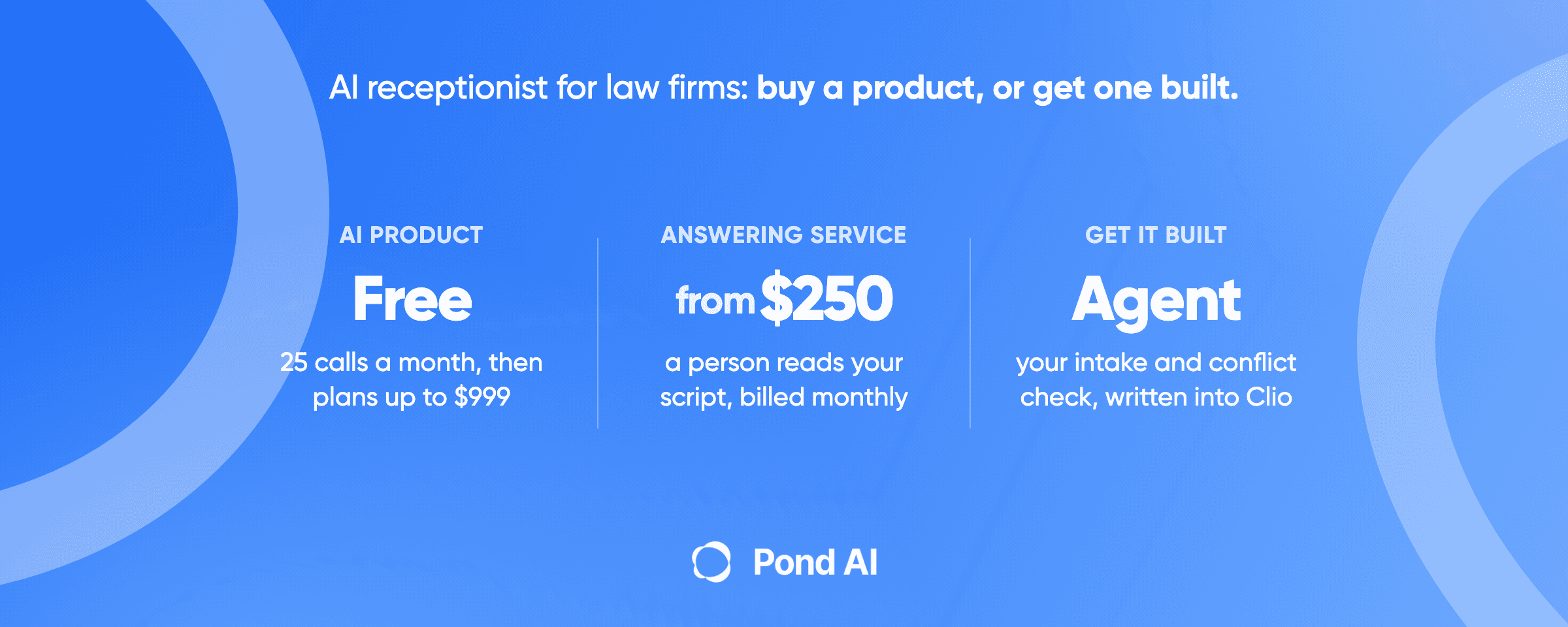
Most law firms should buy an AI receptionist product if their calls are standard intake and their practice-management system is on the vendor's integration list. On October 22, 2026, published AI receptionist plans ran from a free tier of 25 calls a month (Smith.ai) to $999 a month (Atty.ai), and human answering services started at $250 (Ruby) and $300 (Smith.ai). Get a custom intake agent built only when your script, your conflict check or the write into Clio or MyCase goes past what a product supports.
Disclosure: Pond publishes this blog and sells custom AI agent builds. It does not sell a packaged receptionist product. Prices below are US list prices read on each vendor's own page on October 22, 2026, so check the page again before you buy.
Product, answering service or custom agent: the three options side by side
A legal AI receptionist answers the firm's phone with a synthetic voice, asks intake questions and hands the result to a person or a system. You can buy one, pay people instead, or have one built.
Option 1: An AI receptionist product
- Price basis: a monthly bundle of calls or minutes, then per-call or per-minute overage.
- Entry price: Smith.ai's free tier covers 25 calls a month, then $3.00 a call. Dialzara starts at $29 a month for 60 minutes.
- What it handles: answering, a fixed set of intake questions, booking, transfer to a person, and a push of the lead to a supported system.
- Where it stops: custom prompting and custom integrations sit on a higher tier or in a separate statement of work.
- Best when: a solo or small firm with standard intake and a supported system, such as Clio.
Option 2: A human legal answering service
- Price basis: per call (Smith.ai) or per minute (Ruby, LEX Reception, which rounds each call up to the minute).
- Entry price: Ruby at $250 a month for 50 minutes, Smith.ai at $300 a month for 30 calls.
- What it handles: the same intake, booking and transfer work, done by a person reading your script.
- Where it stops: standard intake at Smith.ai is five short-answer questions, and extended intake and conflict checks cost extra per call.
- Best when: your callers expect a human voice and your volume is modest.
Option 3: A custom intake agent built around Clio or MyCase
- Price basis: a build fee, then per-minute telephony and voice-platform charges.
- Entry price: no package price. A Twilio local number receives calls at $0.0085 a minute plus $1.15 a month, and Retell lists $0.07 to $0.31 a minute.
- What it handles: whatever you specify: your intake order, your conflict-check fields, your routing and follow-up.
- Where it stops: at what you specify and test before launch. Who runs it and pays the minutes afterward is a term to agree with the builder.
- Best when: intake is non-standard, your system is unsupported, or you want your own conflict logic run on every call.
What AI receptionists for law firms cost in 2026
Each price was read on the vendor's own page on October 22, 2026, from a US connection. Prices from third-party listicles were left out. One listicle's Smith.ai figures no longer matched Smith.ai's own pages, and Answering Legal and LEX Reception show prices only after a form, so their listicle prices could not be checked.
AI receptionists with a published price:
- Smith.ai AI Receptionist: per call. Free covers 25 calls a month, then $3.00 a call. Pro is $150 a month for 75 calls, $270 for 150 and $500 for 300. Enterprise is $500 for 300 calls or $800 for 500, and the price is custom from 1,000 calls. Every plan lists native Clio integration.
- Atty.ai: per voice minute. $299 a month for 400 minutes, $499 for 850 and $999 for 1,800. It lists Clio and Lawmatics among the CRM integrations on its $499 Front Office AI plan, and CRM setup by its team is an add-on on the $299 plan.
- Dialzara: per talk minute, built for small businesses in general. $29 a month for 60 minutes, $99 for 220, $199 for 500 and $349 for 1,000. CRM connection runs through Make, Zapier or an API.
Human answering services with a published price:
- Smith.ai Virtual Receptionists: per call. $300 a month for 30 calls, $810 for 90 and $2,100 for 300. Add-ons per call include conflict checks at $0.50, a dedicated Spanish line at $1.00 and extended intake at $1.50.
- Ruby: per receptionist minute. $250 a month for 50 minutes, $395 for 100, $720 for 200 and $1,725 for 500, and every plan lists intake plus 24/7 Spanish and bilingual handling as available.
Quote only (no price on the page):
- Answering Legal: a human answering service for lawyers, with a lead form in front of prices. Its help center names Clio Grow, Lawmatics, PracticePanther and MyCase among its integrations.
- LEX Reception: a human service that says "No bots or AI." Plans are listed by minutes, from 150 to 2,500, with prices shown only after a sign-up form ("View plans and pricing").
- CaseGen: an estimate from a browser call with its AI agent, then the founders confirm final pricing, including a one-time setup fee.
- Lexidesk: "one short fit assessment" call, then one flat monthly fee that scales with call and chat volume.
- Hona: the receptionist is a feature of its client platform, and its pricing page returned a 404.
What a human receptionist costs, for comparison
The Bureau of Labor Statistics puts the median receptionist wage at $38,010 a year, or $18.27 an hour, in May 2025. In professional, scientific and technical services, the sector that holds law offices, it is $18.56 an hour.
Those are wages only, before benefits, payroll tax and evening or weekend cover. Software's case is coverage. It answers after a full-time receptionist has gone home.
Why firms look at this: the unanswered phone
For Clio's 2024 Legal Trends Report, Lux ran secret shops of 500 law firms from June 20 to July 5, 2024. Only 40% answered the phone, down from 56% in 2019. Counting callbacks, 52% answered or phoned back, so 48% were essentially unreachable by phone.
Clio also found that only 41% of firms offered rate information on the phone, and 36% explained the legal process or next steps. Clio sells practice-management software, so read this as a vendor's study. It is still the clearest public figure we found on unanswered law-firm phones. Our speed-to-lead benchmarks cover how fast to reach a lead.
What a legal AI receptionist does on a call
Smith.ai's legal answering-service page lists "identifying issues, screening for conflicts, managing intake, and blocking spam," and routes "Prospects, clients, court staff, and opposing counsel" down different call paths. Lexidesk scores each lead from 1 to 10 with the reasons written out, offers warm transfer and signs retainers on the call. CaseGen splits the work between two agents: one answers inbound calls and runs intake, the other calls back new leads and unsigned retainers.
CaseGen's footer states the limit: "It does not provide legal advice." An AI receptionist collects facts, books and routes. A lawyer gives advice.
Where the packaged products stop
The vendors draw the line between product and build on their own pricing pages.
- Smith.ai marks custom AI prompting and custom integrations "Not included" on its Free and Pro AI plans. Both come only on Enterprise.
- Atty.ai says "Undocumented APIs, data cleanup, custom migration or material change requests require a scoped statement of work."
- Dialzara lists custom prompt engineering from its $199 Plus plan and keeps API access for its $349 Elite plan.
- Lexidesk says its engineer builds a custom agent for each firm in two to three days. CaseGen's founders confirm a one-time setup fee and walk through the firm's intake questions and integrations.
So a packaged receptionist covers answering, a fixed intake list, booking and a push to a system the vendor supports. A non-standard script, an unsupported system or your own conflict rules is custom work, whether the vendor does it or a builder does.
Clio adds one limit of its own. Its developer docs say apps and integrations, private apps included, "are not available on the EasyStart pricing tier." No receptionist vendor's page we read says how that affects its Clio link, so ask before you sign if your firm is on EasyStart.
When a firm should just buy a product
Buy one if most of these are true:
- You are a solo or small firm, and most calls are new-client intake or existing clients asking for their lawyer.
- Your intake fits a short list of questions you could write on one page.
- Your practice-management system is on the vendor's integration list, on the plan you pay for.
- A person runs the conflict check after the call.
Then a build is the wrong spend. Smith.ai's $150 Pro plan for its AI receptionist, or a human service if your callers want a person, does the job. Smith.ai's AI receptionist bills month to month with 30 days' notice to cancel, and Lexidesk and CaseGen are month to month. If the only problem is calls that ring out, start with missed call text back in the phone system you already have.
What a custom intake agent writes to in Clio and MyCase
A build earns its cost by writing to the firm's own records.
Clio Grow. The lead inbox takes a lead with one POST, with first name, last name, message, referring URL and source. For a phone lead, Clio's doc suggests static text such as "Call handled by virtual receptionist". Clio labels this a "Legacy Approach" and points builders to its Platform API.
Clio Manage. The API reference lists the writes an intake agent needs: a new contact, matter, calendar entry, communication, note and task. Access is OAuth. A firm's own build is a private app, which needs a paid Clio account and cannot run on EasyStart.
MyCase. The API is OAuth only, and customers get credentials from MyCase support. Access tokens last 24 hours, and the limit is 25 requests per second. Its endpoints include creating a lead, a case and an event. MyCase's pricing page lists Open API on Advanced only, at $130 per user a month billed yearly or $150 monthly, and not on Basic or Pro.
A MyCase Pro firm may need an upgrade before any custom agent can write to it, so confirm with MyCase before you budget. Our guide to CRM integration services covers the routes and how to judge one.
What a custom build costs, part by part
Nobody can total a build for your firm without your call volume, so here are the parts, priced at the source on October 22, 2026.
- Telephony: Twilio charges $0.0085 a minute to receive on a local number plus $1.15 a month for it, or $0.0220 a minute plus $2.15 on toll-free. Recording adds $0.0025 a minute.
- Voice platform: Retell lists $0.07 to $0.31 a minute, pay as you go. Vapi charges $0.05 a minute for hosting, with models passed through at cost, and HIPAA handling is a $2,000 a month add-on. Voiceflow publishes no figures, so its cost comes from a quote.
- The build: scripting, the Clio or MyCase write, testing and upkeep, priced by whoever builds it.
To price a month, take your inbound minutes from last month's phone bill. Add the telephony rate to the platform rate, multiply the total by those minutes, then add the number's monthly fee. That is the running cost before the build fee, and it is the figure to set beside a product's monthly price.
Before an agent takes real calls, test it on scripted ones: a new client, opposing counsel, a caller in Spanish, a caller who starts telling the whole story. Our guide to AI agent testing covers the method.
The rules the firm owns either way
Buy or build, these duties stay with the firm. Your state's rules and ethics opinions may differ from the ABA texts below, so check with your state bar before an AI answers your phone.
- Rule 1.18 covers prospective clients: a person who consults a lawyer about forming a client-lawyer relationship. Whether a call counts as a consultation depends on the circumstances, per the comment, and the duty not to use or reveal what they said holds even if no engagement follows. The comment adds that the duty "exists regardless of how brief the initial conference may be." For a script, that points to taking the parties' names for a conflict check before the story of the case.
- Rule 1.6 covers confidentiality. A lawyer must make reasonable efforts to prevent unauthorized disclosure of client information, which covers what the agent hears and stores from existing clients. A new caller's information is protected through Rule 1.18(b), above.
- Rule 5.3 covers supervision. The firm must make reasonable efforts to ensure nonlawyer assistance is compatible with the lawyer's obligations, from a vendor or a builder.
- ABA Formal Opinion 512, from July 29, 2024, covers generative AI. Lawyers "may not leave it to GAI tools alone to offer legal advice to clients." On confidentiality, it notes that Rules 1.9(c) and 1.18(b) require lawyers to protect former and prospective clients' information much as they protect current clients'. It also lists vendor checks, including understanding the vendor's conflicts check system.
- Rule 7.3 covers calls the firm starts. Comment [1] says a communication is not a solicitation "if it is in response to a request for information," so it matters most when the agent calls people who have not asked to hear from the firm. The rule bars soliciting by live person-to-person contact, with exceptions, and does not say whether a synthetic voice counts. Ask your bar.
Recording consent. AI receptionists can record and transcribe calls. Lexidesk, for one, sends each lead with a link to the recording and transcript. Federal law is one-party consent under 18 U.S.C. 2511. California is stricter: Penal Code section 632 requires the consent of all parties to record a confidential communication, with a fine of up to $2,500 per violation, imprisonment, or both. Ask your counsel what the greeting must say before the agent takes a call.
Where Pond fits
Pond is option 3. Its homepage says "Pond builds, runs and maintains custom AI agents for businesses," and lists "qualifying every new inbound lead and routing the best fits to your team" among its example agents. For a law firm, that is a custom intake agent built for one firm and tied to its Clio or MyCase account. The terms, in Pond's words: "Custom AI agent builds start from $1,000, usually take 1 to 2 weeks," and "Custom builds by the Pond team are refunded within 7 days if benchmarks aren't met."
That refund is only as useful as the benchmark. Before you book, write down what done means, such as every new-client call ending with a lead in Clio, the conflict-check names filled in, and a consultation or callback booked. Then ask Pond:
- Which benchmark the build is tested against.
- Who pays the telephony and platform minutes after launch.
- Whether your Clio or MyCase plan allows the write.
Then do the sum. A build starts at $1,000 before a minute of telephony, and Smith.ai's AI receptionist costs $150 a month on Pro. If a product covers your intake, the product wins. The same buy-or-build test runs through our guide to AI executive assistants.
If a build does fit, book a 30-minute Custom Agent Consultation. In the booking page's words, "We'll learn your use case, understand your goals, and map out a custom AI agent for your business."
Frequently asked questions
What does an AI receptionist cost for a law firm?
On October 22, 2026, Smith.ai's AI Receptionist ran from a free tier of 25 calls a month to $800 a month for 500 calls, with custom pricing above that. Atty.ai ran from $299 to $999 a month by voice minutes, and Dialzara from $29 to $349 a month. Lexidesk and CaseGen give prices only after a call, and Hona publishes none. The human services Answering Legal and LEX Reception show prices only after a form.
Is an AI receptionist a good idea for a law firm?
Yes, if calls to your firm go unanswered. Clio's 2024 secret shop found 48% of the 500 firms it called essentially unreachable by phone. The firm still owns the ethics: prospective-client duties under Rule 1.18, supervision under Rule 5.3, and Formal Opinion 512's line that lawyers may not leave legal advice to an AI tool alone. Check your state bar's guidance first.
Who has the best AI receptionist for lawyers?
We found no independent ranking. Every page-one ranking we read came from a company that sells software, receptionists or staff to law firms or small businesses. Judge fit instead: does it write to your practice-management system on your plan, how does it bill, and does custom intake cost extra? Smith.ai, for one, keeps custom AI prompting for its Enterprise plan.
Does an AI receptionist integrate with Clio or MyCase?
Many integrate with Clio. Among AI products, Smith.ai, Atty.ai, Lexidesk and CaseGen name it. Among human services, LEX Reception names Clio and MyCase, and Answering Legal names Clio Grow and MyCase. Check your plan: Clio says integrations are not available on EasyStart, and MyCase lists Open API on its Advanced plan only.
Can an AI receptionist give legal advice?
No. ABA Formal Opinion 512 says lawyers may not leave it to generative AI tools alone to offer legal advice, and CaseGen's footer says its product "does not provide legal advice." Script the agent to collect facts, book a consultation and transfer urgent calls to a person.
How much do receptionists make?
The Bureau of Labor Statistics gives a median of $38,010 a year, or $18.27 an hour, for receptionists in May 2025. Those are wages before benefits, payroll tax and evening or weekend cover. An AI receptionist is billed by the call or the minute instead.