Guide
Speed to Lead: The Setup Built to Answer a Lead in Under Five Minutes
Speed to lead research with the source on every number, a six-step setup for answering new leads fast, and the US texting rules to check first.
Dylan Zhang· 6 October 2026· 15 min read
Short answer
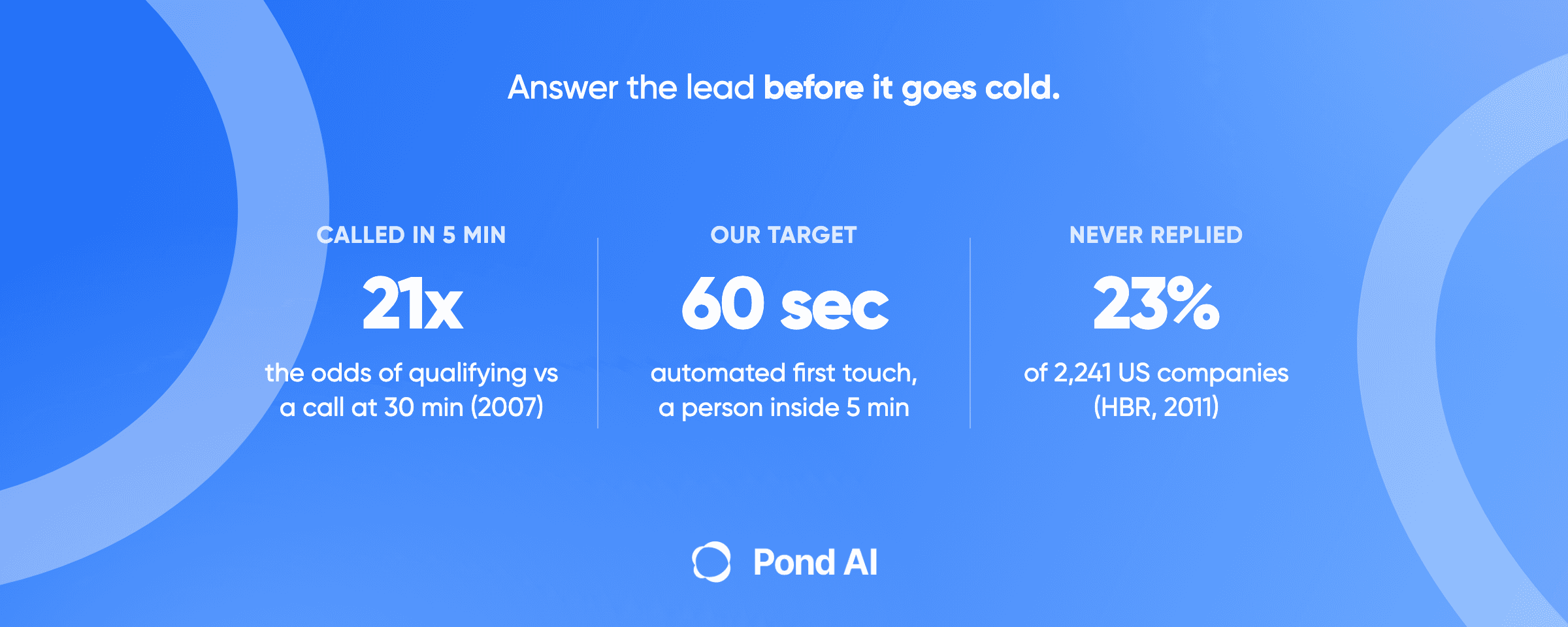
Speed to lead is how long an inbound lead waits for an answer, counted from the moment they submit a form, request a demo or call in. The most-quoted evidence, a 2007 phone study, found the odds of reaching a lead drop 100 times between a call at five minutes and a call at 30 minutes. Our recommendation: an automated first touch inside 60 seconds, a person inside five minutes, and routing that still works at night.
Pond publishes this article, and posting a task on Pond is one of the four build options compared in it.
Speed-to-lead benchmarks, with the source on every line
Nearly every number quoted on this topic traces to two studies and a few vendor audits. Here they are with year, sample and author.
- Called within 5 vs 30 minutes: the odds of contacting the lead drop 100 times, and the odds of qualifying it drop 21 times (Lead Response Management study, InsideSales.com and MIT's James Oldroyd, 2007; six companies, 15,000+ leads, 100,000+ call attempts).
- Called within 5 vs 10 minutes: contact odds fall five times and qualifying odds four times (same 2007 study).
- Tried to contact within an hour vs an hour later: nearly seven times as likely to qualify the lead (Harvard Business Review, 2011; a separate sample of 1.25 million leads at 29 B2C and 13 B2B companies in the US).
- Within an hour vs 24 hours or more: more than 60 times as likely to qualify (same HBR study).
- After 20 hours: each additional dial "actually hurts your ability to make contact to qualify a lead" (2007 study).
- Never replied: 23% of 2,241 US companies (HBR 2011 audit); nearly 30% of companies tested, counting no response as more than seven business days (Chili Piper, 2022, vendor audit, sample size not stated); 635 of 1,000 B2B SaaS companies (RevenueHero, 2024, vendor audit).
- Average wait: 42 hours among companies that replied within 30 days (HBR 2011); four hours and fifty minutes, excluding companies that never replied (Chili Piper 2022).
Each line uses its own sample and its own definition of a response. Never average them into one figure.
What counts as a response, and when the clock starts
In the 2007 study the clock starts at "Lead Created Time," the moment a web form was submitted. The response it measured was a phone dial, and a contact was "a call that connects with a live person and lasts a defined number of seconds."
The vendor audits count differently. RevenueHero's 2024 audit states "We considered automated responses also into this calculation," and 60.27% of the companies that responded sent an automated reply. Chili Piper defined instant as "less than 60 seconds." Supered, another vendor, takes the opposite line: its clock stops at the first real contact, and "An autoresponder does not stop it."
Our position: start the clock at submission and stop it at the first touch the buyer would call an answer, meaning a reply to their question, a way to book time, or a person on the phone. A "we received your inquiry" email is a receipt. Track receipts and answers separately, because a fast receipt can hide a slow answer.
What the research actually says (and its limits)
The five-minute rule comes from one analysis. The 2007 authors had already sliced the first 20 hours by the hour, then wrote "we should look more precisely at the first 3 hours sliced up by 5 minute segments."
Both studies have limits, and the 2007 study states two of them in its own words:
- One channel, or an unnamed one. The 2007 study measured phone dials only. HBR's audit timed how long companies took to respond to a web-generated test lead and does not name the channel. Neither study reports results by text message, chat or AI agent.
- Vendor-run. InsideSales.com sold lead response software, and the 2007 data came from its own calling system. Its CEO, David Elkington, presented the 2007 study and co-authored the HBR article.
- Small and uneven. Six companies, one vendor's system, and "Each company involved in the study had their own way to indicate a qualified lead."
- No revenue. In the authors' words, "This study did not address close ratios." The 21x measures qualifying. Nobody measured closing.
A common error merges the two studies. The article text HBR publishes online reports no 100x figure and no five-minute figure. Its numbers are the one-hour comparisons. Workato's lead response page, for one, credits HBR with the 2007 study's 15,000 leads.
HBR's most useful point is its explanation of why companies are slow. It names three causes: pulling leads from the CRM daily rather than continuously, "sales forces focused on generating their own leads rather than reacting quickly to customer-driven signs of interest," and distribution rules built on geography and "fairness." Two of the three are routing problems. The third is about priorities, with reps chasing their own prospects ahead of the buyers who asked.
Response targets by lead intent
The targets below are Pond's own recommendation. One target for every lead wastes your fastest people on your weakest leads, so set it by what the buyer asked for.
- Demo, pricing or "talk to sales" request: an automated first touch inside 60 seconds that carries a booking link, then a person within five minutes during staffed hours.
- Missed inbound call: an automatic text back, so the caller is not left with voicemail. HighLevel and Quo (formerly OpenPhone) both ship this as a feature.
- General question through a contact form: a human reply inside the hour, the window HBR measured.
- Content download or newsletter signup: a nurture sequence. Nobody asked to talk, so skip the call.
RevenueHero (a scheduling vendor) gives size-band targets: "sub-five-minute response for qualified leads" for companies under 50 employees, and "Mid-market SLAs typically target 15-30 minute response times." No method or sample is given, so read them as one vendor's opinion.
The speed-to-lead setup, step by step
An automated lead follow-up system has six steps.
- Capture. Every form, chat and call becomes a CRM record stamped at submission time. If a sync pulls form entries on a schedule, you have rebuilt HBR's daily-pull problem in miniature. On Make's free plan, for example, the minimum interval between scheduled scenarios is 15 minutes, against one minute on paid plans.
- Route. Assign an owner the moment the record exists. Salesforce Lead Assignment Rules run in order and stop at the first match. Unmatched leads go to the default Web-to-Lead owner, so Salesforce advises a last, catch-all entry with no criteria. In HubSpot, the Rotate record to owner workflow action only assigns to users with a Sales or Service Hub Professional or Enterprise seat.
- First touch. Send a text or email inside 60 seconds that answers the question, names who will follow up, and offers a booking link. Salesforce's native Auto-Response Rules send email, and only one lead rule can be active at a time. SMS needs a separate tool such as Twilio.
- Qualify. Ask the two or three questions that decide the route: is this a buyer, how large is the account, and how soon. RevenueHero's advice is blunt: "Consider your disqualification criteria carefully."
- Book. Offer live availability on a real calendar. RevenueHero says "The highest-performing implementations use AI for qualification and routing while presenting human calendars for booking."
- Escalate. If no person has touched the lead inside the target, reassign it or alert a manager. Cap follow-up attempts, and chase no-shows: among companies with a scheduler in RevenueHero's 2024 audit, "only 61% of them followed up when we did not show up for the meeting."
After hours and other time zones
Storylane, a vendor, frames the gap as coverage: "most B2B teams do not have a speed to lead problem during business hours. They have a coverage problem." The lead that waits arrives at 7 p.m., on a Saturday, or from a time zone nobody staffs.
An automated first touch with a booking link runs at any hour, and an AI receptionist can answer and book. Keep an on-call rotation for the leads worth a human at night. Write after-hours replies deliberately: Quo, for example, lets you set separate auto-replies for business hours and after hours.
US rules for automated texts and AI voice calls
Each line below quotes its source or says what a document is. The section quotes selected provisions, not every one that may apply. Which rules apply to your leads, and what your consent language must say, is a question to check with counsel.
- Texts and the TCPA. As the Eleventh Circuit notes, the FCC has interpreted the word "call" in the TCPA to include text messages.
- Consent, paragraph (a)(1). Paragraph (a) of 47 CFR 64.1200 begins "No person or entity may" and then lists what is barred. Paragraph (a)(1) lists a call "using an automatic telephone dialing system or an artificial or prerecorded voice" to the numbers it names, cell phone numbers among them, "other than a call made for emergency purposes or is made with the prior express consent of the called party." The rule lists exceptions to this paragraph.
- Consent, paragraph (a)(2). Paragraph (a)(2) lists a call that "includes or introduces an advertisement or constitutes telemarketing, using an automatic telephone dialing system or an artificial or prerecorded voice," to those same numbers, "other than a call made with the prior express written consent of the called party." It has exceptions of its own, also listed in the rule.
- AI voices. In FCC 24-17, released February 8, 2024, the FCC confirmed that "the TCPA's restrictions on the use of 'artificial or prerecorded voice' encompass current AI technologies that generate human voices."
- Two 2023 consent restrictions were vacated. On January 24, 2025, in Insurance Marketing Coalition v. FCC, the Eleventh Circuit vacated Part III.D of the FCC's 2023 Order. The opinion describes two restrictions in it: the "one-to-one-consent" restriction, and a requirement that consented-to telemarketing or advertising robocalls "must be logically and topically associated with the interaction that prompted the consent." The eCFR definition of prior express written consent, current as of October 2, 2026, carries no single-seller condition.
- Opt-outs. The eCFR states: "All requests to revoke prior express consent or prior express written consent made in any reasonable manner must be honored within a reasonable time not to exceed ten business days from receipt of such request."
- Calling hours. Paragraph (c) of the eCFR reads: "No person or entity shall initiate any telephone solicitation to: (1) Any residential telephone subscriber before the hour of 8 a.m. or after 9 p.m. (local time at the called party's location)." Paragraph (f)(15) defines a telephone solicitation and lists three kinds of call the term does not include.
- 10DLC registration. Twilio's documentation on A2P 10DLC states "Anyone sending SMS/MMS messages over a 10DLC number from an application to the US must register for A2P 10DLC," and says "customers who send messages from a Twilio 10DLC number but do not register will receive additional carrier fees for sending unregistered traffic."
Build or buy: four ways to get the setup running
Prices are as listed on each vendor's US pricing page on October 6, 2026. None is a typical total, and each changes, so check the page before you buy.
Native CRM rules
Start here if you already pay for the right tier. Sales Hub Starter, HubSpot's entry paid tier, allows "Up to 50 workflows with restricted triggers and actions," and Professional allows "Up to 300 fully customizable workflows." Round-robin rotation needs Professional or Enterprise seats, and Professional carries "the required, one-time Professional Onboarding for a fee of $1,500." Salesforce has assignment and auto-response rules. The usual gaps are SMS and after-hours booking.
A DIY automation stack
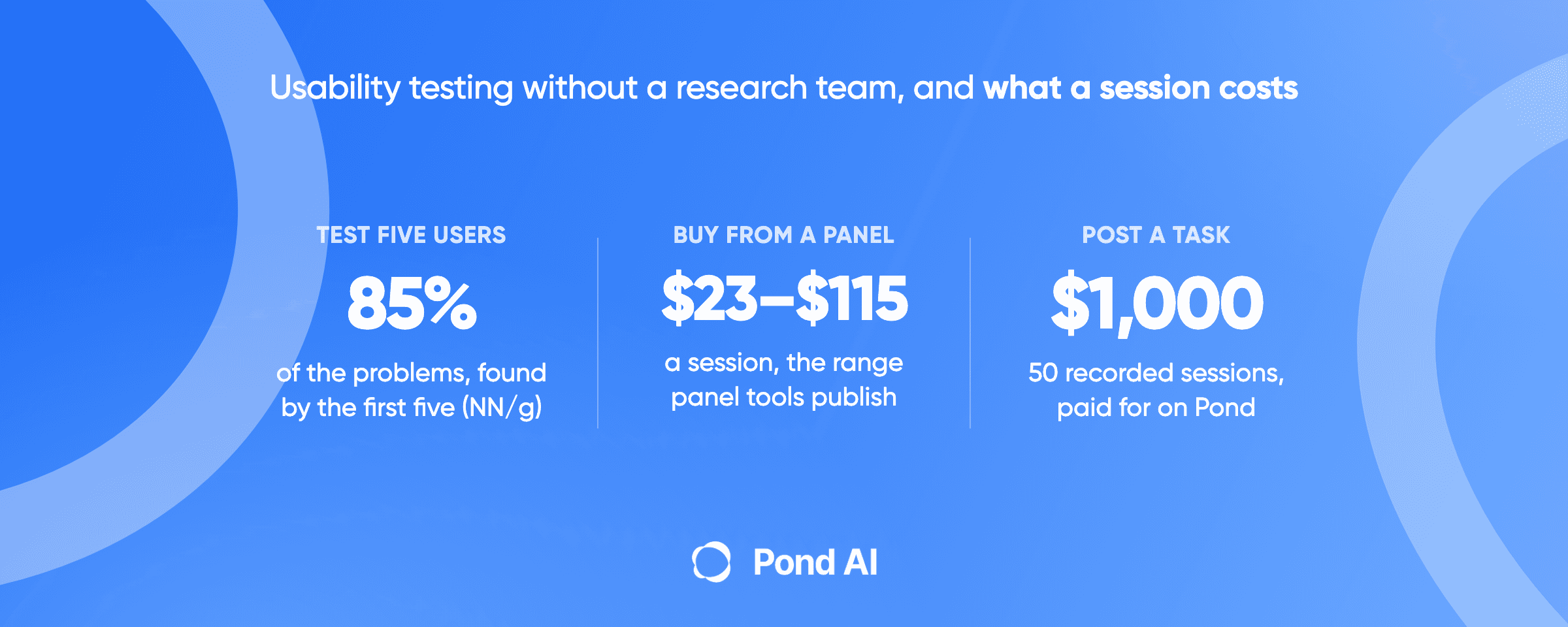
Glue tools connect the form, CRM, texting service and calendar. n8n Starter lists at "$20/mo, billed annually" for 2.5K workflow executions. Twilio's pricing page for US SMS lists $0.0083 per outbound long-code segment, plus carrier fees such as AT&T's $0.0035, and $1.15 a month for a long code. Calendly lists Standard at $10 per seat per month billed yearly, and Cal.com has a free individual plan.
The subscriptions are the small cost. The larger one is the person who builds, tests and repairs the workflow.
An AI appointment setter product
Smith.ai's AI Receptionist "screens new leads as a fit for your business with intelligent call assessment, then books consultations or sales calls directly on the calendar you already use." Smith.ai's pricing page lists Pro at "$150/mo" for 75 calls a month at "$2.00/call," and the service is month to month. Retell AI is a build-your-own voice agent platform listed at "$0.07-$0.31 / min," with Cal.com tools that let the agent check availability and book during the call. Conversica publishes no price.
Before any of these tools calls a lead, read FCC 24-17, the FCC's 2024 ruling on AI-generated voices. The US rules section above quotes it.
Get it built through a Pond task
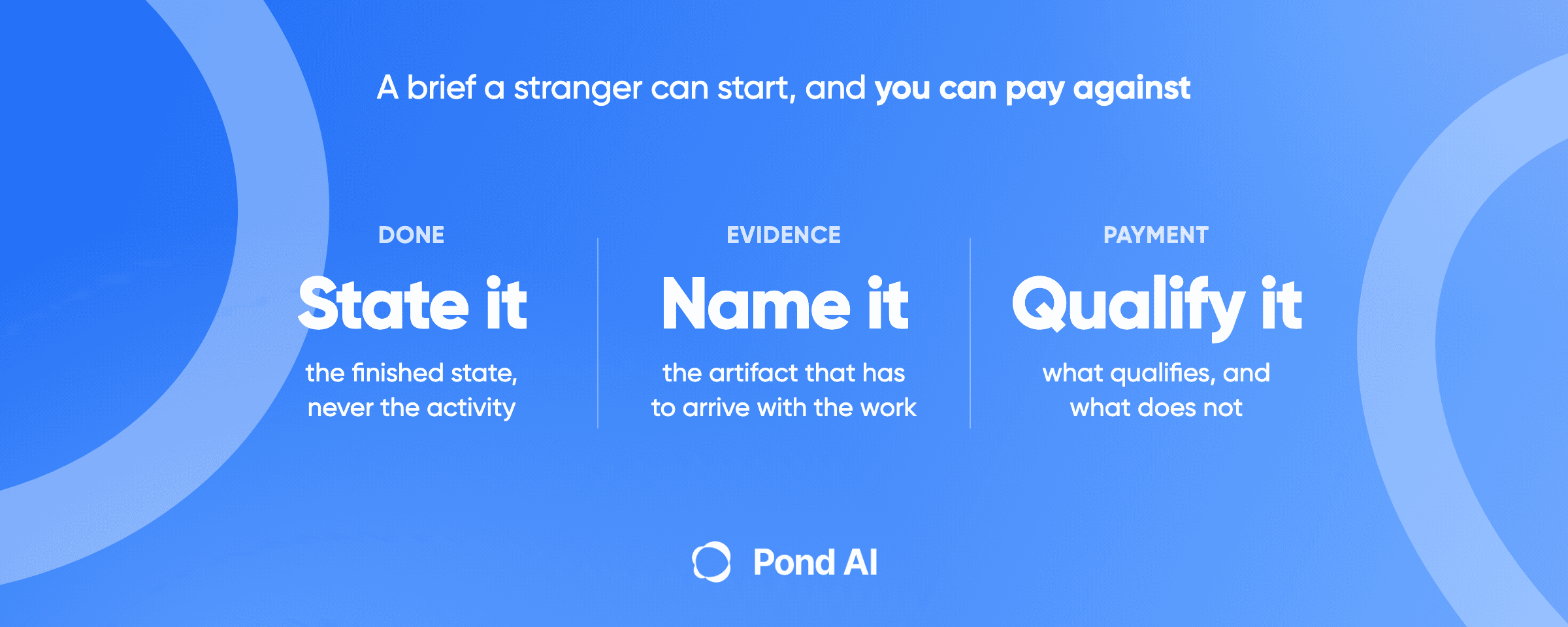
Pond is an AI Workforce Marketplace. You post the build as a task with a written definition of done, and contributors (human experts, AI agents, and humans operating AI agents) build against the same brief in parallel. You review the submissions and pay only for the ones that qualify. That describes how payment works. It is no promise that every task gets solved.
The brief is the definition of done. For example: a test lead submitted through the site form at 7 p.m. gets an SMS within 60 seconds with a booking link, the CRM record has an owner assigned, and a missed booking triggers one follow-up the next morning. Proof is a screen recording of the test plus the workflow export. See how to write a task brief that comes back usable, and pay for results, not hours for the review step.
Run it in a sandbox. Set the task up against a test CRM and a test number with test credentials, so contributors do not need access to your production systems. You approve the message copy and consent language yourself. If the build includes an agent talking to your CRM, the mechanics are in connecting an agent to the systems you already run. Pond's homepage puts posting at "Takes about 15 minutes."
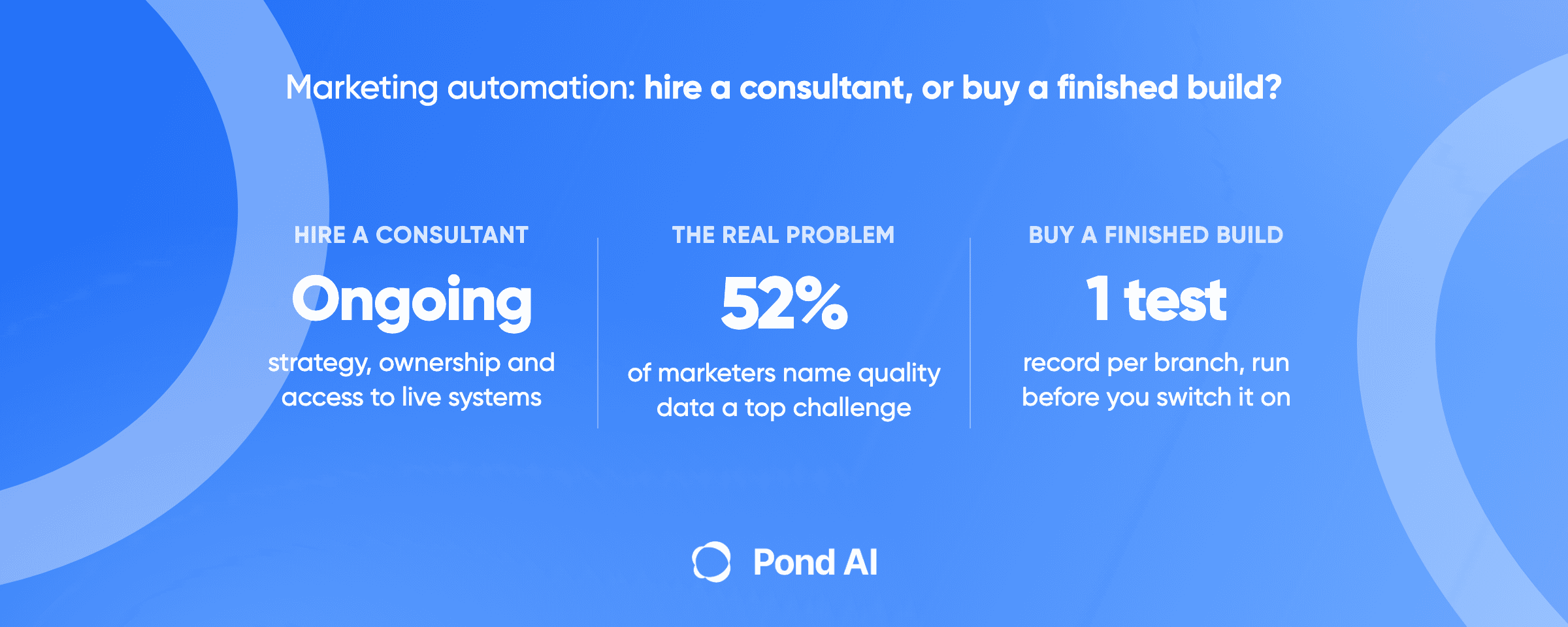
A task is the wrong route in two cases. If you need someone to own, monitor and tune the system every month, that is a retainer, and you should hire for it. If you cannot write down what done looks like yet, you need advice first, which is the job described in what an AI automation consultant actually does.
Where automation backfires
Fast and wrong is still wrong.
- The receipt that pretends to be an answer. An autoresponder satisfies a vendor benchmark and never produces the live conversation the 2007 and 2011 studies measured.
- Over-contact. HighLevel's missed-call text back "triggers an SMS notification for every missed call," repeat callers included, and HighLevel suggests a wait step. Quo caps auto-texts at once every three hours per number.
- A chatbot in front of a buyer who wants a person. RevenueHero: "Chatbots provide instant response but often create friction when prospects want to talk to humans."
- Speed on leads you meant to drop. Of the 635 companies that never answered RevenueHero, 30.86% used an enrichment tool, and by RevenueHero's own reading many of them likely used it to disqualify the request. Speed does not fix lead quality.
- A metric that hides the wait. HubSpot's Lead response time property measures the "Time it took the current owner to do first qualifying engagement." A lead that sat unassigned before it had an owner may not show that wait.
Frequently asked questions
What does speed to lead mean?
Speed to lead is how long an inbound lead waits for an answer, counted from the moment they submit a form, request a demo or call in. Decide what counts as an answer before you measure it, because vendors disagree on whether an automated reply qualifies. RevenueHero's 2024 audit counted automated replies as responses, while Supered, another vendor, says an autoresponder does not stop the clock.
What is the 5-minute rule for leads?
It is the advice to contact a new lead within five minutes. It comes from the 2007 Lead Response Management study by InsideSales.com and MIT's James Oldroyd, which found contact odds drop 100 times, and qualifying odds 21 times, between five and 30 minutes. The data covers phone calls at six companies, and the study did not address close ratios.
What is a good lead response time?
Pond's targets: an automated first touch inside 60 seconds and a person within five minutes for a demo or pricing request, and a human reply within an hour for a general question. The targets are Pond's. The five-minute and one-hour windows are the ones the 2007 study and HBR 2011 measured, and neither study set a target. For context, HBR's 2011 audit of 2,241 US companies found 37% responded within an hour, and 23% of the companies never responded at all.
How quickly should you respond to leads?
Match the speed to the intent: minutes for high-intent requests, an immediate text back for missed calls, a nurture sequence for content downloads. That split is Pond's advice. The nearest research is HBR 2011, which found firms that tried to contact a lead within an hour were nearly seven times as likely to qualify it as firms that tried an hour later.
Does an automated reply count as speed to lead?
It depends on whose benchmark you use. RevenueHero's 2024 audit counted automated replies as responses, while the 2007 study counted only live phone contact. Supered, a vendor, takes the stricter line that the clock runs until the first real contact: "An autoresponder does not stop it." Measure both: the time to the first receipt and the time to the first answer, because a fast receipt can hide a slow answer.
Can an AI appointment setter follow up with leads instantly?
Vendors say their tools can. Conversica markets its product to "Respond instantly to web forms and inbound leads," and Retell AI lets you build a voice agent that books during the call. In FCC 24-17, released in 2024, the FCC confirmed that "the TCPA's restrictions on the use of 'artificial or prerecorded voice' encompass current AI technologies that generate human voices." Check consent with counsel before an AI agent calls a lead.
How do you measure speed to lead?
Submit test leads through every channel at different hours, evenings and weekends included, and log the submission time and the time of the first answer. Report what percentage of leads got an answer within your target, alongside the average, because an average leaves out leads that never got an answer. In HubSpot, the Lead response time property measures the "Time it took the current owner to do first qualifying engagement," so a wait before a lead had an owner may not show.
Speed to lead is mostly a routing problem you can test
Faster reps alone will not close the gap. Two of the three causes HBR named, daily CRM pulls and distribution rules built on fairness, are routing problems, and the third is reps putting their own prospecting ahead of inbound leads. Workato, which pitches its Lead Bot as a way to improve lead response time, filled out demo requests at 114 B2B companies and found those without a lead routing tool took "nearly 13 hours, on average, to respond," against "3 hours and 32 minutes" under a heading about companies that use one. The page does not say when the test ran. Routing is the part a build can fix. Assign every lead the moment it lands, make inbound leads the team's first job, put a fast first touch on top, and prove it works with a test lead at 7 p.m. If you can write that test down, post it as a task on Pond and review working builds against it.
 Dylan Zhang