Short answer
Most businesses should turn on missed call text back in the phone system or CRM they already use, write one short reply and cap repeat texts. Among the tools below that send it today, entry plans run from $15 or $19 a user a month (Quo billed annually; its pricing page showed both prices on October 16, 2026) to $399 (Podium Core), and some add seats or per-text fees. If the reply has to book or answer the caller, packaged AI receptionists already do that. Get it built only when those cannot reach your systems or follow your rules.
Disclosure: Pond publishes this blog and sells custom AI agent builds. Prices are US list prices read on October 16, 2026.
The three setups, side by side
Missed call text back sends a text to a caller when their call goes unanswered. The three ways to get it differ most on what happens after the text lands.
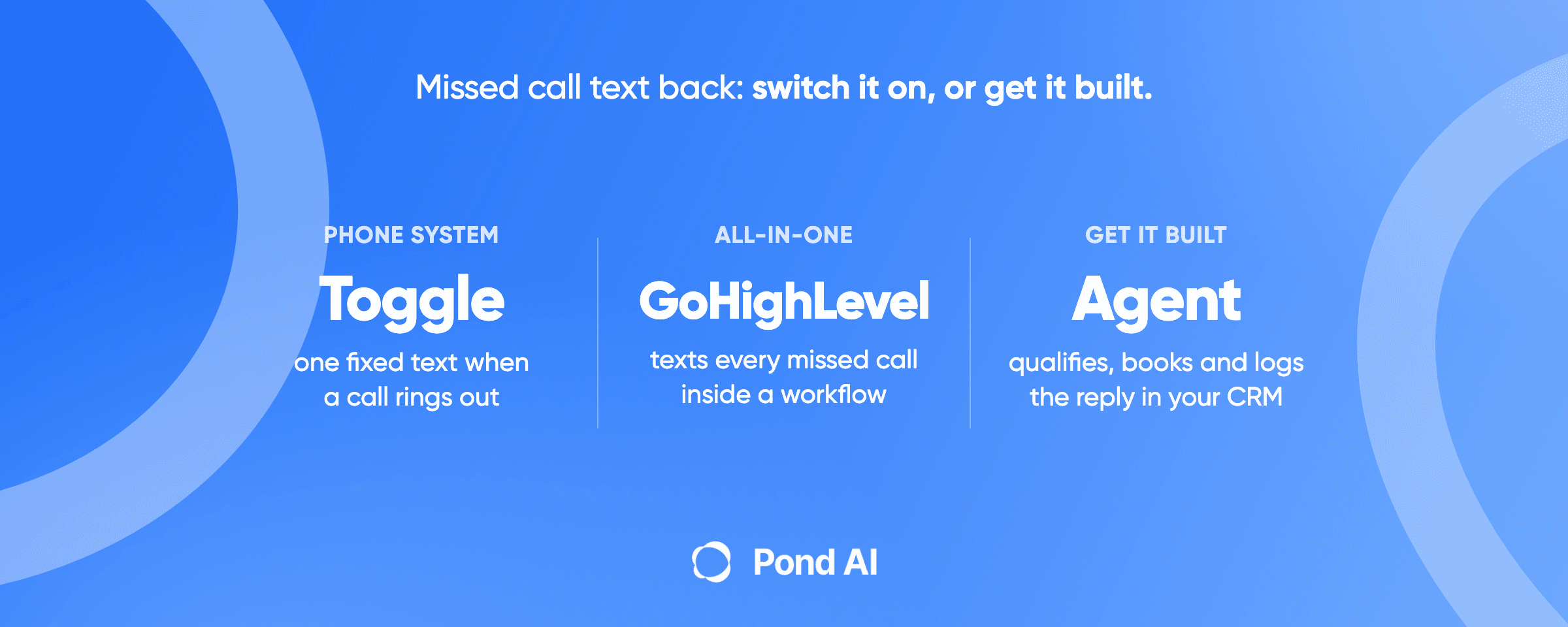
Setup 1: The feature in your phone system
- What it does: sends a fixed text when a call rings out. Quo, Allo, Weave and Podium all list it, and Quo lets you set separate wording for after hours.
- Who it suits: one location, one number, and a person who reads the replies and calls back.
- Monthly cost: Quo from $15 or $19 per user a month billed annually (its page showed both), Allo at $32 a seat (Business, billed yearly), Weave from $199, Podium from $399 plus phone seats.
- Per-text cost: depends on the provider. Allo includes sending to US numbers on Business and Ultra.
- Setup effort: a setting and a message, plus a messaging registration before texts send from a local number.
- What it can't do: answer the reply or change the text based on who called. A person works the replies unless you add an AI feature that answers messages, such as the AI Concierge that Podium lists on its Pro plan. Quo and Allo both list HubSpot and Salesforce sync on their Business plans, which on Quo is a step above Starter, so check the integration list for your CRM.
Setup 2: GoHighLevel or another all-in-one tool
- What it does: texts every missed call, from the number the caller dialed when it can, inside a workflow you can edit.
- Who it suits: a business, or an agency running several, that already keeps contacts and pipeline in GoHighLevel.
- Monthly cost: Starter is $97 a month, with $297 and $497 plans above it. Numbers and texts are billed as usage on top.
- Per-text cost: $0.00747 per segment on HighLevel's own phone system, plus carrier fees.
- Setup effort: switch it on, then edit its workflow so a repeat caller is not texted on every call.
- What it can't do: skip a repeat caller until you edit the workflow, since HighLevel says it texts every missed call, or send from a number that is not eligible to send SMS. It falls back to another eligible number, and with none the attempt fails.
Setup 3: A custom workflow or AI agent into the CRM
- What it does: detects the missed call through your phone provider's API, sends the text, then runs your process: logs the call in the CRM, checks whether the caller is a customer, asks a qualifying question, offers a booking slot.
- Who it suits: multi-location businesses, teams whose CRM the phone system does not talk to, and anyone whose reply depends on who called and when.
- Monthly cost: a local number from $1.15 a month on Twilio, plus the cost of the build and its upkeep.
- Per-text cost: $0.0083 per 160-character segment at Twilio's list price in the US, plus carrier fees.
- Setup effort: a developer or builder, your own messaging registration, and testing on real calls.
- What it can't do: skip the rules. A custom build carries the same consent, registration and opt-out duties as a packaged tool, and you own them directly.
What to text back after a missed call
Each template is under 160 characters before you fill in the brackets, so it bills as one segment. The first two leave room for a business name of 30 characters. Recount once your name and number are in.
Daytime:
[Business] here. Sorry we missed your call. Reply with what you need, or we will call you back within the hour. Reply STOP to opt out.
After hours:
Thanks for calling [Business]. We open at 8am. Reply with what you need, and we will call first thing. Reply STOP to opt out.
Urgent or trades:
[Business] here, sorry we missed your call. Emergency? Call [after-hours number]. Or reply here and we will call back today. Reply STOP to opt out.
The rules behind them:
- Name the business first. Twilio's campaign approval guide tells senders to "Make it clear who's sending the message."
- Promise only a callback time you will keep. Quo's own example promises a reply "by the end of the day."
- Stay under 160 characters. Dialpad warns that a longer auto-reply "may be split into two messages."
- Say how to opt out. CTIA's messaging principles say senders "should state in the message how and what words effect an opt-out."
- Leave out offers and links. The FCC's one-time reply ruling covers a text with "no other marketing or advertising information."
Skip the caller's first name. HighLevel's merge fields "only work if the system already recognizes the contact from a prior interaction," so a first-time caller's name will not fill in.
How missed call text back works
The trigger is a ring timeout. In HighLevel's setup guide, you choose how long the phone rings before a call counts as missed, and "10 to 20 seconds is typically recommended." Answered calls never trigger a text.
The text can come from a different number than the one the caller dialed. HighLevel falls back to another eligible number when the dialed one cannot send, as with "number pools, call tracking numbers, unverified toll-free numbers, or other numbers that aren't eligible to send SMS".
Setup 1 in detail: turn it on in your phone system
Quo (formerly OpenPhone) runs it as an auto-reply and throttles by default: "We won't send automated texts to the same number more than once every three hours." Its pricing page ticks auto-replies, which answer "texts, missed calls, or voicemails", on Starter, Business and Scale. The prices moved between loads. On October 16, 2026, five loads of the page showed Starter at $15 or $19 per user a month billed annually, Business at $23 or $27 and Scale at $35 or $36, with Starter at $28 billed monthly on every load. Check the page before you budget.
Allo ticks missed-call text-back on all three plans in its plan table, Solo included. Solo, at $10 a seat a month billed yearly, shows no outbound SMS and is not open yet ("Solo opens soon"), so in practice a text-back starts on Business at $32 a seat billed yearly or $45 monthly, where sending to US numbers is included.
Weave, aimed at healthcare practices, lists Missed Call Texting from $199 a month. Podium ticks Missed Call Automation on Core ($399 a month), Pro ($599) and Signature (custom), under Podium Phones, an add-on at $30 per user a month for one to four users and $25 for five or more.
We found no documented missed-call text-back on two big phone systems. Dialpad's auto-reply answers texts, and the Google Voice help page we found for missed calls covers notifications. Quo, a competitor, says Google Voice offers no API or third-party app integrations. On those two, the choice is a new phone system, setup 2 or setup 3.
RingCentral sits in between. The request "Auto reply SMS to missed calls" has sat on its ideas board since March 25, 2021, with 148 votes and a status of Planned. But a RingCentral developer tutorial builds one in Workflow Builder, with a "Call missed" trigger, a "Send SMS" action and a limit on repeat texts per caller.
Setup 2 in detail: GoHighLevel
GoHighLevel's plans start at $97 a month with a 14-day free trial. Its own phone system bills a US text at $0.00747 per segment, which HighLevel describes as a 10% discount on Twilio's $0.0083 list price.
The default needs one change. HighLevel's guide warns that the feature texts every missed call, "even if the same caller tries multiple times within a brief timeframe." Its fix is to edit the workflow recipe, for example to "add a 20 +/− minute Wait step", or to tag first and second calls. Keep at least one number verified and able to send, or the attempt fails and shows in the conversation with a reason.
Setup 3 in detail: a custom workflow into the CRM
Here a number on an API provider such as Twilio forwards calls to wherever you answer, and your code sends the text when the forwarded leg ends unanswered. Twilio's Dial reference reports that result as DialCallStatus, and a text-back keys on no-answer, busy and failed. If calls forward to a personal mobile whose voicemail picks up, the call may read as answered. Twilio's reference does not say, so test it.
Everything after the send is code you control, which is the reason to build. CRM integration services compares the ways to connect a tool to your CRM, from a native connector to custom API work, with what each costs and how to test it before go-live, and API integration covers connecting the phone provider to the rest of your stack.
One step up, an AI agent answers the call itself. The AI Receptionist from Allo is $32 a month per agent billed yearly and lists answering calls, booking appointments, sending the follow-up text and updating your CRM. Allo notes under its add-ons: "Pricing is early and can still change." Quo includes 1,000 automation credits, or 10 calls, on every plan, with paid tiers from $25 a month for 40 calls. A custom agent earns its higher price only when those cannot reach your systems or follow your rules (AI agent integration explains what connecting one involves).
What missed call text back costs, in one place
US list prices, read on October 16, 2026. Check before you buy.
- Software plans: Quo from $15 or $19 per user a month billed annually (the page showed both), Allo at $32 a seat on Business billed yearly or $45 monthly, GoHighLevel from $97 a month plus usage, Weave from $199, Podium from $399 a month plus $30 per phone seat for one to four users or $25 for five or more.
- Per text: $0.0083 per 160-character segment at Twilio's list price in the US, or $0.00747 on HighLevel's phone system.
- Carrier fees: Twilio's example is AT&T at $0.0035 and T-Mobile at $0.0045 per outbound text. A reply can cost too: Twilio's long-code table lists inbound SMS fees for AT&T, T-Mobile and US Cellular, and HighLevel's adds Verizon.
- Failed texts: Twilio charges $0.001 for each message that ends in a failed status.
- Numbers and calls: $1.15 a month for a local number on Twilio or HighLevel, and HighLevel bills both legs of a forwarded call. Podium's phone add-on lists "a $500 network optimization fee per location."
- A2P 10DLC, at Twilio's pass-through rates: a one-time brand fee of $4.50 for Sole Proprietor and Low Volume Standard brands, or $46 for Standard. A $15 campaign vetting fee, non-refundable. A monthly campaign fee of $2 for Sole Proprietor, $10 for Standard, or $1.50 for low-volume mixed. Approval takes up to five business days for standard use cases. Allo bundles this as $24 one-time, Quo as $19.50 one-time plus $1.50 to $3 a month, Podium as $5 a month per US location.
As a worked example, one text to a T-Mobile number at Twilio's rates costs $0.0083 plus a $0.0045 carrier fee, before any reply. The texts are cheap. The software, the registration and the time spent on replies are where the money goes.
The rules that bite: consent, registration and STOP
No source treats a missed call as consent
Texts count as calls: asked in FCC 15-72 whether texts get the same protection, the FCC answered "We reiterate that they are." The rule at 47 CFR 64.1200 bars autodialed calls to mobile numbers without prior express consent, and the Supreme Court narrowed what counts as an autodialer in Facebook v. Duguid in 2021.
Nothing we read says a missed call is consent to a text. The FCC's one-time reply ruling applies "only when the on-demand text message has been expressly requested by the consumer in the first instance," and the case it ruled on began with a consumer's text. CTIA's messaging principles treat a quick single reply as conversational when the consumer texts first. A call is not a text, so a missed-call text fits none of CTIA's categories cleanly, and an offer pushes it toward promotional, where CTIA says the consumer "should agree in writing to receive promotional texts." State law can be stricter: Florida's Telephone Solicitation Act counts a text that solicits a sale as a telephonic sales call.
Registration asks how the recipient opted in
Carriers require A2P 10DLC registration to send from a local number, and unregistered traffic draws extra carrier fees. The campaign form asks for "a clear description of the opt-in method(s) you use to collect consent", and Twilio's examples are a website checkbox, a signature, a text opt-in, or an agent asking on a live call. A missed call has none of those.
STOP has to work
The federal rule lists stop, quit, end, revoke, opt out, cancel and unsubscribe as valid ways to revoke consent by text, honored within a reasonable time "not to exceed ten business days." One confirmation is allowed, with no marketing in it, and one sent within five minutes is presumed covered. CTIA adds that nothing should follow it. Florida gives a sender 15 days to stop text solicitations after a STOP reply.
Calling hours
The federal rule bars telephone solicitations, texts to mobile numbers included, before 8 a.m. or after 9 p.m. at the recipient's location. Its definition excludes messages sent with prior express invitation or to someone with an established business relationship. Florida's window for commercial solicitation calls closes at 8 p.m. Whether an after-hours text-back is a solicitation depends on what it says.
Send this to your own counsel
Give your lawyer the exact text, the hours it sends, the states you serve and your registration's opt-in description. The consent wording is their call, and your phone vendor cannot make it for you.
What the missed-call statistics do and do not show
The most-quoted figure, that about 62% of calls to small businesses go unanswered, traces to a 2016 forum post by 411Locals on Moz. It describes "a small study with 85 businesses", counts calls that reached voicemail as unanswered, and says nothing about callbacks or texts. The claim that 40 to 50 percent of callers reply to a text, against 10 to 20 percent who return a voicemail, has no study behind it that we could find.
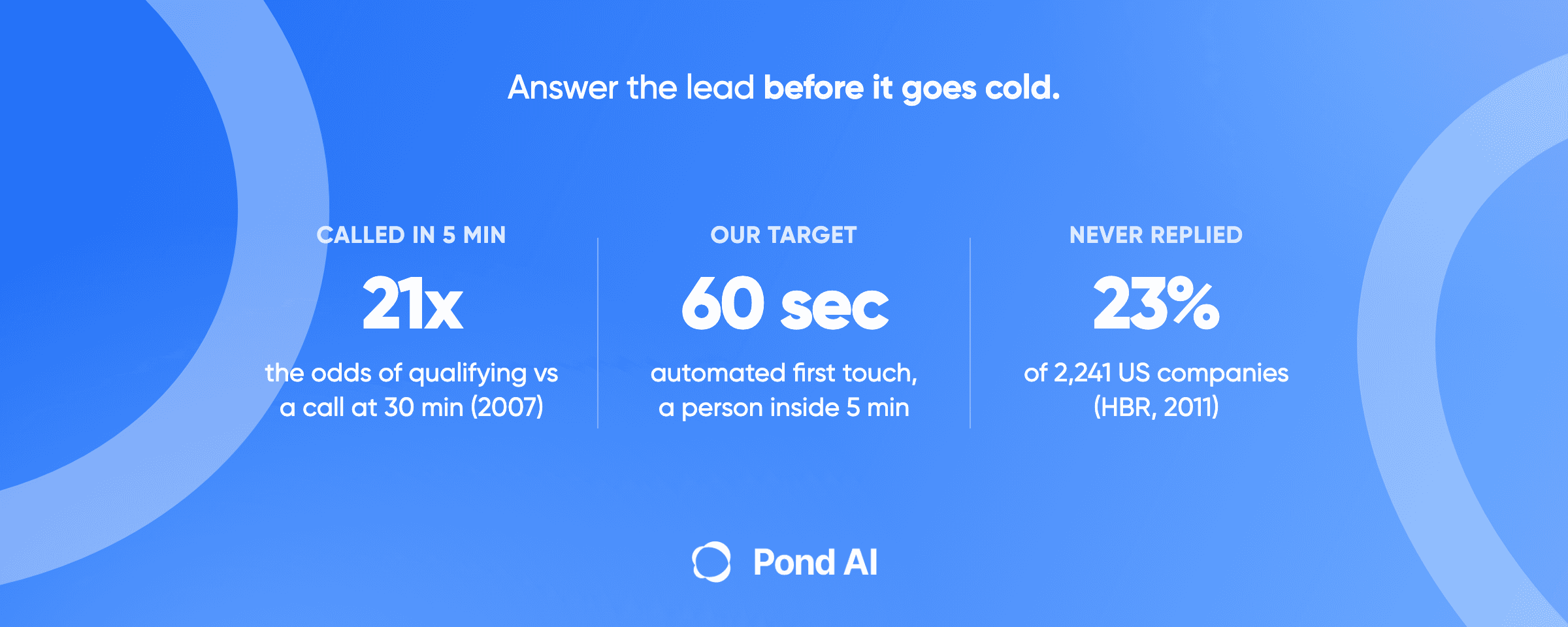
The best callback data we found is one vendor measuring its own customers. Quo's analysis of 16.7M missed calls found "69% of missed business calls don't get a callback within 48 hours." That measures whether the business called back, and Quo sells the fix. For research on how fast a lead needs an answer, see Speed to Lead.
When to have it built
Run the numbers with your own data, because no published benchmark fits your business.
- Missed calls a month, from your phone system's call log.
- Share that are new leads, leaving out customers and spam.
- Share of those a text wins back, which you learn only by tracking replies for a few weeks.
- Close rate and average job value, from your own records.
Multiply them for what the text is worth a month, then compare that with setup 1's cost and a build's. If setup 1 captures most of the value, stop there.
A build earns its cost when one of these is true:
- The CRM needs the record. Your phone system cannot log missed calls and replies where your team works.
- The reply depends on who called. A customer, a new lead and a supplier need different texts.
- You run more than one location. Each branch needs its own routing, hours and callback promise.
- Repeat callers get spammed. A fixed cap like Quo's three hours, or HighLevel's wait step, does not match how your customers call.
- The text needs to do work. Ask a qualifying question, offer a booking slot, or hand a hot lead to a person in minutes.
None of those true? Use the feature in the phone system you already pay for.
Where Pond fits
Pond is setup 3. Its homepage says "Pond builds, runs and maintains custom AI agents for businesses," and two of its example agents are the work that follows a missed-call text: "qualifying every new inbound lead and routing the best fits to your team" and "keeping your CRM, inbox and spreadsheets in sync." The terms, in its words: "Custom AI agent builds start from $1,000, usually take 1 to 2 weeks," and "Custom builds by the Pond team are refunded within 7 days if benchmarks aren't met."
That refund is only as good as the benchmark. Before you book, write down what done means, such as every reply logged on the right CRM record and a booking slot offered to each new lead. Ask which benchmark the build is tested against, and whether 10DLC registration, carrier fees and number rental are in the build or yours.
Then do the sum: a build starts at $1,000, and the Starter plan on Quo costs $180 or $228 a year per user billed annually, depending on which price the page shows you. Only the work in the five triggers closes that gap, so if none applies, Pond is the wrong spend. AI agent development covers what such builds cost and what decides the result.
If one does, book a 30-minute Custom Agent Consultation. Tell Pond what the missed-call reply has to achieve. In the booking page's words, "We'll learn your use case, understand your goals, and map out a custom AI agent for your business."
Frequently asked questions
What to text back after a missed call?
Name your business, say you missed the call, promise a callback time you will keep, and invite a reply. Keep it under 160 characters so it bills as one segment, add opt-out wording such as "Reply STOP to opt out", and leave out offers and links. The FCC's one-time reply ruling covers a text with no other marketing in it, and Twilio's campaign guide asks senders to make clear who is sending.
Can GoHighLevel text back missed calls?
Yes. GoHighLevel has a built-in Missed Call Text Back setting, and its plans start at $97 a month, with texts billed as usage on top. By default it texts every missed call, including repeat calls from the same person, so add a wait step or first-call and second-call tags in its workflow. Keep at least one number verified and able to send, or the attempt fails and shows in the conversation with a reason.
Is there a free way to auto text back a missed call?
Only as a workaround on a personal phone. Quo's autoresponder page points to a free Android app called SMS Auto Reply and to the iPhone's Driving Focus, and calls that route limited and "not a good fit for companies that want to text customers at scale." The business tools offer trials instead: GoHighLevel 14 days, Allo seven days and Quo a free trial, and GoHighLevel says usage fees may apply even during its trial.
Is missed call text back legal?
No regulator or industry guideline we read treats a missed call as consent to a text. Texts count as calls under federal rules, and carrier registration asks how recipients opted in. Where the federal revocation rule applies, a STOP request must be honored within a reasonable time not to exceed ten business days, and CTIA says nothing should follow the confirmation. Have your own counsel review the exact wording before launch.
Why did my missed call text back send twice?
HighLevel's built-in setting texts on every missed call, even when the same person calls several times in a row, while Quo caps automated texts at one every three hours per number. A wait step or a repeat-caller check stops it, and RingCentral's Workflow Builder tutorial sets a per-caller limit on its "Call missed" trigger.
How much does missed call text back software cost?
At US list prices, Quo starts at $15 or $19 per user a month billed annually (its pricing page showed both on October 16, 2026), Allo at $32 a seat on Business billed yearly (the first open Allo plan that sends texts), GoHighLevel at $97, Weave from $199 and Podium from $399 a month plus phone seats. On Twilio or HighLevel, texts add $0.0083 or $0.00747 per segment, plus carrier fees.
Missed call text back or an AI receptionist?
A text-back acknowledges the call and leaves the follow-up to a person. An AI receptionist answers, books and logs. The AI Receptionist from Allo is $32 a month per agent billed yearly, a price Allo says is early and can still change, and Quo includes 10 calls of AI agent work on every plan, with paid tiers from $25 a month for 40 calls. Choose the receptionist when nobody can return calls quickly, and a custom agent when neither tool can reach your systems.