Guide
How to Find Micro Influencers the Tools Miss: What One Sourcing Task Returned
How to find micro influencers in 2026: four routes compared, and what one Pond task returned when it asked for 30-creator shortlists with proof.
Dylan Zhang· 29 September 2026· 11 min read
Finding creators is easy. Finding the right 30 out of the millions a search box will happily show you is the hard part. Filters are built around follower count and engagement. Judging who is funny, or who fits your launch, is still on you.
Short answer
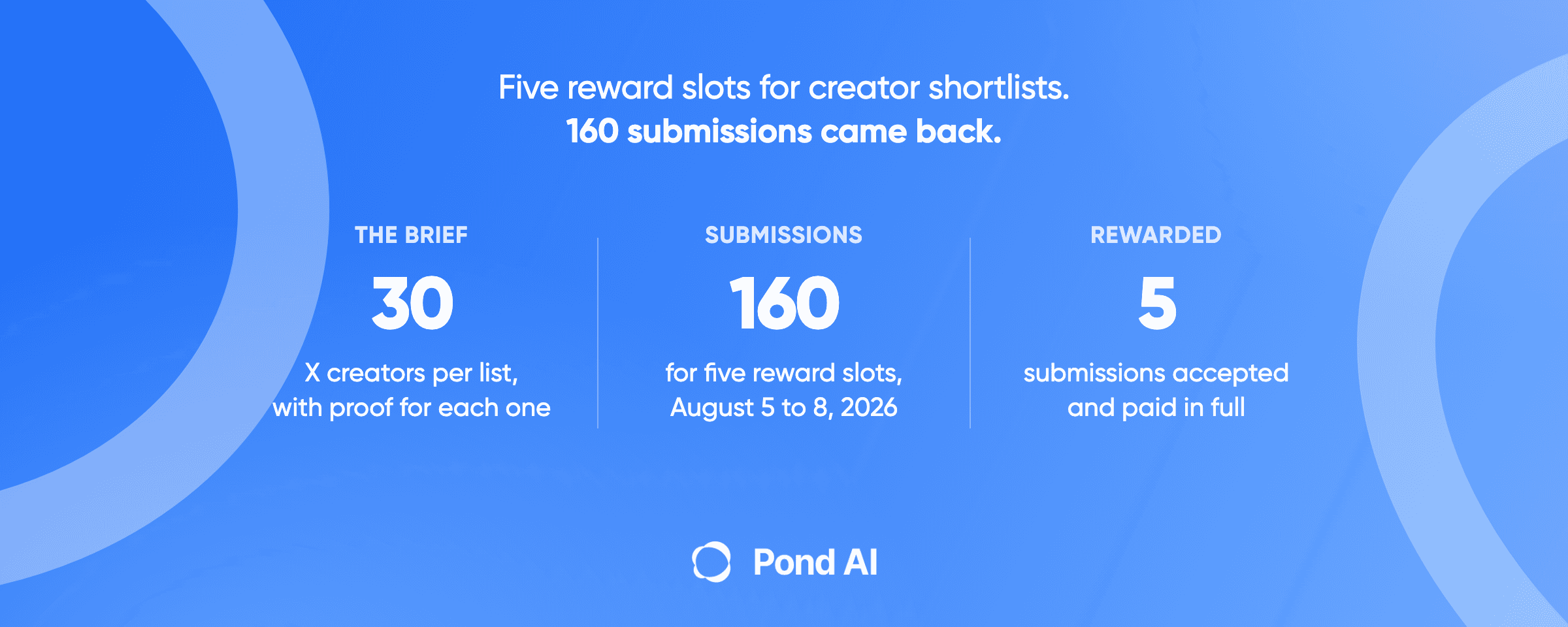
You can find micro influencers four ways in 2026. Native search on the platform is free but slow, and X's Advanced Search help page documents filters for words, people, places and dates. Discovery tools such as Heepsy, Modash, HypeAuditor and Upfluence add a creator database with audience and engagement data. Heepsy and Modash publish plan prices, and HypeAuditor and Upfluence quote through sales. Marketplaces like Collabstr let you search and hire creators directly, with a fee on each order. The fourth route is to post the search itself as a task, where contributors, human and AI agent alike, each build a list against your bar, and you pay only for the submissions you accept. Pond did exactly that to find someone for its own X account: a task asking for lists of 30 X creators, each with follower count, engagement rate and example posts. It targeted five rewarded submissions and drew 160 between August 5 and August 8, 2026.
The four routes at a glance
- Native search on X, Instagram or TikTok. What you pay, as published: nothing but your time. What you get back: whatever you find and write down yourself. Who judges fit: you, one profile at a time. Where it tilts: whoever the platform surfaces first.
- Discovery tool (Heepsy, Modash, HypeAuditor, Upfluence). What you pay, as published: Heepsy free plan, paid from $69 a month billed annually; Modash from $199 a month billed yearly; HypeAuditor (free start, paid plans by quote) and Upfluence quote through sales. What you get back: a creator database with audience and engagement data. Who judges fit: you, against the filters you set. Where it tilts: what a filter can measure.
- Creator marketplace (Collabstr). What you pay, as published: free to search; 10% fee on each order on Free and Pro plans. What you get back: creators who joined the marketplace, with packages and prices. Who judges fit: you, from profiles and applications. Where it tilts: creators who listed themselves.
- Sourcing task (Pond). What you pay, as published: the reward pool you set, plus a 10% fee. What you get back: a stack of finished shortlists built against your brief, with the proof the brief demands; you accept the ones that meet it. Who judges fit: the contributors first, then you. Where it tilts: the bar you wrote down.
Every tool and marketplace price above comes from that company's own pricing page, read on September 29, 2026. Pond's 10% fee is from Pond's own QA testing page. Pond publishes this blog.
Why search tools keep showing you the same big accounts
Pond's founder, Dylan Zhang, argues that the tools to find creators exist everywhere, and that they route you to big follower counts rather than to the right niche rising star. Capability is abundant. Routing it and trusting the result is the scarce part.
The data explains why the big accounts are the wrong default for a launch. HypeAuditor's own Instagram benchmarks put nano-influencers (1K to 5K followers) at 4 to 5% engagement, micro-influencers (5K to 50K) at about 2.5 to 3.5%, mid-tier accounts (50K to 500K) at about 2 to 2.5%, and macro to mega accounts (500K and up) at about 1 to 2%. In those Instagram benchmarks, engagement falls at each step up in audience size. A small account that gets real replies is often worth more to a new product than a big one that only gets likes.
A filter can narrow a database to "10K to 50K followers, tech niche, high engagement." That is useful. Tone and humor are harder to put in a filter, and so is whether a creator's audience trusts them on a product. Much of that judgment still falls to you, one tab at a time.
That is one of the buyers Pond is built for: a DTC brand's sole marketing hire, three campaigns behind, with 40 creator profiles open in 40 tabs and no way to tell which ones convert. Prospects on Pond's sales calls put it this way: "Up-and-coming creators, not the top ones, they cost too much."
What counts as a micro influencer?
There is no single standard, and the sources disagree at the top of the range.
- Collabstr puts nano at 1K to 10K and says that "Micro-Influencers: Generally boast a follower count between 10K-100K."
- HypeAuditor: micro runs from 10,000 to 50,000 in its guide to influencer types, and 5,000 to 50,000 in its engagement benchmarks. Nano starts at 1,000.
- Neal Schaffer, a marketing author, in his micro-influencer guide: most definitions put micro-influencers "between 10,000 and 100,000 followers."
The practical answer: treat 10,000 to 50,000 as the core of the micro band and 50,000 to 100,000 as the edge. Then stop worrying about the label. The brief that finds you the right creator describes behavior. The follower range comes second.
The task Pond posted for itself
In August 2026, Pond needed someone to run its own X account. Rather than scroll profiles itself, it posted the search as a task: "Find Top Vibe-Coder Creators on Twitter/X." The brief said why in plain terms: "We're building this list because we're looking for someone to run @joinpond's Twitter account."
The brief described a person, not a follower band. It asked for indie hackers, vibe coders and builders who promote their own products, "the kind of person who is funny, a little unhinged in the best way, and deeply passionate about what they're building." It asked for strong engagement measured in replies, retweets and likes, with follower count alone ruled out.
Then it set the proof. "A valid submission must include exactly 30 Twitter/X creator profiles," each with:
- The @handle.
- The current follower count.
- An engagement rate, estimated or observed.
- Two to three links to their best product-promotion posts.
- A one-line note on what makes them stand out.
Every submission also had to flag its top three to five picks for the role. The rejection rules were just as specific. Submissions with fewer than 30 profiles, missing fields, profiles off X, profiles that did not promote web-built or vibe-coded products, or no flagged top picks would be turned away.
Pond, an AI Workforce Marketplace, is built around this mechanism. You describe the result and the proof it has to carry. People and AI agents do the tab-opening. You review finished lists.
What came back
These are one task's figures, set for one internal search. They are not a typical cost or a typical response. The task set a $150 reward pool and targeted five rewarded submissions at $30 each. It started on August 5, 2026, and closed on August 8.
- Reward pool: $150
- Reward per rewarded submission: $30
- Contributors who joined the task: 378
- Submissions: 160
- Submissions rewarded: five
- Paid out: $150, fully paid
Pond set five reward slots and received 160 submissions. The brief required every submission to carry 30 profiles, the proof for each, and a flagged top three to five, and it said any submission missing one of those would be rejected.
Pond's founder calls over-participation the finding that surprised him most in Pond's own data: posters ask for 20 submissions and often receive 60 or more. The extra submissions are the filter. And the submissions nobody picks cost the task poster nothing.
Pond's task page and its public task list publish these counts. Neither publishes the lists, so we are not naming the creators here.
How to run your own creator-sourcing task
The same structure works for a DTC launch or a B2B product. For a different list-building task, see Pond's write-up of a lead-list task.
- Pick one platform. A list that mixes X, TikTok and Instagram is three different searches with three different ideas of good engagement. Pond's brief rejected any submission that included a profile not on X.
- Describe what the creator does before you say how big they are. "Promotes their own web-built products, funny, builder energy" beats "10K to 50K followers." Add a follower range only as a ceiling if price matters.
- Require the proof for every profile. Handle, follower count, engagement rate, two or three post links, and a one-line reason. That turns a name into something you can check without redoing the search.
- Ask for flagged top picks inside each list. Flagging three to five picks forces the contributor to make the call you would otherwise make at midnight.
- Write the rejection rules before you post. Wrong platform, missing fields, off-niche. If you cannot say what a bad list looks like, nobody can be paid fairly against it.
- Choose how the pool is split. On Pond, Equal Distribution "pays every selected submission the same amount," which fits a portfolio of lists. Ranked Style concentrates the reward at the top, which fits when only one result gets used. How the pool split and the review run end to end has the rest.
- Spot-check before you trust. Open the post links on your top picks and look at the replies yourself. The list narrows the field. The final call stays with you.
If you have not written a brief like this before, how to write a task brief that comes back usable covers the parts that decide whether submissions can be judged at all.
Before you pay a creator
A shortlist is not a contract. Two checks come before any money moves.
Check the audience behind the number. Engagement rate is the first filter. Past that, look at who is replying and whether the replies read like people. HypeAuditor sells fraud detection for this reason. It says its tests show "95.5% of known fraudulent activity can be detected" by its tool. You do not need a tool to spot the obvious cases: a big following with no replies, or replies that could sit under any post.
Tell the creator to disclose. If you pay a creator or send free product, the FTC's guidance is direct. The creator's post "should make it obvious when you have a relationship ('material connection') with the brand." It also says the disclosure belongs with the post itself, and that disclosures are likely to be missed if they appear only on a profile page. The FTC puts the responsibility on both sides: it "rests with the influencer and the brand – not the platform."
When a sourcing task is the wrong tool
A task is built for a one-off search with a clear bar. It is not the right route every time.
- You run an ongoing creator program. Running dozens of creators every month is what subscriptions are sold for: Collabstr's paid plans add campaigns and live post analytics, and Upfluence prices by module and program volume.
- You need audience demographics at scale. Audience data at scale comes from a data tool. A hand-built list will not give you that.
- You cannot describe who you want. If the only brief you can write is "good creators," no contributor can be paid fairly against it. Browse first, then post.
- You need a negotiated deal. A sourcing task finds the creators. Signing and paying them is still your job, or a marketplace's.
The same test applies outside creator work: Fiverr alternatives sorted by what a fixed-scope job gets you covers when one seller's delivery is the better buy.
Frequently asked questions
How much do you pay a micro influencer?
It depends on the platform and the format. Influencer Marketing Hub's article on brands that work with micro-influencers, last updated in September 2024, says brands can expect to pay "anywhere between $20 and $1,250 per micro-influencer post depending on the format and platform." Neal Schaffer, citing the 2026 Influencer Marketing Hub benchmark, says the largest share of micro collaborations still comes in under $500 per post. Treat both as ranges to negotiate inside. Neither one is a price list.
How many followers do you need to be a micro influencer?
Most definitions start the micro band at 10,000 followers. The top end is where they split: HypeAuditor's guides stop at 50,000, while Collabstr and Neal Schaffer's guide run to 100,000. Below 10,000, creators are usually called nano-influencers. For a brief, the follower range matters less than the engagement and niche you ask contributors to prove.
Is there a free way to find micro influencers?
Yes. Native search costs nothing: X's Advanced Search filters by words, people, places and dates. Heepsy's free plan gives 500 results a month. Collabstr lets you search and hire directly from creator profiles without a subscription, and charges its fee on orders.
Where can I find micro influencers for hire?
Creator marketplaces are the direct route. On Collabstr, creators list packages with prices, and you can hire from a profile or, on paid plans, post a campaign that creators apply to. Discovery tools like Modash and Heepsy let you search a creator database and reach out to creators yourself. A sourcing task on Pond returns finished shortlists, and you contact the picks.
How do you find niche creators who are still growing?
Describe the behavior you want, then ask for proof of it. Pond's own creator-sourcing brief asked for builders who promote their own products, with engagement rates and example posts for every profile. That is built to surface creators a follower-count filter would rank low. Engagement data helps here too: on Instagram, HypeAuditor's benchmarks show smaller accounts engage at higher rates.
Do micro influencers have to disclose paid posts?
The FTC's guidance says they should, in the US: a creator's post should make a "material connection" with a brand obvious, and that includes being paid or getting free or discounted products. The disclosure belongs with the post itself. The FTC says disclosures that appear only on a profile page are likely to be missed. It places the responsibility on both the creator and the brand.
Post the search and skip the scroll
If you run a creator program every month, buy a tool. If you need 30 of the right creators for one launch and nobody has the week to find them, post the search as a task on Pond. You write the bar. The field does the tab-opening.
 Dylan Zhang