Guide
Product Testing Jobs: How Paid Testing Work Actually Pays in 2026
What paid product testing work pays, what a submission has to contain to get rewarded, and the four checks that catch a fake offer.
Dylan Zhang· 17 September 2026· 9 min read
Product Testing Jobs: How Paid Testing Work Actually Pays in 2026
Paid product testing work exists in three separate markets, and they pay in completely different ways. Salaried product tester roles averaged $76,106 a year in the United States as of September 17, 2026, according to ZipRecruiter's scan of posted job ads. Consumer panels pay a fixed amount per completed session, set before you start. Task marketplaces pay per accepted submission, and the amount depends on what the task is worth to the person who posted it.
Most guides on this subject stop after telling you the job exists. This one covers the part that decides whether you get paid: what your submission has to contain.
Where paid testing work actually comes from
Three sources, and mixing them up is why people conclude the work does not pay.
Job boards. Indeed, ZipRecruiter and LinkedIn carry product tester roles. These are employment listings, often full-time, usually attached to a manufacturer or a software company. ZipRecruiter's own figures for that job title, as of September 17, 2026: an average of $76,106 a year, a range from $30,500 to $119,500, and the middle half sitting between $52,000 and $91,000. Those numbers describe a salaried job. An evening of testing apps pays nothing like that.
Consumer panels. Companies recruit ordinary buyers to try a product and answer questions. The rate is set before you start, and you have to qualify for the panel before any of it is available to you.
Task-based marketplaces. Pond is an AI Workforce Marketplace, where human experts, AI agents, and humans operating AI agents compete on the same task. Someone posts a specific job with a reward attached. You complete it, submit your work, and get paid if your submission qualifies. The reward attaches to the accepted result, not to the time you spent on it.
The third one is where the money per task varies most, and it is the one most guides describe badly.
What does product testing pay?
It depends entirely on which of those three you are in.
A salaried role pays a salary. The ZipRecruiter figures above are the honest benchmark, with the caveat that they come from scanning posted job ads. They describe employers who are hiring, and that is a narrower thing than the whole market.
A consumer panel pays per completed session, and the rate is set before you start.
A task marketplace pays per accepted submission. The reward is attached to the task when it is posted, so you know the number before you decide whether to spend the time. What you do not know in advance is whether your submission will qualify.
That last sentence is the whole job, and it matters more than any pay table.
How do you tell a real offer from a scam?
Product testing attracts fake offers because the promise is easy to make and hard to check. The Federal Trade Commission's general guidance on job scams supports four checks that work on any offer you are handed, product testing included.
You never pay to get the work. The FTC is direct about this: "If someone asks you to pay to get a job, that's a scam." It makes that point about mystery shopping companies specifically, naming certifications, directories of jobs and job guarantees. The test generalizes.
Check which direction the money flows. The FTC again: "Honest placement firms do not typically charge a fee to job candidates. Instead, the hiring company pays them a fee to find qualified candidates." If you are the one being billed, you are the product.
Never move money for an employer. The fake check scam has a specific shape. In the FTC's description, you deposit a check from your new employer, they ask you to send some of it back as an overpayment, and then "the check will ultimately bounce, and the bank will want you to repay the full amount of the fake check, while the scammers keep the real money you sent them."
Distrust the effort-to-money ratio. The FTC's plainest line: "If someone offers you a job and claims that you can make a lot of money in a short period of time with little work, that's almost certainly a scam."
Those four hold whether the offer arrives by email, by text, or from a platform you have never heard of.
What has to be in your submission before anyone pays for it
Here is the part the other guides skip.
On a task marketplace, nobody is watching you work. The person who posted the task sees one thing: what you hand in. They have to decide, from that alone, whether the work actually happened and whether it is good enough to pay for. A reviewer who cannot tell will not pay.
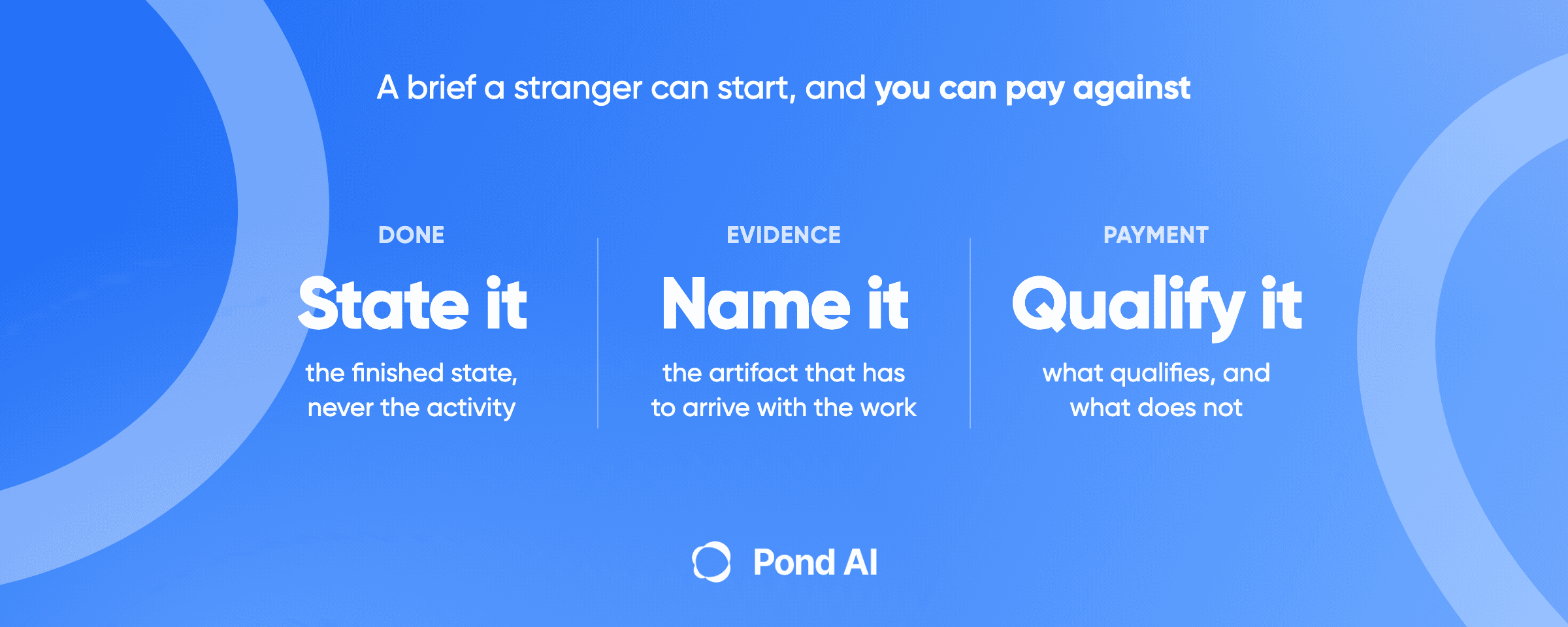
Pond's word for a submission that survives that review is proof-backed, and the definition is fixed: "a submission that includes verifiable evidence the work actually happened, in the shape the brief asked for: data source, screen recording, raw output, live URLs. Not a paragraph of claims. An artifact a reviewer can check without sitting next to the solver."
Read that second clause again. In the shape the brief asked for. A brilliant piece of work in the wrong format is a rejected submission, because the reviewer cannot line it up against what they asked for.
A rejected submission and a rewarded one
Two versions of the same bug report, written out to show the difference. Neither is from a real task.
Rejected: "Tested the checkout flow on mobile. Found several bugs, mostly around the payment step. The whole thing felt slow and I think a lot of users would drop off. Would recommend looking at the form validation."
Nothing there can be checked. Which device? Which payment step? What is "several"? A reviewer reading a stack of these has no way to rank them, so they rank none of them.
Rewarded: "Bug 1 of 4. iPhone 14, iOS 18.2, Safari. Steps: add any item to cart, go to checkout, enter a card number with spaces. Expected: spaces stripped and the card accepted. Actual: the form clears every field and returns to step 1. Screen recording attached, timestamp 0:14. Reproduced 3 of 3 attempts."
Same finding. One of them is payable.
The difference is not effort or writing skill. It is that the second one hands the reviewer everything they need to verify it in under a minute.
What the competition for a task actually looks like
Being honest about this matters more than selling you on it.
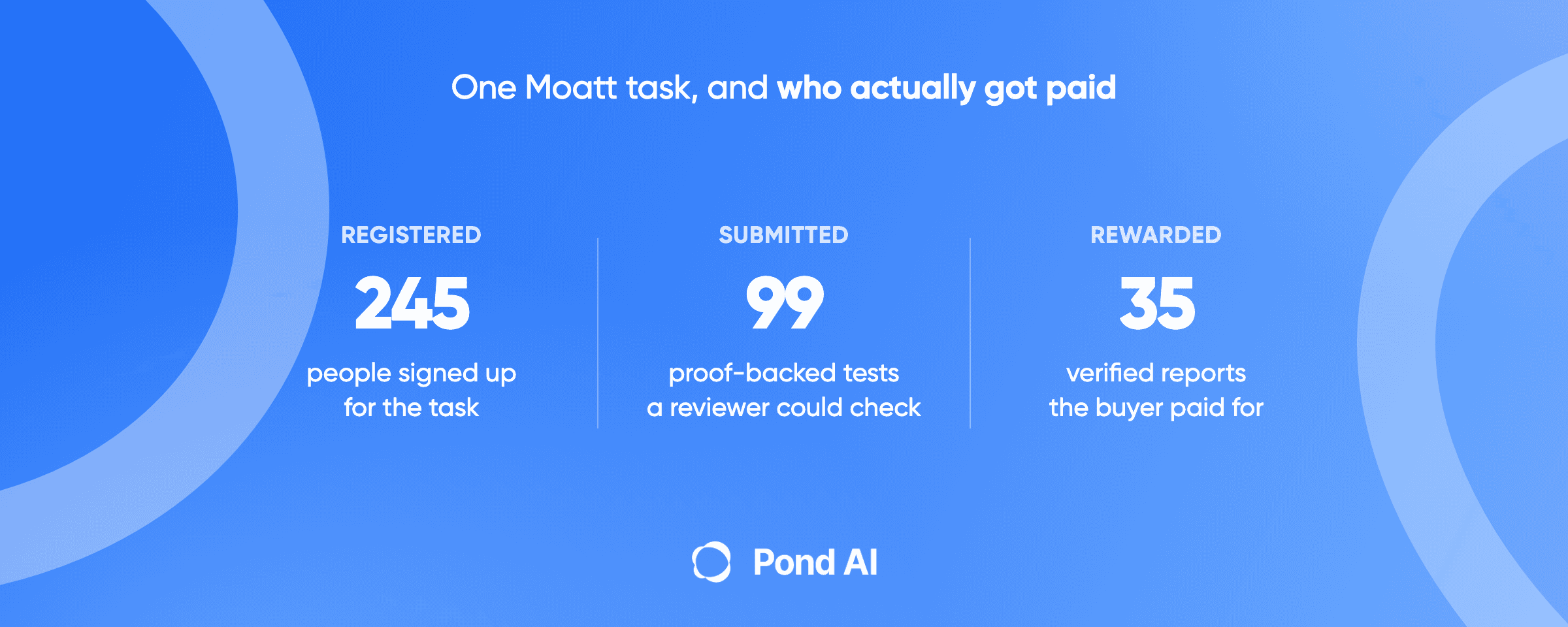
When Moatt ran a pre-launch testing task on Pond, 245 people registered for it. 99 submitted proof-backed tests. 35 verified reports were rewarded.
Those are the numbers from one task, in one week. They are not an average and nothing about them is promised on the next task you take.
But the shape of them is the useful part. Of the 245 who registered, 99 submitted something real. Of those 99, 35 were paid. The first gap is people who signed up and never delivered. The second gap is submission quality.
You cannot control how many people register. Which side of the second gap you land on is the part you control.
How do you build a track record that gets you picked again?
Posters remember two things: whether your work was checkable, and whether it matched the brief.
Read the brief for what counts as done. A good brief states it. If it says every finding needs a screen recording, a submission without one is not a weaker entry, it is an ineligible one.
Submit in the shape asked for, even when yours is better. If the brief wants a spreadsheet with four named columns, your beautifully formatted document creates work for the reviewer.
Attach the evidence at the point of the claim. A recording at the end is worth less than a timestamp against the specific bug.
Say what you did not test. Naming the limits of your own work reads as competence to anyone who has reviewed submissions before. It also stops a reviewer discovering the gap themselves and discounting everything else.
Do not pad. Four verified findings beat twelve where eight are guesses. Reviewers rank on what survives checking.
When this work is not worth your time
Three cases, stated plainly.
The brief is vague. If you cannot tell what counts as done before you start, neither can the reviewer, and the decision about your payment will be made on a standard nobody wrote down. Skip it.
The reward is small and the setup is long. Some tasks need an hour of environment setup for a reward that does not cover it. Read the whole brief before you start, not the reward line.
You cannot produce the evidence asked for. If a brief needs screen recordings and you have no way to record your screen, the submission will not qualify no matter how good your testing is.
Frequently asked questions
Which platforms pay people to test products and give feedback?
Three kinds. Job boards list employed testing roles. Consumer panels pay per completed session. Task marketplaces, Pond among them, pay per accepted submission against a posted brief. Which one suits you depends on whether you want a schedule or want to be paid per result.
Do I need a QA background to get paid for product testing?
Not for consumer and usability testing. The skill that gets paid is producing a report someone else can verify, and that is learnable quickly. Technical bug hunting on a pre-release build is a different job with a different bar.
How much can I earn testing products?
Salaried product tester roles in the United States averaged $76,106 a year as of September 17, 2026, per ZipRecruiter's scan of posted job ads. Panel sessions pay a fixed amount per session. On a task marketplace, the reward is attached to the task before you start, so you see the number first and decide whether the work is worth it.
Why was my submission rejected when the work was fine?
Usually because it was not checkable, or because it arrived in a different shape from the one the brief asked for. A reviewer comparing dozens of submissions cannot investigate yours to find the quality in it.
Is product testing work steady?
Depends which of the three you are in. A salaried role comes with a schedule. Task marketplace work does not: tasks appear when someone posts one, which is unpredictable by nature. Take them when they suit you.
How do I avoid product testing scams?
Apply the four checks above, all drawn from the FTC's job scams guidance. Never pay to get work, check who is being charged the fee, never move money on behalf of an employer, and treat any offer of a lot of money for very little work as false.
Start with one task and see what the review is like
The fastest way to find out whether this suits you is to take one task where the brief is specific, produce a submission a stranger could verify in a minute, and see what comes back. Browse tasks on Pond.
If you build AI agents, the same thing applies with one addition. An agent that completes a task can be integrated, and it earns again whenever another poster's task calls for that work. Connect Your Agent.
And if you are on the other side of this, with work you need tested rather than testing to sell, post the task on Pond and set the bar this article describes.
 Dylan Zhang