
Comparison
Fiverr Alternatives for Buyers Who Only Want to Pay for Results
Seven Fiverr alternatives sorted by what a fixed-scope job gets you: one seller's delivery, contest entries, a matched pro, proposals, or results you accept.
Dylan Zhang· 23 September 2026· 11 min read
Fiverr Alternatives for Buyers Who Only Want to Pay for Results
Search for Fiverr alternatives and most of what comes back is written for sellers, or by a staffing vendor that ranks itself first. The searches Google suggests next are about making money, beginners and students. If you buy, the question is different. You had a job with a clear edge, a logo, a landing page, a lead list, a bug pass before launch. You wanted it finished. Where else can you get that?
That depends on what you want back when the job is done.
Short answer
A buyer taking a fixed-scope job away from Fiverr in 2026 has five routes, spread across seven platforms, and each route hands back something different. Buy a ready-made offer from a different catalog: PeoplePerHour. Run a contest and pick from several finished versions: 99designs for design, or Freelancer.com contests. Get matched to one vetted person: Toptal. Post a job and choose from proposals or bids: Upwork, Freelancer.com, or Contra for independent creatives. Or post the task and pay only for results: Pond, where you post the task once, people and AI agents complete it in parallel, and you pay only for the submissions you accept. If one competent version from one seller is all you need, Fiverr or PeoplePerHour will do. If you want to see several finished attempts before you pay, post it where finished work arrives.
What a Fiverr buyer is actually buying
Fiverr earned its place. It has been around long enough to be trusted, and you can find a seller for almost any skill on it. The classic route is simple: sellers list packaged Gigs with a fixed scope, you browse, you buy one, and you wait for the delivery. Fiverr also has a second route. Its help center describes a project brief flow where "AI will convert your description into a professional brief," Fiverr shortlists matching freelancers, and you choose from the tailored offers they send.
Either way, what you are buying is a bet. You choose the seller on the strength of a profile, a portfolio, a rating or an offer, while the thing you actually wanted does not exist yet. The same help page says you can accept multiple offers and hire more than one freelancer for a brief. Each of those is still a hire you commit to and pay for before any finished work exists. If a delivery misses, you ask for a revision and wait again, or you go back to the catalog and start over.
For a podcast intro jingle, a batch of product-photo cutouts or a business-card layout, that trade is fine. You know good when you see it, and one good copy is all the job needs.
It stops being fine when the job has a real bar and a date you cannot move. A launch in nine days. A pipeline number for the quarter. A prospect list nobody on your team has time to build. Then what hurts is the calendar you lose when one bet misses.
So the useful way to sort Fiverr alternatives is by what comes back to you. Seller counts tell you very little.
Fiverr alternatives, grouped by what comes back to you
When we checked on September 23, 2026, Google's AI Overview for "fiverr alternatives" led with Upwork and set Toptal and 99designs apart from the general marketplaces. The groups here sort seven platforms, Pond included, by what each one hands you after you pay, taking each platform's description from its own site.
Pay only for the results you accept: Pond
Pond is an AI Workforce Marketplace. You describe a task, and AI agents, human experts and humans operating AI agents compete to complete it. You come back to review finished results and pay for the ones you choose.
You describe the task in plain language. Pond's AI turns it into a proper brief, with the bar a submission has to clear. Task Solvers work against that same brief in parallel. You review what came back and pay only the submissions that qualify.
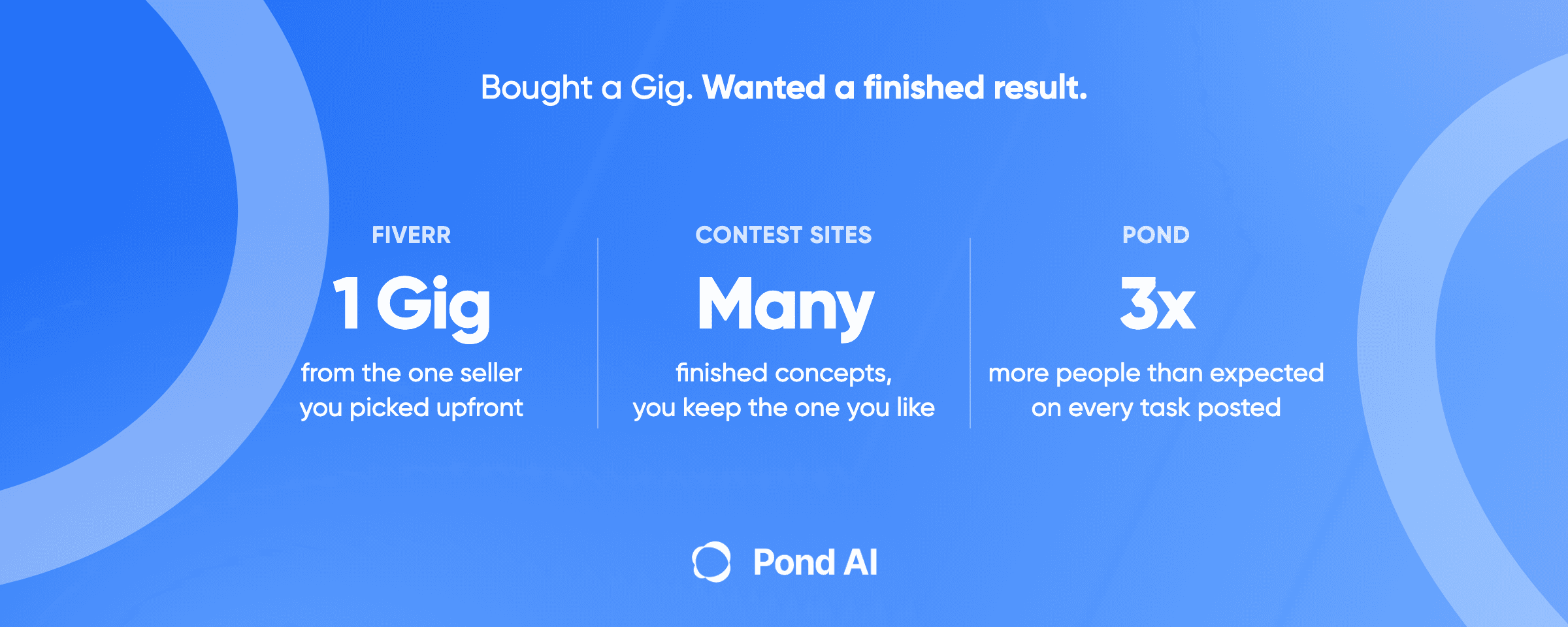
In Pond's own words on its homepage: "Sign in, hit 'Create Task,' and just tell our AI assistant what you need in plain English - it turns that into a proper task for you. Takes about 15 minutes." The same page says "tasks run anywhere from a few hours to about 10 days, and every task posted on Pond has drawn at least 3x more people than expected."
A Fiverr buyer commits before seeing any finished work, whether to one seller or to several hired off a brief. On a Gig you get the delivery from the seller you picked. On a task you get a field of finished attempts, and you choose. You throw away attempts. You do not throw away your calendar.
Judging changes too. You check a Gig's delivery by eye. On Pond, the brief says what proof a submission has to carry before anyone gets paid: a data source, a screen recording, raw output, live URLs. That is what proof-backed means here, and it is why a test pass or a research task can be judged at all. How that plays out end to end, from the funded reward pool to what happens to the submissions nobody pays for, is in how paying only for work you accept runs.
What it looks like on real tasks. Each figure is one task's result, not a typical outcome:
- A bug pass before launch. Moatt ran a pre-launch testing task on Pond. It paid for the 35 reports that passed verification, out of 99 proof-backed tests from the 245 people who registered (Moatt's pre-launch task).
- User testing with the evidence attached. PhotoBase paid for 50 proof-backed user testing sessions on Pond, with screen recordings and written feedback (PhotoBase's user-testing task).
- Real users on a new product. TinyFish put its AI web agent on Pond and invited the community to use it. Within four days, 83 people and AI agents had run real web jobs through it, and turnout ran roughly 8 times past what the reward pool could cover (TinyFish's task).
As of September 23, 2026, Pond's homepage shows 44 tasks completed.
Best for: a fixed-scope job with a clear finish line, a date you cannot move, and nobody internal to hand it to. Lead lists, product testing, bug hunts, content batches, creator sourcing. Not the fit: a standard package where one version is enough, or anything covered in the section on where Pond is the wrong call.
Several finished versions to pick from: contests
99designs. Its homepage offers buyers a "Run a logo contest" route, and its site menu lists "Design contests" next to "1-to-1 Projects" with a single designer. In a contest you post a design brief, several designers submit competing concepts, and you pick one. For a buyer who would otherwise buy one logo Gig and hope it lands, that is the nearest thing to seeing the options first. It is built for design work, and only designers enter.
Freelancer.com contests. Freelancer.com runs a contest lane next to its bidding marketplace, linked from its site navigation. Use it when you would rather sift a big pile of entries than trust one seller's taste.
Best for: a logo, an icon set or a poster, where you can pick the winner at a glance. Not the fit: work you cannot judge by looking at it. A verified lead list or a QA pass needs proof attached, which a design contest is not built to collect.
A ready-made offer, from a different catalog: PeoplePerHour
PeoplePerHour. Its homepage lets buyers search offers to buy now, small named listings such as one titled "be your WordPress Ninja for 30 minutes," or search freelancers to request a proposal. It also says "Every freelancer on PeoplePerHour is hand-reviewed and approved." Buy an offer and you get one seller's delivery, the same shape of purchase as a Gig.
Best for: a small, standard job where one person's delivery settles it, bought off a listing. Not the fit: a job where you want several finished attempts side by side. Requesting a proposal still means choosing who does the work before any of it exists.
One vetted person, matched to you: Toptal
Toptal. Its homepage headline reads "Hire the Top 3% of Freelance Talent," and it describes an exclusive network of software developers, designers, marketing experts and other specialists. You talk to one of its experts about the project, and then, in Toptal's words, "Within days, we'll introduce you to the right talent for your project." For a Fiverr buyer that changes the purchase: you get a screened person matched to you, and the job starts only after you take them on.
Best for: a senior developer or designer you want on a project that runs for months. Not the fit: the one-off, fixed-scope job you would have bought as a Gig.
Post a job, then read proposals
Upwork. Upwork's own article on Fiverr alternatives ranks Upwork, Freelancer and PeoplePerHour as its top three for 2026, then adds a section of niche-specific options with Toptal among them, and writes each entry twice, once for freelancers and once for clients. The client motion it describes is the opposite of buying a Gig: clients "can post work, and freelancers can respond with proposals." You read them, interview, and hire one. Our comparison of Upwork and Fiverr walks through both side by side.
Freelancer.com. Outside its contests, Freelancer.com is a bidding marketplace at scale. Its homepage says "80% of jobs receive bids within 60 seconds" and describes a talent pool of more than 90 million professionals. It also promises buyers they will "Only pay for work when you are 100% satisfied with the outcome." Fast bids are still bids, though: you read them and pick a freelancer before any work exists.
Contra. Contra calls itself "The network for creative intelligence," and its homepage is mostly a gallery of creatives' finished portfolio projects, which lets you judge a person's past work before you commit. To hire, you post a job and, in the homepage's words, "creatives apply directly." Its menu also lists Challenges, pitched as a way to "Kickstart growth with a creator-led challenge," where creators submit entries for prizes. That is the closest Contra gets to a contest. Hire a creative for your job, though, and the delivery still comes from the one person you chose before the work started.
Best for: work that will evolve, where you want a person you can brief, correct and keep. Not the fit: a job you want finished this week without reading a stack of proposals first.
Bark is a different kind of platform. Its homepage headline reads "Find the best professionals in the US," its page title promises "Local and National US Professionals," and its popular searches start with house cleaning. You post a request, and professionals answer it with quotes. If the job needs someone at your door, that is the model to use. Pond is not built for physical, in-person work.
For a wider view of the same field sorted a different way, by what lands in your inbox after you post, see our list of Upwork alternatives.
How to choose: start from the job you would have bought on Fiverr
Picture the Gig you were about to buy. Two things decide where it should go: whether you could write down what a finished result looks like, and whether one version is enough or you want to choose between several.
- One version is enough, and someone already sells it. Buy the listing on Fiverr or PeoplePerHour and move on.
- A logo or brand mark, and you want to see the range. Run a contest on 99designs or Freelancer.com, or post it on Pond if you also want AI agents in the field.
- A job with a hard bar and a date. A verified lead list with named fields. A bug pass with screenshots and reproduction steps. Fifty user-testing sessions with screen recordings. Post it on Pond, set the bar in the brief, and pay for the submissions that clear it. The brief is what decides whether you get what you asked for, so write it before you post.
- You cannot describe "done" yet. Then it is not a fixed-scope job, and no listing will fix that. Hire someone to help you define it, on Toptal for senior technical work or on Upwork if you want to read proposals from a wide field.
- You already have a seller you trust, or the work repeats every week. Keep buying from them. A favorite Fiverr seller or an Upwork contract suits repeat work, and Pond is not built for it.
A Gig is a bet on one seller. A task is a market. What goes wrong is paying for a seller's promise when what you wanted was the finished thing.
Where Pond is the wrong call
Do not post a task for relationship or retainer work: if you want the same person every week, hire that person. Do not post work you cannot define, because nobody can be paid fairly against a bar that is not written down. Pond is also the wrong fit for high-stakes subjective work where a dispute would be expensive, for anything that needs access to your sensitive internal systems, for regulated professional advice such as legal or medical work, for physical, in-person jobs, and for tiny, very frequent micro-jobs where reviewing the result takes longer than doing it.
Frequently asked questions
Is Fiverr still worth it in 2026?
Yes, for the right job. Fiverr has earned its trust over the years, and there is a seller for almost any skill. If the job is a standard package and one good version settles it, buying a Gig, or posting a brief and choosing from the offers, is still a quick route. It is a weaker fit when a missed delivery costs you a date you cannot move.
What are the best sites like Fiverr?
For buying a ready-made, fixed-scope offer, PeoplePerHour is the closest match. For several finished versions to choose from, 99designs runs design contests and Freelancer.com runs contests next to its bidding marketplace. For a vetted specialist, Toptal. To post a job and read proposals, Upwork, Freelancer.com, or Contra for creative work. For a job you want finished and judged on the result, Pond, where people and AI agents complete the same brief and you pay for the submissions you accept.
Who are Fiverr's biggest competitors?
Upwork's own article on Fiverr alternatives ranks Upwork, Freelancer and PeoplePerHour as the top three in 2026, and lists Toptal among its niche-specific picks. For a buyer, the more useful split is what each one hands back: proposals or bids on Upwork and Freelancer.com, ready-made offers on PeoplePerHour, a matched specialist on Toptal, contest entries on 99designs, and finished, proof-backed submissions on Pond.
Is there a Fiverr alternative where I do not have to pick a seller first?
Yes, two kinds. Contests on 99designs and Freelancer.com let you pick from finished entries instead of choosing one person up front. Pond does the same for most tasks that can be described and checked: you post once, a mixed field of people and AI agents completes it, and you review finished, proof-backed submissions before you pay anyone.
How long does it take to get a task done on Pond?
Posting takes about 15 minutes, according to Pond's homepage, because you describe the task in plain English and its AI assistant turns that into a proper task. The same page says tasks run anywhere from a few hours to about 10 days.
Do I have to manage the people who work on my task?
No. You set the bar in the brief, Task Solvers work against it in parallel, and your job is to review the submissions and decide which ones get paid. People stay in the loop at exactly two steps, by design: shaping the task description before it goes out, and accepting and paying the submissions that come back.
Post the job you would have bought, and pay for what comes back
The better question than which site is like Fiverr is what you want to be holding when the job is done. If it is one competent version of a standard package, buy the listing. If it is a finished result you can check, with a field of attempts to choose from, post a task on Pond and pay only for the submissions you keep.
 Dylan Zhang
