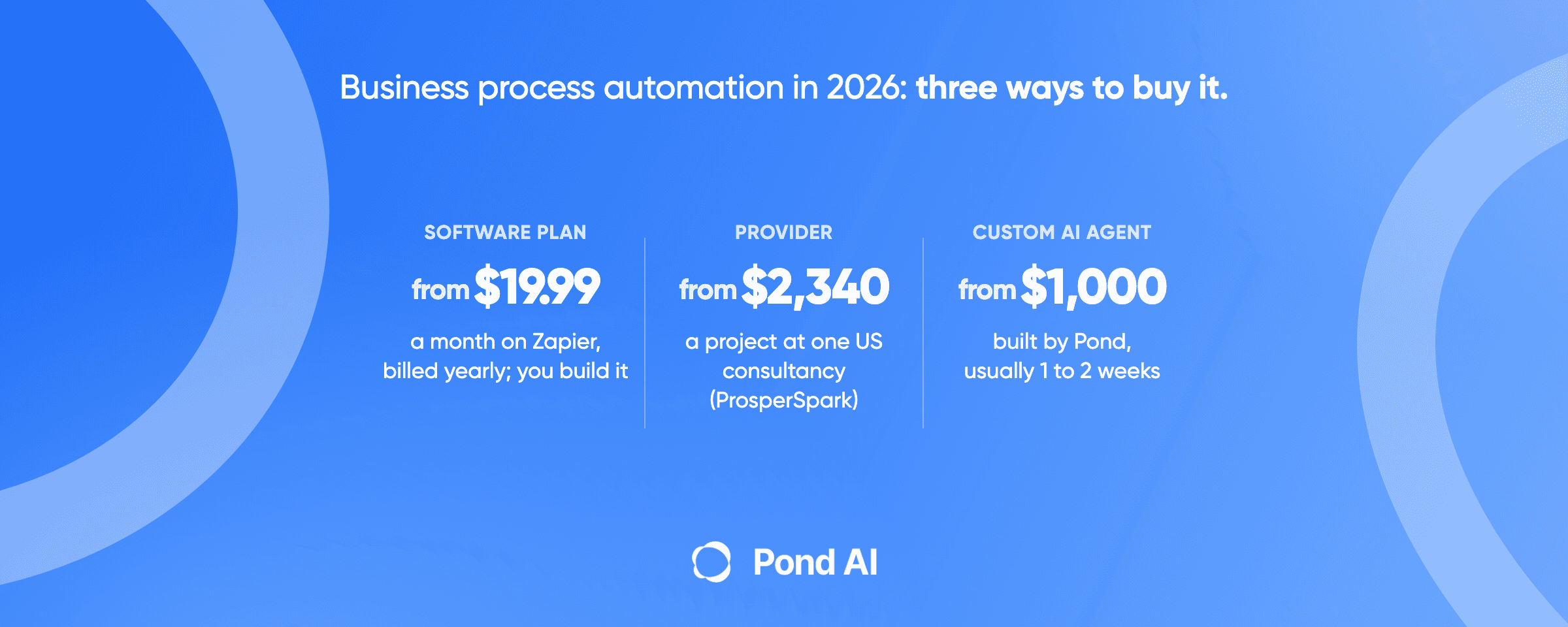
Short answer: Business process automation services come in three routes. You build on a software plan: Zapier lists Professional from $19.99 a month billed yearly, and n8n lists Starter at 20€ a month billed annually. You hire an outside provider: ProsperSpark lists projects from $2,340. Or you have a custom AI agent built for you, which Pond lists from $1,000. Prices were read on November 24, 2026. Before you pick a route, check what your current tools already automate, then rank your processes with the four-question score below and start with the one that scores highest.
Pond builds custom AI agents. The routes below are laid out by what each one asks of you, and each price carries its billing period and its source.
What does each route cost and ask of you?
| Route | What you pay (read November 24, 2026) | What it asks of you | Best when |
|---|---|---|---|
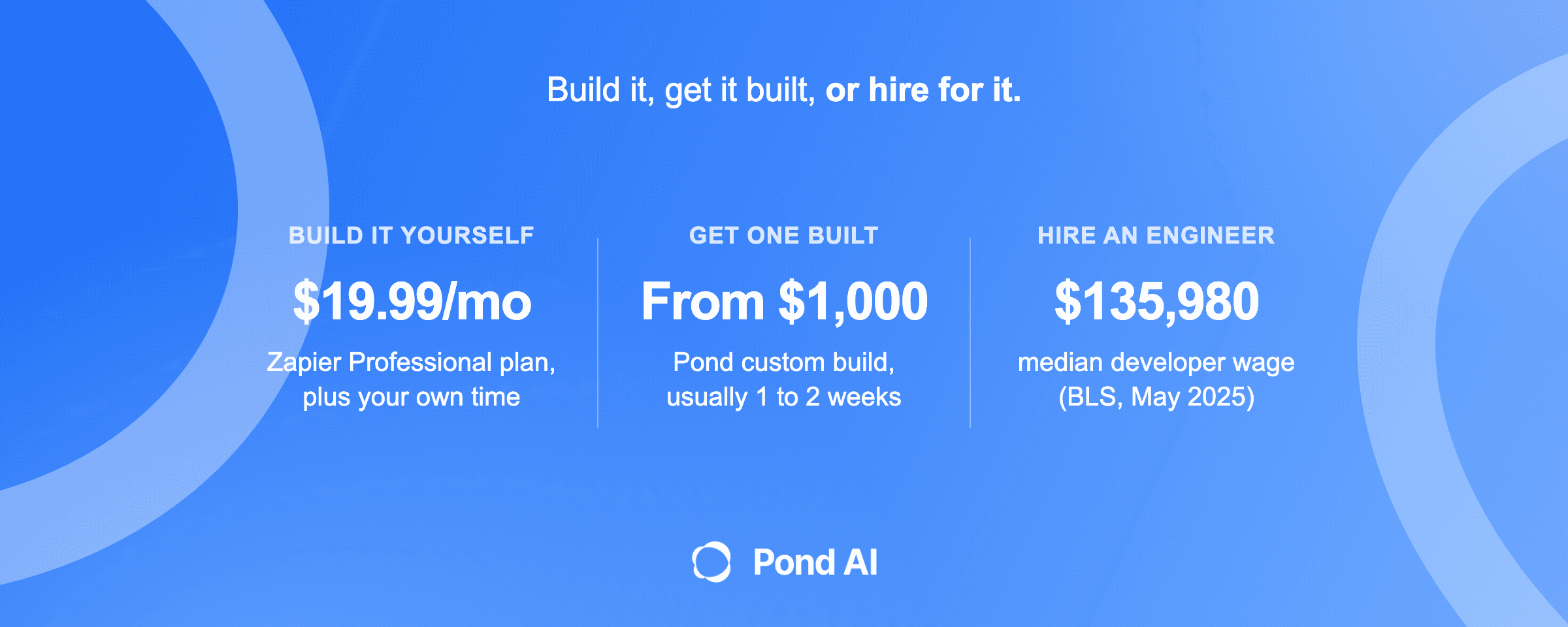
| Software plan you build yourself | Zapier: Free at $0 for 100 tasks a month, Professional from $19.99 a month, Team from $69 a month, on yearly billing. n8n: Starter 20€ a month for 2.5K executions, Pro 50€ for 10K, billed annually. Power Automate: Premium $15 per user a month, Process $150 per bot a month, paid yearly. UiPath: Basic from $25 a month, with a note that the plan is changing | Someone on your team builds, tests and fixes it | The steps are fixed rules and you have a builder |
| Outside provider or consultancy | ProsperSpark: projects from $2,340, Managed Automation from $500 a month, a 40-hour block at $7,800. Automaly (pounds): assessment from £5,000, build from £10,000, support from £250 a month | You scope the work and pay per project or per month | The input is messy, or nobody on your team can build |
| Custom AI agent built for you | Pond: custom builds start from $1,000, usually take 1 to 2 weeks and come with a 7-day refund. Build prices are on Pond's AI agent development page | You write the rules down and agree the scope and the acceptance test with Pond | One process is worth a purpose-built agent |
Software prices are per month, in the currency each vendor shows, and the billing period differs by vendor. Make's paid plans are not in the table because their prices could not be read on November 24, 2026. Make's free plan includes 1,000 credits a month, and credits are its billing unit. The three units are not interchangeable: Zapier bills tasks, n8n bills workflow executions, Make bills credits.
What is business process automation, and how is it different from RPA?
IBM defines business process automation (BPA) as "a strategy that uses software to automate complex and repetitive business processes." Robotic process automation (RPA) sits inside it. IBM says "RPA falls under the umbrella of BPA" and describes it as software that mimics human steps by following rules. Microsoft describes its RPA tool as built for "simple or complex rule-based tasks."
Two neighbors are easy to mix up. IBM describes business process management (BPM) as "a discipline that involves continuous collaboration between business and IT teams to model, analyze and optimize business processes from start to finish," and says BPA and RPA can be viewed as tools within it. Workflow automation covers a defined series of tasks, and IBM notes some workflows need "a mix of automated tasks and manual intervention," especially where a person has to judge. IBM also draws the line between RPA and AI: "RPA is process-driven, whereas AI is data-driven." A bot follows the steps a person defined. That matters when you choose a route, because a process with a messy input does not suit a fixed-rule bot.
What should you automate first?
Rank your candidates with this score. It is Pond's own test, built on the criteria in IBM's guide. It is not an industry standard. Give a process one point for each yes.
- It runs often and many people touch it. IBM lists "high volume, repetitive tasks, time sensitivity and multiple people for execution" as the marks of a good candidate.
- You can write the steps and the finished result in one sentence. IBM says every process needs "clear documentation that defines the task involved, responsible parties and execution timelines." Pond's guide to CRM workflow automation puts the same test for a rule: "If you cannot write that sentence, the rule is not ready."
- A wrong run is cheap to catch and undo. One provider's buyer guide says a reliable system will "pause, request more information or route work to a person instead of guessing." That is a seller's view, but the test holds: if a mistake costs a customer money, keep a person in the step.
- One named person owns the exception and the day it breaks.
Rank by total score. Ties go to the process that runs more often. Start with the top one at small scope: IBM advises organizations with minimal or no automation to "start small by automating processes that can build momentum." A process that scores zero or one on questions 2 and 3 is not ready. Write the steps first, then score it again.
Route by what the top process needs. Fixed rules and a builder in house point to a software plan. A messy input or no builder points to a provider or a custom agent. That last choice is a price and ownership question to settle on a call, so the questions below are for that call.
What do your existing tools already automate before you buy any service?
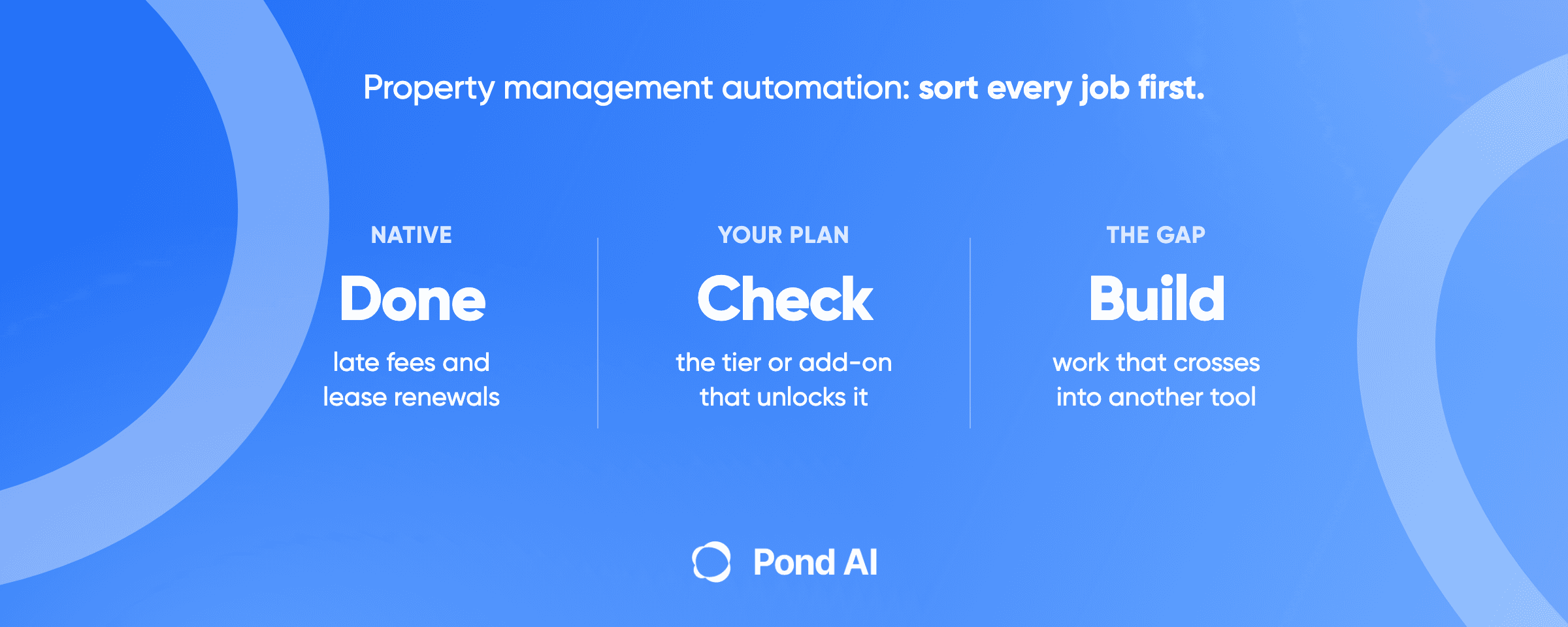
Before you buy any service, check what your existing tools already automate. Pond's post on purchase order automation has a section headed "What your accounting tool already does for purchase orders". It reads the maker's own help and pricing pages for QuickBooks Online, Xero and NetSuite and says, tool by tool, what each does and where it stops. On QuickBooks and Xero, as their own pages describe them, "a person does that step" of matching a bill against a receiving record. Approval on the purchase order itself is an Advanced-plan feature in QuickBooks Online.
Pond's guide to data entry automation makes the same point for a CRM. HubSpot's knowledge base says that on a form submission, "if a contact already exists in your account with the same email address, the new contact information will be added to the existing contact." That duplicate check needs no service at all. The guide adds that features like this do not move data between systems, and that is where a tool or a provider comes in.
Run the check on your CRM, accounting or helpdesk tool in three moves. List the rules you want automated. Look each one up in that tool's help pages and note which plan includes it. Pay a provider only for what is left.
What do outside providers charge?
Each figure below is one seller's own, read on that seller's pricing page.
- ProsperSpark (US consultancy): projects from $2,340, with final pricing depending on scope. Ongoing support from $1,560 a month. Managed Automation, covering setup, hosting and maintenance in one plan, from $500 a month.
- Automaly (UK agency, pounds): an AI readiness assessment from £5,000, credited against a build. Design, build and deploy from £10,000, with the price fixed before the work starts and paid in milestones. Support only from £250 a month for monitoring and fixes on a live build.
Two sellers also publish bands about their own market, with no method or sample behind either. The Automators writes: "Small-business implementations commonly cost $2,500 to $15,000 upfront, with ongoing costs of $500 to $5,000 per month." Dan Cumberland Labs, a consulting firm, writes: "AI automation consulting typically costs $30,000-$150,000 for project-based engagements." They differ by an order of magnitude, so read each as that seller's own range. The Automators adds that cost rises with custom APIs, legacy-system access, several data sources or agentic decision-making. For the cost of hiring one person to advise or build, see our guide to the AI automation consultant.
Who handles the case the automation cannot, and who owns it on the day it breaks?
Ask about exceptions and ownership before you sign, whatever the route. Pond's solutions page has a section headed "Who owns it on the day it breaks?" and says "These systems drift." It tells the buyer to get the test set handed over with the system. It is also honest about the limit: "If the real need is somebody on call for the next year while the system drifts, that is an ongoing relationship rather than a deliverable." In that case a support plan from a provider fits better than a one-time build.
The Automators says it documents the workflows and accounts it delivers "so clients can understand what they own." Ask every provider for the same, in writing.
Questions to ask before you buy
- What does the process do when it meets a case it cannot handle: stop, queue it, or alert a named person?
- Who is that person, you or the provider?
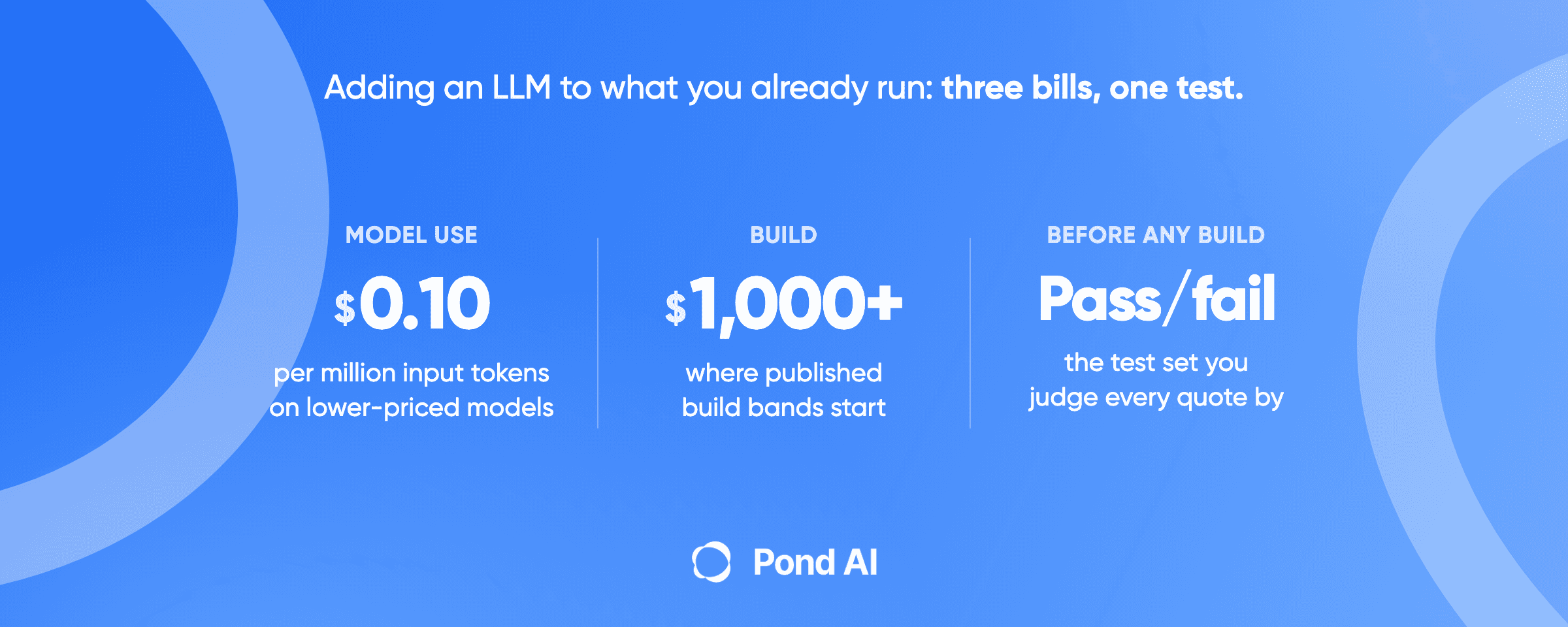
- Are running costs, such as model usage or hosting, in the quote or billed separately?
- Who owns the finished automation and its accounts at handover?
- Do you get the test cases handed over with the system?
- Which of the three billing units applies, and what does your volume come to in that unit?
Frequently asked questions
What are business process automation services?
They are outside help with using software to automate repetitive, multi-step work such as order handling, invoicing or helpdesk routing. IBM defines the field as "a strategy that uses software to automate complex and repetitive business processes." The help ranges from a plan you configure yourself to a provider or a custom build.
What is the difference between business process automation and workflow automation?
Workflow automation covers a defined series of tasks, and some of those tasks may stay with a person where judgment is needed. Business process automation is the wider strategy of automating whole processes. RPA, which mimics human steps by following rules, falls inside it.
How much do business process automation services cost?
It depends on the route. Software plans start at $0 on Zapier's free plan (100 tasks a month) and Professional is listed from $19.99 a month billed yearly. A provider such as ProsperSpark lists projects from $2,340. Pond lists custom agent builds from $1,000. Two sellers' own bands differ: $2,500 to $15,000 upfront from one, $30,000 to $150,000 from the other, and neither states a method.
What should a small business automate first?
Score each process on four questions: how often it runs, whether you can write the steps in one sentence, whether a wrong run is cheap to catch, and whether one person owns the exceptions. Start with the highest score at small scope.
Is RPA the same as business process automation?
No. IBM says RPA falls under the umbrella of BPA. RPA is software that mimics human steps by following rules a person defines, and Microsoft describes its RPA tool as built for "simple or complex rule-based tasks." BPA is the wider strategy of automating whole processes. RPA suits fixed steps. A process with messy input needs more than a rule-following bot.
Should I use a software plan or hire a provider?
Use a software plan when the steps are fixed rules and someone on your team can build and fix them. Hire a provider when the input is messy or nobody can build. Whichever you choose, ask who handles the exception and who owns it on the day it breaks.
Can Pond build a custom agent for a business process?
Pond builds custom AI agents, and its page lists builds from $1,000, usually 1 to 2 weeks, with a 7-day refund. You write the rules down and agree the scope and the acceptance test with Pond. If you need someone on call for a year while the system drifts, that is an ongoing relationship rather than a one-time build.
Next step
If your top-scoring process runs on fixed rules and someone on your team can build it, start with a software plan. If it needs a purpose-built agent, Get a custom AI agent. If you want to try the platform first, Try Pond.