Short answer
Build the agent yourself when the job is simple, runs inside tools you already use, and you have a few hours a week to keep it working. Get one built when the job crosses several systems, handles money or customers, or has to work every day without you watching it. Hire an engineer only when AI is becoming part of your product, because a full-time salary pays for itself only with a steady stream of builds.
Disclosure: Pond publishes this blog, sells a monthly plan, offers a build-your-own route, and builds custom agents. Every third-party plan name and price below is the vendor's own, read on November 3, 2026, in US dollars.
Build it yourself on a platform
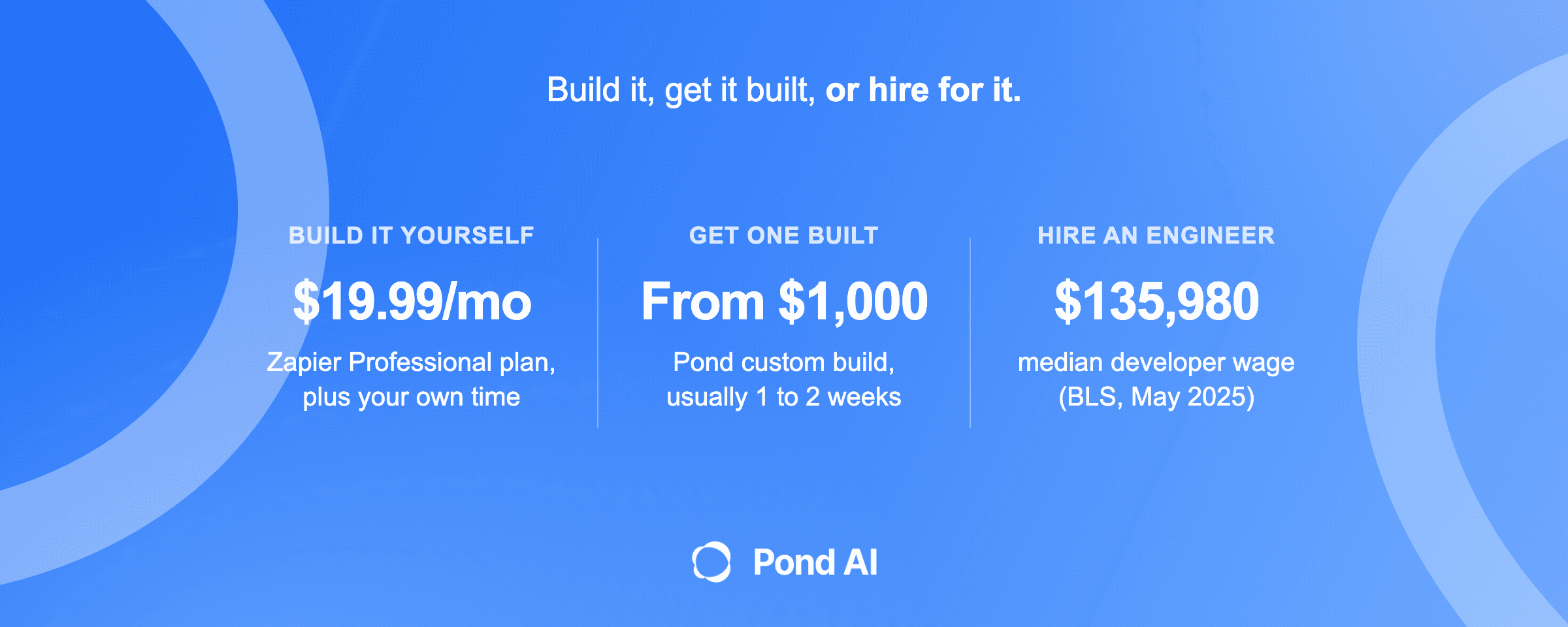
- What you pay: a platform plan, for example $19.99 a month for the Professional plan on Zapier billed yearly, or $20 a month on n8n's Starter plan billed annually, plus your own time.
- Time to a first working agent: your own hours, set by how complex the job is.
- Who keeps it running: you.
- Main risk: it fails quietly when an app or login changes.
- Best for: one team, one workflow, low stakes.
Get one built
- What you pay: agencies' lowest published bands run from $20,000 to $50,000. Pond's custom builds start from $1,000. These prices cover different scopes, so compare what each one includes.
- Time to a first working agent: Pond quotes 1 to 2 weeks for a custom build.
- Who keeps it running: agree it before the build starts.
- Main risk: a scope that was never written down.
- Best for: a job that crosses several systems or touches customers.
Hire an engineer
- What you pay: a median software developer wage of $135,980 a year (BLS, May 2025), before benefits and recruiting.
- Time to a first working agent: recruiting time, then the build.
- Who keeps it running: the engineer.
- Main risk: one person carries all of it.
- Best for: AI that is part of your product.
What do build, buy and hire mean for a small business?
Most build-versus-buy guides are written for companies with an IT department. For them, "build" means a team of engineers and "buy" means an enterprise platform. A business with 5 to 50 people has three different choices.
Build it yourself. You use a no-code or low-code platform and wire the agent up yourself. Zapier, n8n, Make, Lindy and Gumloop all sell this. So does Pond: its homepage says you can "describe what you need in plain language," and the agent runs inside the AI assistant you already use.
Get one built. Someone else scopes, builds and hands over the agent. That can be an agency, a consultant or a builder like Pond. Pond's homepage puts it this way: "Need something more complex? Pond can build it for you."
Hire an engineer. You bring someone onto the payroll who builds and maintains agents as their job.
One more option belongs on the list: build nothing. Both major model makers say some jobs may not need an agent at all. That comes up again below, and it is the cheapest route when it fits.
How much does each route cost in 2026?
The three routes are priced in completely different units, so compare what each one delivers before you compare the headline numbers.
Building it yourself: a platform plan plus model usage
Here is what the main platforms list on their own pricing pages:
- Zapier. The Professional plan is "Starting from $19.99 /month" and the Team plan "Starting from $69 /month" for 25 users. Those are the prices the page shows with yearly billing, its default setting, and the page says annual payments get "a lower monthly fee." Agents are priced separately. Agents Pro is "$400 billed annually," shown as $33.33 a month, for 1,500 activities a month. (Zapier pricing)
- n8n cloud. Starter at "$20/mo, billed annually" for 2.5K workflow executions, and Pro at "$50/mo, billed annually" for 10K. n8n bills by execution "regardless of complexity." (n8n pricing)
- Lindy. Free credits worth $50 to start, which last seven days. Paid plans are billed per person, and the page says "Every active user in your workspace is billed." (Lindy pricing)
- Gumloop. The Pro plan "Starts at $37 / month" with a 14-day free trial and 20k credits a month. (Gumloop pricing)
- Make and Relevance AI. Neither showed a plan price on its pricing page on November 3. Make says credits are now its billing unit. Relevance AI's page shows an Enterprise tier with a sales contact.
Each platform bills a different unit: tasks, activities, executions or credits. A plan with more units is not more work done. One agent run can use one execution on n8n and many credits on another platform.
If you build straight on the AI models instead, you pay per million tokens. OpenAI lists GPT-6.1 Terra at $1.00 per million input tokens and $5.00 per million output tokens (OpenAI API pricing). Anthropic lists Claude Sonnet 5.5 at $2 and $10 (Anthropic pricing). The subscription you already pay for may cover part of this. On Anthropic's paid plans, Max includes $100 of monthly API credits.
The cost that does not appear on any pricing page is your own time. Count your hours before you compare platform fees.
Getting one built: a scoped price for a scoped job
Agencies publish their own price bands, and the floors sit in the tens of thousands. Neoteric, a software agency, says a custom agent usually starts at $25,000 to $50,000 for a focused proof of concept, and can pass $100,000 in production. Cleveroad, another agency, lists $20,000 to $35,000 and up for its simplest tier. Neither gives a sample or a method, so read these as asking prices from sellers. Our AI agent development page covers what agent builds cost in more detail.
Pond's homepage says: "Custom AI agent builds start from $1,000, usually take 1 to 2 weeks, and come with a 7-day refund that applies only to custom builds." The refund has a condition: custom builds "are refunded within 7 days if benchmarks aren't met."
These prices cover different scopes. An agency proof of concept at $25,000 and a Pond build from $1,000 are not the same job at a twenty-fifth of the price. Ask any builder what the quoted price includes: how many tools the agent connects to, how many rounds of changes, and who hosts it.
Neoteric names what pushes the price up: "The more the agent touches real business processes, the more the budget needs to cover data, integrations, permissions, testing, monitoring, and long-term maintenance." That list applies to every builder.
Hiring an engineer: a salary before anything ships
The US Bureau of Labor Statistics does not list a separate occupation for AI engineers. The two closest are software developers and computer and information research scientists. "The median annual wage for software developers was $135,980 in May 2025," and the median for computer and information research scientists was $140,300 (BLS). Those are wages. Benefits, payroll taxes and recruiting come on top.
BLS projects demand for software developers to be strong "due to the continued expansion of software development for artificial intelligence (AI)."
How long until the first working agent?
There is no neutral benchmark for this, so treat any confident number with suspicion, including ours.
What the sources do say:
- A custom build from Pond: 1 to 2 weeks, per Pond's homepage.
- Building it yourself: platforms advertise fast setup, but the real time depends on the job. A one-step workflow and an agent that reads documents and writes to three systems are different projects.
- Hiring: add recruiting and onboarding before the first build starts.
For a sense of scale, MIT NANDA's 2025 study of corporate AI pilots found that mid-market companies moved faster than enterprises: "Top performers reported average timelines of 90 days from pilot to full implementation." Enterprises, which the report defines as firms with over $100 million in annual revenue, "took nine months or longer." The report gives no timing figure for small businesses.
Who keeps the agent working once it is live?
Upkeep is an ongoing cost on top of the build, whoever pays it, and it continues for as long as the agent runs.
Agents break when the world around them changes: an app updates its fields, a login expires, a customer writes in an unexpected way. On Zapier, if 95% of a Zap's runs in the last seven days stop or error, "the Zap will be automatically turned off." It then "will not run again until the user manually enables it" (Zapier docs). If you built it yourself, you are the person who notices and fixes it.
Some actions need a person watching no matter who built the agent. OpenAI's guide to building agents says: "Actions that are sensitive, irreversible, or have high stakes should trigger human oversight until confidence in the agent’s reliability grows." Its examples are canceling orders, large refunds and payments (OpenAI guide).
Settle maintenance before any build starts:
- Who watches for failures, and how will you find out?
- Who fixes the agent when a connected app changes?
- Is upkeep in the build price, or billed separately?
- Which actions need a person to approve them?
If a builder cannot answer these, the price you were quoted is not the full price.
Does buying beat building? What the research says
Two large studies point the same way. Neither looked at businesses of 5 to 50 people specifically.
MIT NANDA's 2025 report says: "external partnerships with learning-capable, customized tools reached deployment ~67% of the time, compared to ~33% for internally built tools" (MIT NANDA, The GenAI Divide, in a copy hosted by mlq.ai). The report also warns that "The correlation between external partnerships and success does not necessarily prove causation." The figures come from interviews with 52 organizations.
Menlo Ventures surveyed 495 US enterprise AI decision-makers in November 2025. It found that 76% "of AI use cases are purchased rather than built internally," up from 53% in 2024 (Menlo Ventures). Its survey measured what companies chose. It did not measure what worked.
You may have seen the claim that 95% of AI projects fail. It comes from the same MIT report, and it measured something narrower: whether generative AI pilots showed a measurable profit-and-loss impact about six months in. The report calls its own figures "directionally accurate based on individual interviews rather than official company reporting." Wharton professor Kevin Werbach called the study "deeply problematic." Use the number carefully, or not at all.
Gartner predicts that over 40% of agentic AI projects will be canceled by the end of 2027. That is a forecast. Nobody has measured it yet.
For a small business, the useful lesson is narrower than buying everything. In MIT's data, external partnerships with customized tools that learn reached deployment more often than tools built in-house. That is a correlation from interviews with 52 organizations, so treat it as a pointer, not a rule.
When should you build it yourself?
Build it yourself when all of these are true:
- The job is one workflow inside tools you already use. For example, a form that lands in your CRM, or an email summary every morning.
- A mistake costs little. Nothing goes to a customer, and no money moves without you.
- Someone on the team will own it. That person checks it weekly and fixes it when an app changes.
- You can describe the job in plain steps. If you can write down what goes in and what should come out, a platform can usually do it.
Pond offers this route too. You describe the agent in plain language, and it runs inside the AI assistant you already use. If you are choosing between platforms and hired help for this kind of job, our guide to hiring a Zapier expert, n8n consultant or Make developer compares those routes.
When should you get one built?
Get one built when any of these are true:
- The agent crosses several systems. It reads from one tool, decides, and writes to two others. Every connection is a place where it can break, and our API integration page covers that connection work.
- It touches customers or money. Bookings, refunds, quotes and replies to customers need testing before launch, and a person approving the risky steps.
- It has to run every day. A daily job needs monitoring, and someone has to answer for it when it fails.
- Nobody on your team has the hours. A DIY agent that nobody maintains turns into a broken one.
Before you ask anyone for a quote, write down what counts as done: the inputs, the output you expect, and three real examples to test against. Our guide to writing a task brief shows how. Then test the result the way our guide to testing an AI agent describes, before customers see it.
When should you hire an engineer?
Hire when AI becomes part of what you sell. Running the office is a smaller job. A full-time engineer makes sense when you have a steady list of builds, the agents need deep access to your own product or data, and you want that knowledge to stay inside the company.
For a business of 5 to 50 people running internal workflows, a full-time engineer is usually more capacity than the work needs. At a median wage of $135,980, the role only makes sense with a full year of builds ahead.
When should you not build an agent at all?
When fixed rules can do the job. Both major model makers say to check this before you build.
Anthropic's guide to building agents: "we recommend finding the simplest solution possible, and only increasing complexity when needed. This might mean not building agentic systems at all" (Anthropic).
OpenAI's guide lists three signs that a job suits an agent: complex decisions, rules that are hard to maintain, and heavy reliance on unstructured data, such as reading documents or talking with users in natural language. Then it says: "Before committing to building an agent, validate that your use case can meet these criteria clearly. Otherwise, a deterministic solution may suffice."
In plain terms: if the job follows fixed rules every time, a simple automation will do it more cheaply and more reliably than an agent. Gartner makes the same point about the market: "Many use cases positioned as agentic today don’t require agentic implementations."
A five-question way to decide
Answer these in order. Stop at the first answer that settles it.
- Does the job follow the same fixed rules every time? Yes: use a plain automation, not an agent.
- Is AI part of the product you sell? Yes: plan to hire an engineer.
- Does it touch customers, money, or more than two systems? Yes: get it built, with a written test before launch.
- Will someone on your team own it every week? No: get it built, and agree who maintains it.
- Is it one workflow, low stakes, in tools you already use? Yes: build it yourself.
If you land on "get it built," talk to the Pond team about a custom build, and ask for a quote for that scope. If you land on "build it yourself," Try Pond and describe the agent you need in plain language.
Frequently asked questions
How much does it cost to have a custom AI agent built?
It depends on the scope, and published prices cover very different jobs. Agencies' lowest published bands run from $20,000 to $50,000, for a proof of concept or a simplest tier. Pond's custom builds start from $1,000, usually take 1 to 2 weeks, and come with a 7-day refund that applies if benchmarks aren't met. A build from $1,000 is not the same scope as an agency proof of concept, so ask every builder what the price includes and who maintains the agent afterwards.
Can I build an AI agent inside ChatGPT or Claude?
Yes, for simpler jobs. Pond's build-your-own route connects to the AI assistant you already use, and you describe the agent in plain language. If you build on the models' APIs directly instead, you pay per million tokens, for example $2 input and $10 output for Claude Sonnet 5.5.
How long does it take to build a custom AI agent?
Pond quotes 1 to 2 weeks for a custom build. There is no neutral benchmark across builders, and a do-it-yourself build depends on how complex the job is. In MIT NANDA's 2025 study, top-performing mid-market companies averaged 90 days from pilot to full implementation, and enterprises took nine months or longer.
Is it cheaper to build an AI agent yourself?
The platform fee is lower: $19.99 a month for the Professional plan on Zapier billed yearly, or $20 a month on n8n's Starter plan billed annually. The full cost includes your time to build it, test it and fix it when connected apps change. If nobody on the team has those hours, count that as a cost before you choose this route.
Should I hire an AI engineer or pay someone to build the agent?
Hire an engineer when AI is part of the product you sell and you have a steady list of builds. The median software developer wage was $135,980 in May 2025, before benefits. For internal workflows in a 5 to 50 person business, paying someone to build the agent is usually the better fit.
Do most AI agent projects fail?
The often-quoted 95% figure comes from an MIT NANDA report that measured whether generative AI pilots showed profit impact about six months in. Its method has been criticized. The same report found that external partnerships with customized tools reached deployment about twice as often as internal builds, which the report itself calls a correlation. It does not claim proof.