Short answer
An AI answering service is software that picks up your business line, talks to the caller, takes a message or books the job, and passes urgent calls to a person. In November 2026 the paid entry plans we checked start between $29 and $250 a month and bill by the minute, by the call, by the caller, per agent or at a flat rate. Buy one when you need calls answered and booked this week. Get a custom agent built when the call has to end with a real record in your CRM or follow your own intake steps that no plan's template holds.
Disclosure: Pond publishes this blog and sells custom AI agent builds. It does not sell a packaged answering service or receptionist product. Every price below is a US list price, on monthly billing unless we say otherwise, read on the vendor's own pricing page on November 4, 2026. Check the page again before you buy.
The options at a glance
Ten services, all named on Google's first page or in the AI answers we track, plus the build route. Eight answer with AI first, though Smith.ai's AI Receptionist can transfer a call to a live receptionist and Smith.ai also sells hybrid and human-first plans. Abby Connect mixes human and AI answering, and Ruby uses human receptionists:
- Smith.ai AI Receptionist. Per call. Free for 25 calls, then Pro from $150 a month for 75 calls. Best for: AI first with human receptionists on the same account.
- Goodcall. Per unique caller. Starter $79 a month for 100 callers. Best for: high call counts from repeat callers.
- Rosie. Per minute. Professional $49 a month for 250 minutes, with no per-minute overage. Best for: a small, steady call load.
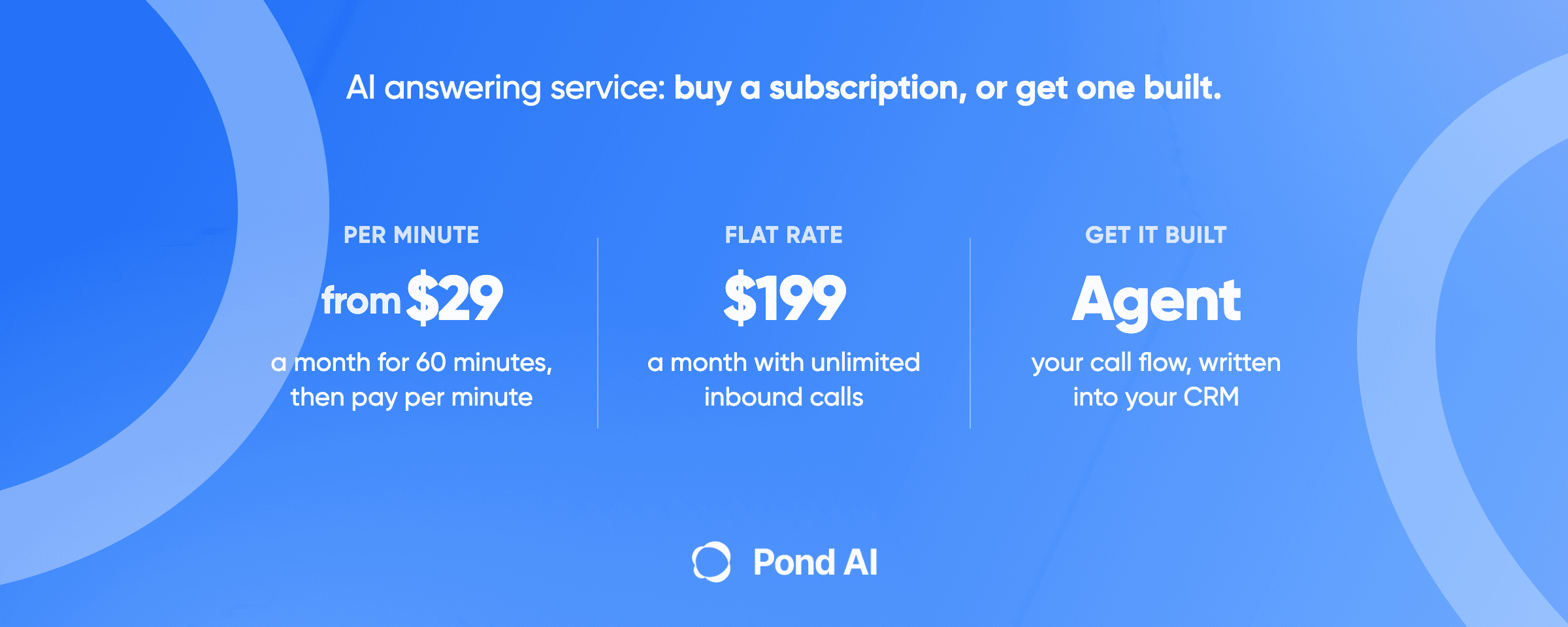
- Dialzara. Per minute. $29 a month for 60 minutes up to $349 for 1,000, with published overage. Best for: predictable per-minute math.
- My AI Front Desk. Per minute. $99 a month for 200 voice minutes plus about 40 more from included credits, then $0.25 a minute. Best for: phone, chat and SMS in one bundle.
- NextPhone. Flat rate. $199 a month with unlimited inbound calls. Best for: high volume with no overage bill.
- RingCentral AI Receptionist (AIR). Per minute. $49 a month for 100 minutes, then $0.50 a minute. Best for: teams already on RingCentral.
- Allo. Per agent, on a per-seat phone plan. The AI Receptionist is $45 a month on top of a $45 Business seat, so $90 a month, or $64 billed yearly. Best for: small teams that want a new phone system too.
- Ruby. Human receptionists by the minute, our human baseline. From $250 a month for 50 minutes. Best for: a person on every call.
- Abby Connect. Human and AI on one minute pool. Starter $164 a month for 50 Abby Minutes. Best for: mixing human and AI answering.
- A custom agent built on a voice platform. A developer or an agency sets up an agent on a platform such as Retell, Vapi or Bland, wired to your calendar and CRM. Retell quotes $0.07 to $0.31 a minute. Best for: calls that must follow your own steps into your own systems.
How we compared them
We read every price on the vendor's own pricing page from a US connection. Where a vendor hides a number behind a sales call, we say so instead of guessing. The billing unit matters more than the headline price. Per-call, per-minute, per-caller and flat plans rank in a different order at 100 calls a month than at 1,000. So we price the same workload on each plan, then ask what happens to the call after the AI hangs up.
The products, one by one
Smith.ai AI Receptionist: per call, with humans on the same account
Smith.ai sells the job three ways: "AI-first", "Hybrid" and "Human-first". The AI answers first, and "the call can be transferred to a live North America-based receptionist" when it needs a person.
Pricing is per call. The free tier covers "25 calls/mo ($3.00/call after that)". Pro is $150 a month for 75 calls, $270 for 150 and $500 for 300, with extra calls at $2.50, $2.30 or $2.17. Enterprise is $500 for 300 calls or $800 for 500, with extra calls at $2.17 or $2.10, and custom pricing from 1,000 calls. The AI product is "a month-to-month service".
The plans list "AI Scheduling (Calendly & more)" and "Native integrations (Clio, Zapier & more)". The limit to know: "Custom AI prompting by our technical team" is on Enterprise only. On Free and Pro, custom prompting and custom integrations are not included.
Goodcall: per caller, never per minute
Goodcall counts unique callers, defined as "One phone number, once a month." Starter is $79 a month for "100 unique customers a month then 79¢ each. About 150 calls/month." Growth is $129 for 500 unique customers, then 26¢ each. Scale is $299 for 2,000, then 15¢ each. On minutes, its pricing FAQ says: "No. We never meter minutes."
It connects natively to Google Calendar, Google Sheets and HighLevel, and says "Zapier connects Goodcall to your CRM and more than 10,000 other apps". For health care, Goodcall signs a business associate agreement (BAA) "on the Scale plan ($299 a month) and on Enterprise."
Rosie: 250 minutes for $49, and no per-minute overage
Rosie bills by the minute. Professional is $49 a month with "250 minutes per month", Scale is $149 with 1,000 minutes, and Growth is $299 with 2,000 minutes. Annual billing gives "2 months free". Rosie has no per-minute overage rate. Its FAQ says that if you exceed your limit, "we'll automatically move you up to the next plan - at that plan's standard price, never more." Above Growth's 2,000 minutes, Rosie asks you to get in touch for a custom-volume plan.
Booking straight into your calendar starts on Scale, as do warm transfers, where "Rosie briefs your team before connecting". Every plan includes Zapier.
Dialzara: per-minute math you can plan around
Business Lite is $29 with "Up to 60 minutes of talk time included" and overage at $0.48 a minute. Pro is $99 for 220 minutes at $0.45. Plus is $199 for 500 minutes at $0.40. Elite is $349 for 1,000 minutes at $0.35.
Calendar sync with Google or Outlook starts on Pro. Lite has blind transfer only; warm transfer starts on Pro. CRM links run through Make, Zapier or the API, graded by plan. Custom work sits in a managed tier, "Done for You!", from $1,500 a month.
My AI Front Desk: phone, chat and text in one bundle
"Answering phone calls starts at $99/mo on Business-in-a-Box, or $79/mo billed annually, and that includes 200 voice minutes". The bundle adds web chat, SMS and a built-in CRM. Extra minutes cost 25 credits each at "1 credit = $0.01", so $0.25. The plan includes "a pool of 1,000 overage credits each month", which "covers about 40 more minutes", then auto-reload buys 1,000 credits for $10. The page also says that "Businesses running more than 25 interactions a day move to Partner or Enterprise pricing", and "API access & custom integrations" sit on those tiers.
NextPhone: flat rate, unlimited calls
"NextPhone starts at $199 a month, flat, with unlimited inbound calls." Growth is $299 and Scale is $599, with no per-minute charges or overage. Paying yearly brings Pro to $166 a month.
On Pro you build the agent yourself. Every plan "Books into Google & Outlook calendars", but CRM and intake connections (Clio, MyCase, HubSpot, GoHighLevel and more) start on Growth, and custom call flows and custom integrations are Scale only. NextPhone's own advice: "Pick Growth if you want us to build and test it for you, or connect it to your CRM or booking tool."
RingCentral AI Receptionist (AIR): for teams already on RingCentral
AIR on its own "Starts at" $49 a month with "100 minutes included". Over the allowance, "Pay-as-you-go charges of $0.50 per minute apply", and "Call time is rounded up and billed in 30-second increments." RingCentral also sells extra minute bundles but prints no price for them, so $0.50 is the only published overage rate. RingCentral's product page says AIR connects to your calendar and CRM and passes callers to your team with a call summary attached. Its plan table lists Salesforce, Zoho and HubSpot as CRM integrations and HIPAA compliance as included.
Allo: a phone system with an AI add-on
Allo is a per-seat phone system. "The AI Receptionist costs the same as a Business seat and follows your annual or monthly billing": $32 a month per agent billed yearly, or $45 monthly. It needs a paid plan underneath. Allo lists Solo at $10 a seat billed yearly, or $15 monthly, but marks it "Coming soon", so the cheapest plan you can buy today is Business at $32 a seat billed yearly, or $45 monthly. One receptionist on one Business seat comes to $90 a month, or $64 a month billed yearly. The receptionist "Updates your CRM after every call". Allo's pricing FAQ says every paid plan includes "native CRM sync (HubSpot, Salesforce, Attio and more)", while the plan cards name those CRMs under Business and list "Native CRM autofill" on Solo. Allo publishes no minute allowance or overage for the receptionist and notes that "Pricing is early and can still change."
Ruby: human receptionists by the minute
Ruby sells people's time; its AI features support its receptionists rather than answer calls on their own. Its receptionist plans differ only in minutes, and every plan gets the same features. Plans run $250 a month for 50 minutes, $395 for 100, $720 for 200 and $1,725 for 500, with "optional AI enhancements" at no extra cost. It does not publish an overage rate, and larger plans are quoted by phone.
Abby Connect: human and AI on one minute pool
Abby sells Starter at $164 a month for 50 Abby Minutes, Essential at $329 for 100, Professional at $599 for 200 and Growth at $1,380 for 500. AI answering costs half, since "1 Abby Minute = 2 minutes" when the AI picks up. "Overage is billed at your plan's Abby Minute rate", and the page does not print that rate in dollars. Integrations beyond its standard list become a project: "Custom integrations, automations, and tailored call workflows are then scoped and built for you as a custom solution."
What a month costs at 100, 300 and 1,000 calls
No vendor publishes an average call length. Goodcall uses four-minute calls as an example. We assume 3 minutes a call. That figure is ours, so 100 calls is 300 minutes, 300 calls is 900 minutes and 1,000 calls is 3,000 minutes. Each figure is the cheapest published plan that covers the load, on monthly billing, with published overage added. Two products are left out. Allo publishes no minute allowance or overage for its receptionist, so its $90 monthly entry ($45 plus a $45 Business seat, since Solo is "Coming soon") cannot be scaled to a call count. Abby Connect bills overage at "your plan's Abby Minute rate" but prints no dollar figure for it, so we would be guessing. Taxes and number fees are excluded.
100 calls a month (300 minutes)
- Goodcall: $79 (Starter covers about 150 calls).
- My AI Front Desk: about $119 ($99, the credit pool, then two $10 reloads).
- Dialzara: $135 (Pro, $99 plus 80 minutes at $0.45).
- Rosie: $149 (Professional's 250 minutes run out, so Rosie moves you to Scale).
- RingCentral AIR: $149 ($49 plus 200 minutes at $0.50).
- NextPhone: $199 (Pro, flat).
- Smith.ai AI: $212.50 (Pro, $150 plus 25 calls at $2.50).
- Ruby: $1,725 (the 500-minute plan; 200 minutes is not enough).
- Custom agent on Retell: $26 to $98 in usage ($0.07 to $0.31 a minute plus $0.015 telephony), plus the build.
300 calls a month (900 minutes)
- Goodcall: $129 (Growth covers about 750 calls).
- Rosie: $149 (Scale, 1,000 minutes).
- NextPhone: $199 (Pro, flat).
- My AI Front Desk: about $269 ($99, the credit pool, then 17 reloads).
- Dialzara: $349 (Elite, 1,000 minutes).
- RingCentral AIR: $449 ($49 plus 800 minutes at $0.50).
- Smith.ai AI: $500 (300 calls).
- Ruby: above its largest published plan, so priced by phone.
- Custom agent on Retell: $77 to $293 in usage, plus the build.
1,000 calls a month (3,000 minutes)
- NextPhone: $199 (Pro, flat).
- Goodcall: about $172 at Goodcall's own 1.5 calls per caller (Growth plus about 167 callers at 26¢), or $259 if every caller is new.
- My AI Front Desk: about $789 on credits, but at about 33 calls a day the page points you to custom Partner or Enterprise pricing.
- Dialzara: $1,049 (Elite, $349 plus 2,000 minutes at $0.35).
- RingCentral AIR: $1,499 ($49 plus 2,900 minutes at $0.50).
- Smith.ai AI: $1,850 (Enterprise, $800 for 500 calls plus 500 at $2.10).
- Rosie and Ruby: above their largest published plans, so custom pricing.
- Custom agent on Retell: $255 to $975 in usage, plus the build.
The billing unit decides the order. NextPhone stays at $199 and Goodcall rises from $79 to between about $172 and $259, while Dialzara, RingCentral AIR and My AI Front Desk climb with every extra minute. A custom build is not the cheapest line at 100 calls once you add the build itself, and at 1,000 calls the flat and per-caller plans still undercut it. The case for building is rarely the phone bill. It is what the call does next.
Where the subscriptions stop
Every product above answers calls. The differences show up after the caller hangs up.
- Custom work often sits at the top tier or goes through a consultation. Smith.ai keeps custom AI prompting for Enterprise. NextPhone marks custom integrations and custom call flows as Scale only. My AI Front Desk keeps API access and custom integrations for Partner and Enterprise. Rosie keeps custom agent training for Growth, its largest published plan. Dialzara lets you edit the prompt yourself on Lite, Pro and Plus, but its custom integrations sit in the managed tier, "Done for You!", at "$1,500+ per month". Abby Connect includes a custom solutions consultation with every plan, and its custom integrations and call workflows are then "scoped and built for you as a custom solution." Goodcall works differently: on every plan you can describe a change in plain English and get "new questions, new steps" added to the agent.
- CRM write-back varies. NextPhone (from Growth), RingCentral AIR, Allo and Smith.ai connect to named CRMs directly. Goodcall connects natively to HighLevel and reaches other CRMs through Zapier, an API tool or an MCP server. Dialzara links CRMs through Make, Zapier or its API, with API access on Elite. Rosie uses Zapier and says it is "actively working on direct CRM integrations". Any of these routes handles a contact and a note. It gets harder when the call must update a deal stage, check a service area or create a job with the right fields.
- Transfers are tiered. Dialzara Lite has blind transfer only. Rosie's warm transfer starts at $149.
- HIPAA is a plan decision. Goodcall signs a BAA on its $299 plan and up, Allo charges $50 a month extra, RingCentral lists it as included, and Ruby lists HIPAA-compliant services. Abby marks its HIPAA options as human only. Several other pricing pages we read say nothing about it, so ask in writing before any patient calls go through.
When a subscription is the right call
Buy a product if most of these are true:
- Your calls are simple: hours, prices, take a message, book a slot.
- Your booking tool is Google Calendar, Outlook, Calendly or HighLevel, which the products connect to directly.
- A note in your inbox or a Zapier row is enough record of the call.
- You want it live this week, with no project to manage.
- You take fewer than a few hundred calls a month, or you can pick a per-caller or flat plan.
For many small businesses this is the right answer. The cheapest plans here cost less a month than a receptionist earns in a day. The Bureau of Labor Statistics puts the median receptionist's pay at $38,010 a year, or $18.27 an hour (May 2025), before benefits, payroll tax or evening cover.
When a custom agent on your CRM beats a subscription
A custom agent is worth it when the call starts a workflow instead of ending one. Signs you are there:
- The call must create a real record. A new lead, deal or job in your CRM with the fields your team uses. A transcript in a Zapier row does not count.
- Your intake has steps a template cannot hold. Service-area checks, qualifying questions that branch, a quote range from your own price list, a routing rule by job type.
- The agent needs your data mid-call. An existing customer, an open ticket or a technician's schedule.
- You would otherwise pay for the top tier anyway. If the features you need sit on Enterprise or a managed plan, compare that bill with a build and its upkeep.
- Your volume is high and the plan you need is metered. At 1,000 calls, Dialzara comes to $1,049 and Smith.ai Enterprise to $1,850, against $255 to $975 in Retell usage plus the build and upkeep. NextPhone and Goodcall come in around or below the low end of that usage alone, so a build has to earn its keep on what the call does, not on price.
Calling back the people you missed is a weak fallback. Pew found that eight in ten Americans "don't generally answer their cellphone when an unknown number calls" (2020). Answering live beats chasing the call later.
What a custom build costs, part by part
A custom agent has three cost lines. See each one before you agree to a build.
- The phone and voice layer, per minute. Retell quotes "$0.07-$0.31/minute" pay as you go, with telephony at $0.015 a minute and 20 concurrent calls included; some model choices on its price list cost more. Vapi charges $0.05 a minute for hosting, with the transcriber, model and voice billed on top, and its own 1,000-minute estimate came to $82 to $129 a month. Bland is $0.14 a minute with no platform fee, or $0.12 with a "$299/month platform fee". Synthflow now sells only an annual enterprise agreement.
- The build. Someone writes the call flow, connects the calendar and CRM, and tests it on real calls. That is the part several subscriptions sell as their top tier.
- Running it. Prompts drift, your services change and the CRM gets new fields. Agree up front who maintains the agent and who pays the per-minute bill.
The platforms sell parts, not a finished receptionist. Bland makes the point about its rivals: "Their advertised per-minute rate is the platform fee only." Ask any builder for the all-in per-minute figure.
Where Pond fits
Pond builds custom AI agents. It sells no receptionist product, and its homepage does not mention phone answering. In its own words: "Pond builds, runs and maintains custom AI agents for businesses." Its pricing line reads: "Custom AI agent builds start from $1,000, usually take 1 to 2 weeks, and come with a 7-day refund that applies only to custom builds." On tools, Pond says "Yes, your agent can work with your CRM, email, spreadsheets and other tools."
If phone calls are part of the job, ask Pond directly whether it would take on that work before you book. Bring three things to that conversation:
- What done means: for example, every new-customer call ends with a contact and a job in your CRM, and a booked slot or a callback task.
- Which voice platform the build would run on, and who pays its per-minute bill after launch.
- The benchmark the 7-day refund would be measured against for an agent that handles calls.
If your calls are simple, buy a product above. If you want a custom agent to touch phone calls, ask Pond first whether it would take that on, as above. For an agent that works with your CRM and the other tools your team runs on, get a custom AI agent built by Pond, or try Pond and build your own.
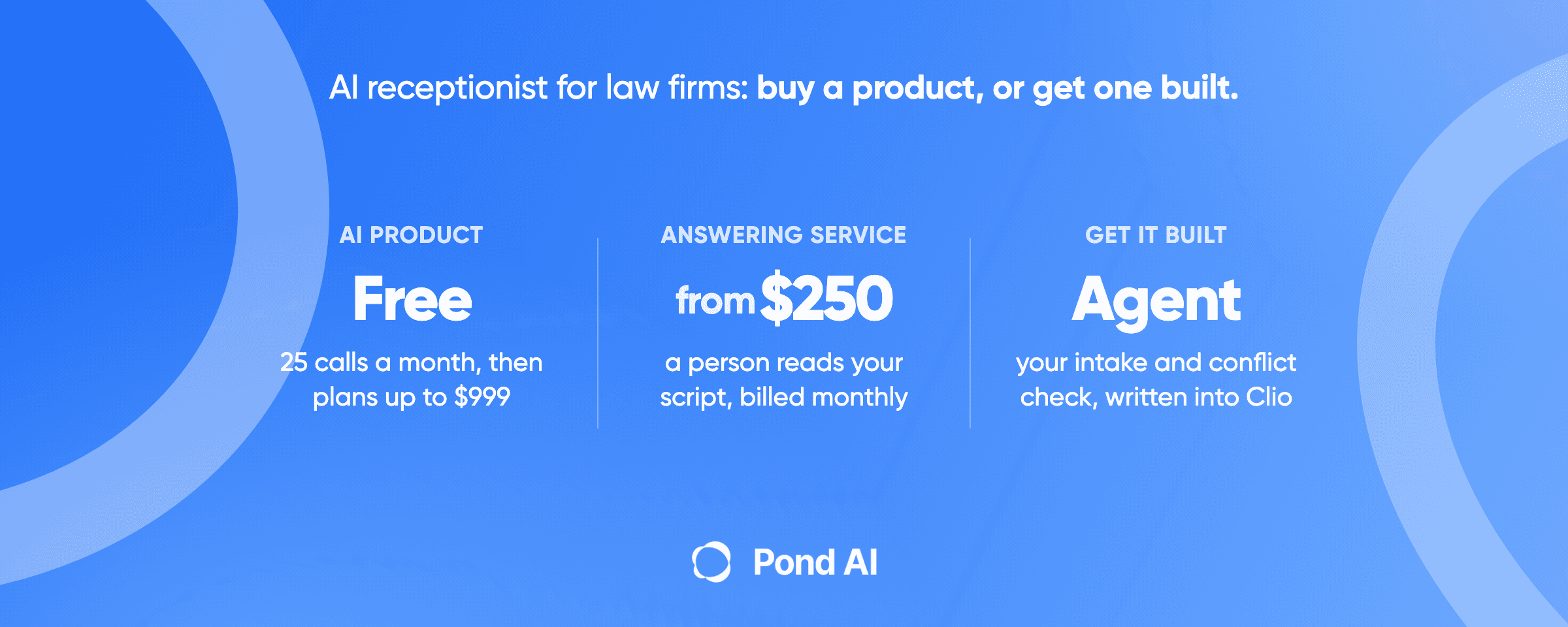
Related reading: AI receptionist for law firms, missed call text back, speed to lead, build vs buy an AI agent, AI agent integration and CRM workflow automation.
Frequently asked questions
How much does an AI answering service cost per month?
On November 4, 2026, entry plans ran from $29 a month (Dialzara, 60 minutes) to $250 (Ruby's human service, 50 minutes). Rosie and RingCentral AIR start at $49, and NextPhone's flat $199 with unlimited inbound calls is the highest AI entry price. Smith.ai has a free tier for 25 calls. Your billing unit and call volume move the bill more than the entry price.
What is the best AI answering service for a small business?
Start with Goodcall if you take up to a few hundred calls a month: it priced lowest of the subscriptions in our worked month at 100 calls ($79) and 300 calls ($129). At 1,000 calls, NextPhone's flat $199 and Goodcall's $172 to $259 stay low, while Dialzara, RingCentral AIR and Smith.ai pass $1,000. For a human on some calls, look at Smith.ai or Abby Connect.
Is an AI answering service better than a human one?
For routine calls it is far cheaper. Ruby's human plans start at $250 a month for 50 minutes, and Smith.ai's human receptionists at $300 a month for 30 calls. A person still handles upset callers, edge cases and judgment calls better. Smith.ai and Abby Connect sell both, so you can route by call type.
Is there a free AI answering service?
Smith.ai's AI Receptionist is free for 25 calls a month, then $3.00 a call. Free trials are more common: Rosie, Dialzara, NextPhone and My AI Front Desk each offer seven days, Allo offers three, and Goodcall lets you test a demo agent before you connect a number. Run any trial on real calls.
Can an AI answering service connect to my CRM?
Yes, natively or through a connector such as Zapier. NextPhone connects to Clio, MyCase, HubSpot and GoHighLevel on Growth and Scale, and Allo says its receptionist "Updates your CRM after every call". Goodcall links natively to HighLevel and reaches other CRMs through Zapier, an API tool or an MCP server. Dialzara uses Make, Zapier or its API, and Rosie uses Zapier for now. If the call must create a record with your own fields, a custom agent built on your CRM is the safer route.
Per minute, per call or flat rate: which billing is cheapest?
Per-caller and flat plans win as volume grows. At 1,000 calls in our worked month, NextPhone stayed at $199 and Goodcall came to about $172 to $259, while Dialzara reached $1,049. Per-call plans like Smith.ai's suit long calls. Per-minute plans like Dialzara's and RingCentral's suit short calls at low volume. Price your own month at your real call count.
Can I build my own AI answering service?
Yes. Voice platforms sell the parts by the minute. Retell quotes $0.07 to $0.31 a minute, Bland charges $0.14 a minute (or $0.12 with a $299 monthly platform fee), and Vapi's own estimate for 1,000 minutes comes to $82 to $129 a month. You or a developer still write the call flow, connect the calendar and CRM, test it and maintain it. Several subscriptions sell that work as their top tier.
Do AI answering services handle HIPAA calls?
Some do, on specific plans. Goodcall signs a BAA on its $299 Scale plan and Enterprise, Allo charges $50 a month per workspace for one, and RingCentral lists HIPAA compliance as included with AIR. Ruby lists HIPAA-compliant services (its service is human), and Abby marks its HIPAA options as human only. Get the vendor's answer in writing before patient calls go through.