Short answer: An after-hours answering service picks up your business line when the office is closed, sorts the caller into emergency or routine, pages the on-call technician when it is urgent, and books the rest. There are three ways to buy one in 2026: a live call center, an AI answering product, or a custom agent built to your own steps. For a home-services company, the right pick is the cheapest route that ends the night with a real job on your schedule, not just a message in your inbox.
We make Pond, which builds custom AI agents, including answering agents, so weigh our view of the build route accordingly. Every price below is the vendor's own US list price on monthly billing, read on the vendor's pricing page on November 10, 2026. Check the page again before you buy.
The three routes at a glance
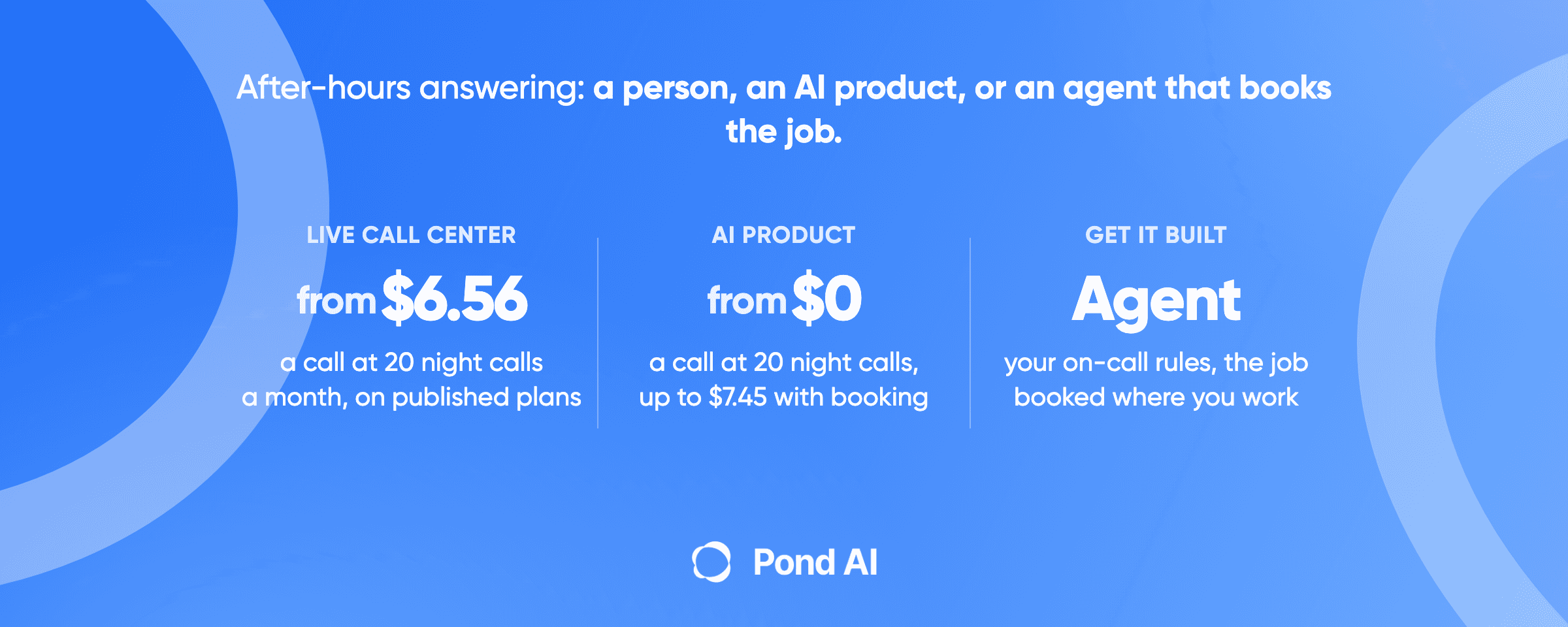
| Route | What one after-hours call costs (published plans, 3-minute call) | What happens on an emergency | Can it book the job into your schedule? | Best for |
|---|---|---|---|---|
| Live call center | $6.56 to $19.75 a call at 20 calls a month | A person follows your script and pages the on-call technician | Smith.ai sells booking as a $1.50-a-call add-on; Housecall Pro's own service books into its calendar | Shops that want a person on every call, whatever it costs |
| AI answering product | $0 to $7.45 a call at 20 calls a month | Transfers to a person; on some plans the AI briefs them first | On some plans: Smith.ai's AI schedules with Calendly; Rosie books into the calendar from its $149 plan | Routine calls, steady volume, a booking tool the product already supports |
| Custom agent built to your steps | $0.21 to $0.93 a call in voice-platform usage, plus the build | Whatever your steps say, written by you | Yes, if the build connects it to the calendar and CRM you already use | Shops whose booking rules or systems no plan's template holds |
The cost figures come from the table further down, where every plan and assumption is shown. For a full product-by-product review of the AI options, see our AI answering service comparison. This page is about the after-hours window: the emergency call, the on-call page, and the job that should be on the board by morning.
What an after-hours call has to do
An after-hours call in HVAC, plumbing or electrical work is one of three calls, and each needs a different ending.
- An emergency. No heat in January, a burst pipe, a sparking panel. The call has to reach the on-call technician fast, with the address and the problem written down.
- A routine job. A dripping tap, a tune-up, a quote. The call should end with a booked slot, not a promise that someone will call back.
- Everything else. A supplier, a wrong number, a sales pitch. These should cost you as little as possible.
There is one more case, and it comes before all three. A caller who smells gas or has carbon monoxide symptoms is not a booking. Columbia Gas of Ohio tells that caller to "go outside and call 911", and to leave the building without using a phone or light switch inside it. The first sentence your answering service says on that call is get out and call 911. Only then does anyone page a technician. Each local gas utility publishes its own instruction, so write yours into the script word for word.
A good after-hours setup gets each of those endings right. That is a better test than "answers 24/7", which each of the top five Google results for this search in the US claimed on November 10, 2026.
Route 1: a live call center
A live call center puts a trained person on your line overnight. The person reads your script, takes the details, and pages your on-call technician for an emergency. AnswerForce's home-services page describes exactly that job: answer the emergency call, "capture the necessary information, and dispatch your on-call technicians." It does not print a price; every plan sits behind a "See Prices" form.
The services that do print prices bill in two ways:
- Per call. Smith.ai's human receptionists cost $300 a month for 30 calls, $810 for 90 and $2,100 for 300. Night calls cost no more than day calls: "Calls at 2 pm and 2 am cost the same." Booking an appointment is an add-on at $1.50 a call.
- Per minute. Ruby charges $250 a month for 50 receptionist minutes, up to $1,725 for 500. MAP Communications starts at $49 a month with no minutes included and $1.37 for each minute, and its Business plan is $179 for 125 minutes.
Per minute, the live services spread widely. Ruby's entry plan works out to $5.00 a minute. MAP's Business plan averages about $1.43 a minute across its included minutes. So be careful with any single "market rate". Goodcall, which sells AI answering, says on its pricing page that "A live answering service runs about $1.50 to $1.90 a minute." Ruby's entry plan, at $5.00 a minute, costs well above that range.
What you get for the money is judgment. A person can hear panic, ask a follow-up nobody scripted, and decide a call is urgent. What a live service does not do by default is put the job on your schedule. Smith.ai charges extra for it, and its booking add-on works with tools such as Calendly and Acuity. Field-service software is a different matter. Housecall Pro sells its own trained-agent service, HCP Assist, that books "straight onto your Housecall Pro calendar", with weekday, weekend or 24/7 coverage. It shows no price on its page.
Route 2: an AI answering product
An AI answering product answers the call with a voice agent, follows a script you fill in, and sends you a summary. It costs a fraction of a person per call, and most plans let it hand a call to a human.
Three published examples, read on November 10, 2026:
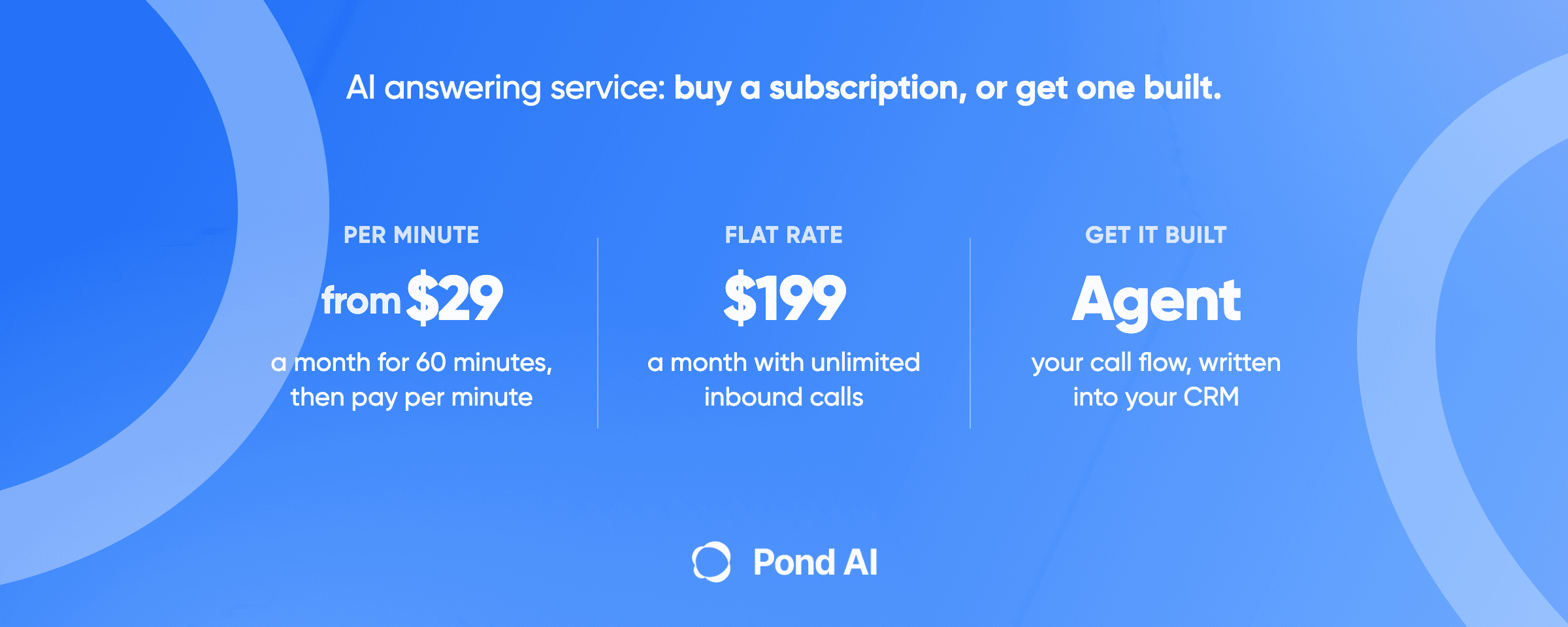
- Smith.ai AI Receptionist. Free for 25 calls a month, then $3.00 for each extra call; Pro is $150 a month for 75 calls. Scheduling with Calendly is on every plan, and the AI can transfer a call "to a live North America-based receptionist" when it needs a person.
- Goodcall. $79 a month for 100 unique customers, then 79 cents each, where a customer is "One phone number, once a month." It does not bill by the minute.
- Rosie. $49 a month for 250 minutes on Professional, which can text the caller a booking link. Booking straight into your calendar starts on the $149 Scale plan, which also adds warm transfers, where Rosie briefs your team before it connects the caller.
Field-service software is adding the same thing. Jobber lists an AI Receptionist add-on to "Provide 24/7 customer service over call or text" and book jobs in the Jobber calendar. We could not confirm its price from Jobber's pricing page.
The limit of a product is its template. It books into the calendars it supports, asks the questions its form holds, and transfers the way its plan allows. If your emergency rules are simple and your booking tool is on the vendor's list, that limit costs you nothing. The full list of products, prices and billing units is in our AI answering service comparison.
Route 3: a custom agent that books the job
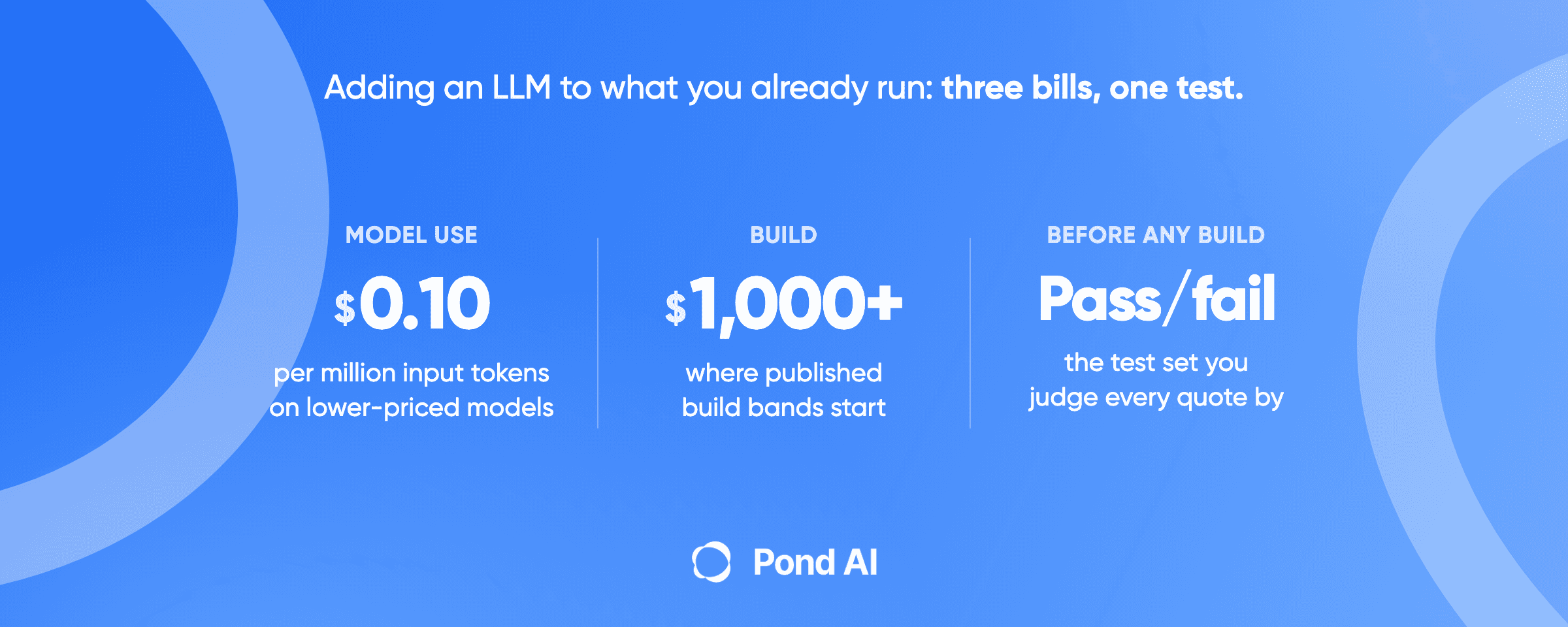
A custom agent is a voice agent built to your own call flow and connected to your own systems. It runs on a voice platform such as Retell, which quotes $0.07 to $0.31 a minute for voice agents. Someone still has to write the call flow, connect the calendar or CRM, test it, and keep it working when your schedule rules change. That work is the real cost, and it is why this route is not the cheapest one for most small shops.
It pays off when the night shift has rules a template does not hold. Some examples:
- The on-call technician changes by day of the week, by trade, or by area.
- An emergency call needs a dispatch fee quoted and accepted before anyone drives out.
- A routine job has to land in a specific slot type, with the equipment and the address already on the work order.
- The record has to exist in the CRM by morning, so the office does not retype voicemails.
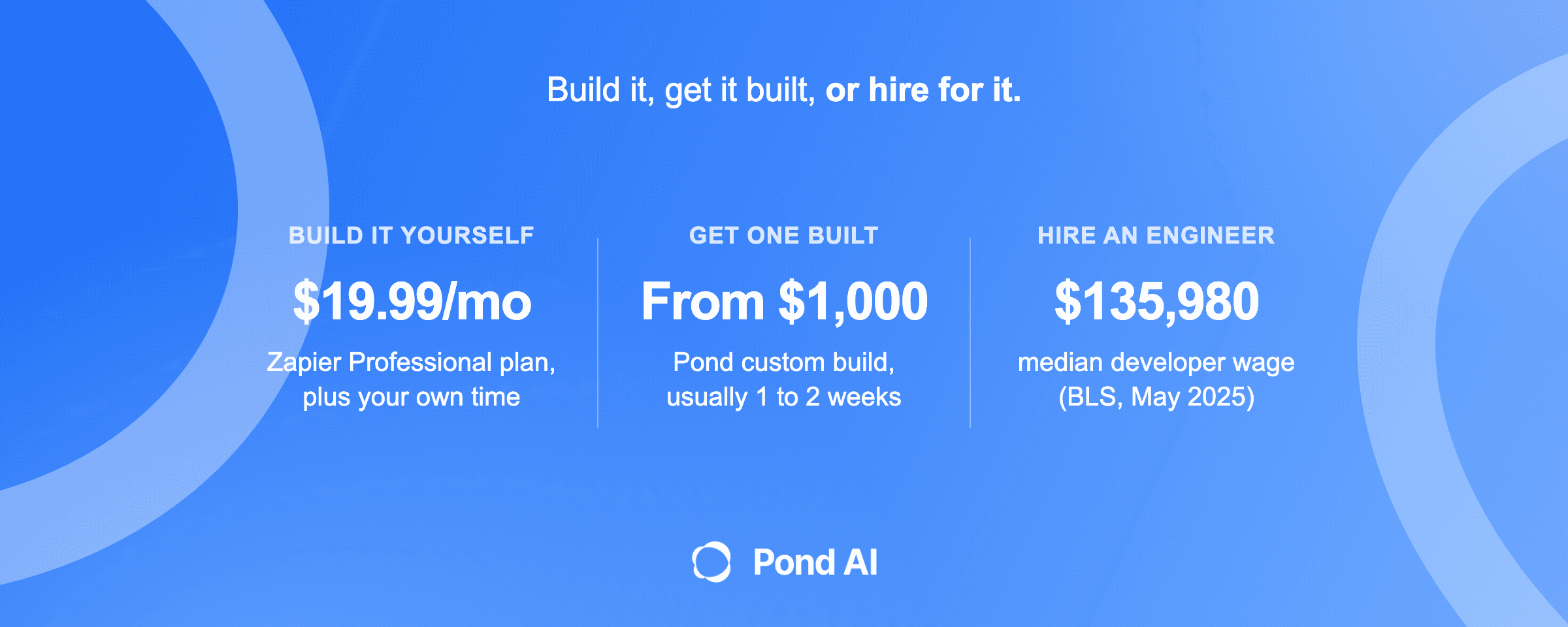
Pond builds this kind of agent. Pond "builds, runs and maintains custom AI agents for businesses," and Pond's founder confirms it builds AI receptionists and answering services as custom agents. Per Pond's home page, custom builds "start from $1,000, usually take 1 to 2 weeks, and come with a 7-day refund that applies only to custom builds." Its home page also says custom builds "are refunded within 7 days if benchmarks aren't met," and that an agent can work with "your CRM, email, spreadsheets and other tools." Pond does not publish a monthly running cost for a custom agent, and it has no published answering-agent customer result yet, so ask for both before you buy. If you would rather build the agent yourself, Pond's AI agent development page lists a Free plan at $0 billed by usage, Build at $100 a month plus usage, and Scale at $200 a month plus usage.
For the wider decision between doing it yourself, buying a product and getting it built, see build versus buy.
What 20 and 60 after-hours calls cost
The table prices the same night-and-weekend workload on each published plan: 20 calls a month for a small shop, 60 for a busy one. We assume a 3-minute call. That is our assumption, not a vendor figure, so swap in your own call length. Each row uses the cheapest published plan that covers the volume on monthly billing.
| Plan | 20 calls (60 minutes): month / per call | 60 calls (180 minutes): month / per call |
|---|---|---|
| Smith.ai human receptionists (Starter, then overage) | $300 / $15.00 | $645 / $10.75 |
| Ruby (100-minute plan, then 200-minute plan) | $395 / $19.75 | $720 / $12.00 |
| MAP Communications (pay as you go, then Business) | $131.20 / $6.56 | $250.50 / $4.18 |
| Smith.ai AI Receptionist (Free, $3.00 a call after 25) | $0 / $0 | $105 / $1.75 |
| Goodcall Starter (each call a new customer) | $79 / $3.95 | $79 / $1.32 |
| Rosie Professional (texts a booking link) | $49 / $2.45 | $49 / $0.82 |
| Rosie Scale (books into the calendar) | $149 / $7.45 | $149 / $2.48 |
| Custom agent on Retell, voice-agent usage only (no build, no phone line) | $4.20 to $18.60 / $0.21 to $0.93 | $12.60 to $55.80 / $0.21 to $0.93 |
Three things the table does not show:
- The build. The custom row leaves out the build itself ($1,000 and up at Pond) and the cost of running and maintaining it, which Pond does not publish.
- The services with no public price. AnswerConnect, AnswerForce and HCP Assist publish no plan price, and we could not confirm the price of Jobber's add-on, so none of them is in the table.
- What a booked job costs. Divide the per-call cost by the share of calls that end as a booked job. If one call in three books, a booked job costs three times the per-call figure. We do not know your booking rate, and no study we found measures it for after-hours calls, so we will not print one.
The billing unit changes the order. A per-minute live service charges for every minute a stressed caller talks. A per-caller or flat AI plan charges the same for a long call as a short one. At 20 calls, MAP's pay-as-you-go plan ($6.56 a call) costs less than Rosie's booking plan ($7.45). At 60 calls, every AI plan in the table costs $2.50 a call or less, and the cheapest live plan costs $4.18.
Where the booked job lands
A call that ends in a message is not a booked job. A booked job is a time slot in the tool your technicians work from, with the address and the problem already on it. Ask every vendor which tool it writes to before you compare prices.
- A general calendar (Calendly, Google Calendar). Smith.ai's AI plans and Rosie's Scale plan book here. This works if your office books from that calendar.
- Your field-service software. Housecall Pro's HCP Assist and Jobber's AI Receptionist book into their own calendars. AnswerForce's home-services page shows ServiceTitan and Housecall Pro logos but does not say on that page what it writes to either one. Ask.
- Your CRM, by your rules. A custom agent can write the job, the notes and the caller's details where your team already works, in the shape your team uses. See AI agent integration for how that connection is built and tested.
If nobody answers at all, a missed call text back is the cheap safety net, but it only starts after the call is lost. A caller with water on the floor will try the next number, which is the argument of speed to lead.
Which route fits which shop
- Pick a live call center if your after-hours calls are mostly emergencies, your callers need a calm person, and a few hundred dollars a month is small next to one missed furnace job. Pay for booking only if the service writes to the tool you schedule from.
- Pick an AI answering product if most night calls are routine, your schedule lives in a calendar or field-service tool the product supports, and your emergency rule fits in one transfer step. Start on a free or low plan and read the call summaries for two weeks.
- Get a custom agent built if your on-call rules, dispatch fees or booking slots do not fit any plan's template, or if the job has to arrive in your CRM with nothing retyped. Expect a build fee and a running cost, and ask for both in writing.
You can also mix two routes: a person for emergencies and an agent for everything else. That costs less than a person on every call.
Frequently asked questions
How much does an after-hours answering service cost?
On published plans read on November 10, 2026, a 3-minute after-hours call costs about $6.56 to $19.75 with a live service at 20 calls a month, and $0 to $7.45 with an AI answering product. A custom agent costs $0.21 to $0.93 a call in voice-platform usage, plus the build. Several services, including AnswerConnect and AnswerForce, publish no price at all.
Do answering services charge more for nights and weekends?
Not on the published plans we read. Smith.ai says plainly that "Calls at 2 pm and 2 am cost the same." Ruby and MAP list no separate night rate, and MAP includes 24/7 coverage on every plan. MAP's own pricing page still warns that after-hours or holiday support "can significantly add to your monthly expenses" across the market, so check the contract before you sign.
Can an after-hours answering service dispatch my on-call technician?
Yes, if you give it a dispatch rule. Live services such as AnswerForce describe paging the on-call technician as part of the job. AI products transfer the call to a person; Rosie's Scale plan briefs your team before it connects the caller. A custom agent follows whatever on-call rota you write into it.
Can it book jobs into Housecall Pro or Jobber?
Housecall Pro and Jobber each sell their own answering option that books into their own calendar: HCP Assist uses trained agents, and Jobber's AI Receptionist is an add-on. HCP Assist shows no price on its page, and we could not confirm the price of Jobber's add-on. Other services book into general calendars such as Calendly, and a custom agent can be connected to the field-service tool or CRM you already use.
What should the service do with a gas leak or carbon monoxide call?
Tell the caller to leave and call 911 before anything else. Columbia Gas of Ohio's instruction is to "go outside and call 911", and other utilities publish their own. Put your local utility's wording in the script, then have the service page your on-call technician.
Live person or AI for HVAC and plumbing calls at night?
Use a person where judgment matters most, which is the true emergency, and let an AI take the routine calls that only need a slot. You can run both: the AI answers, books the routine jobs, and transfers emergencies to a person or to the on-call technician.
What does a custom answering agent add over a subscription?
Your own rules and your own systems. A subscription asks the questions its template holds and books into the tools it supports. A custom agent follows your on-call rota, dispatch fees and slot types, and writes the job into the calendar and CRM you already use. It costs more up front: at Pond, custom builds start from $1,000 and usually take 1 to 2 weeks.
Get an after-hours agent built
If your night calls follow rules no plan's template holds, Pond can build an agent that answers, sorts emergencies from routine, pages your on-call technician, and books the job where your team works. Custom builds start from $1,000, usually take 1 to 2 weeks, and are refunded within 7 days if benchmarks aren't met.
If your team wants to build its own agent with ready-made tools, Try Pond. If you want Pond's team to build, run and maintain an after-hours agent for you, Get a custom AI agent.