Short answer: The best Zapier alternatives for AI agents in 2026 fall into two groups. For automation with AI steps, n8n suits technical teams that want to self-host or pay per workflow run, Make suits visual builders, and Activepieces is the open-source pick with a free plan. For agents that choose their own next step, Gumloop and Lindy are self-serve builders, while Relevance AI sells through its sales team. If nobody on your team has time to build an agent and keep it working, have it built instead.
Pond publishes this blog. Pond builds custom AI agents and offers tools to build your own, and Pond is not in the comparison table or the tool reviews.
Zapier alternatives at a glance
| Tool | Best for | Entry price, as listed | Watch for |
|---|---|---|---|
| Zapier (the baseline) | Teams already running Zaps across many apps | Professional from $19.99 a month billed annually, or $29.99 billed monthly, for 750 tasks a month. Free has 100 tasks a month | Every successful action step counts as a task |
| n8n | Teams with a developer who wants to self-host or pay per run | Starter is $24 a month billed monthly, or $240 a year billed annually, for 2,500 executions a month (USD) | The free self-hosted edition is licensed for internal business use |
| Make | Scenarios with branches, built visually | Core is $16 a month billed monthly, or $144 a year billed annually, for 10,000 credits a month (US pricing) | Plans differ by country |
| Activepieces | A free, open-source start | Free is $0 for 1,000 credits a month. Plus is $20 flat per month, billed monthly, for 10,000 credits a month | Core code is MIT licensed |
| Pipedream | Developers adding connectors to their own agents and apps | Free is $0. Startup is $99 a month billed annually, or $150 billed monthly, with 10,000 usage credits | Priced for developers, not as a like-for-like Zapier swap |
| Power Automate | Teams already on Microsoft's tools | Premium is $15.00 per user a month, paid yearly | Agents are sold separately through Copilot Studio |
| Zapier Agents (the agent baseline) | Agents inside an existing Zapier account | Agents Pro is $50 a month billed monthly, or $400 a year billed annually, for 1,500 activities a month | Billed in activities, apart from Zap tasks |
| Gumloop | Teams building and sharing AI agents | Pro starts at $37 a month for 20k credits a month, with a 14-day free trial | Agents stop when credits run out unless pay-as-you-go is on |
| Lindy | An AI employee that plugs into your tools | Team from $29.99 a month per active user for 3,000 credits. Some visitors see $49.99 for 5,000 credits | Every active user in the workspace is billed |
| Relevance AI | Enterprise agent programs | No public price. Enterprise only, through sales | No self-serve plan |
Prices are each vendor's own, in US dollars, checked November 6, 2026. Credits are not comparable across vendors: Make, Activepieces, Pipedream, Gumloop and Lindy all use the word, and each one means something different by it.
Why teams start looking for a Zapier alternative
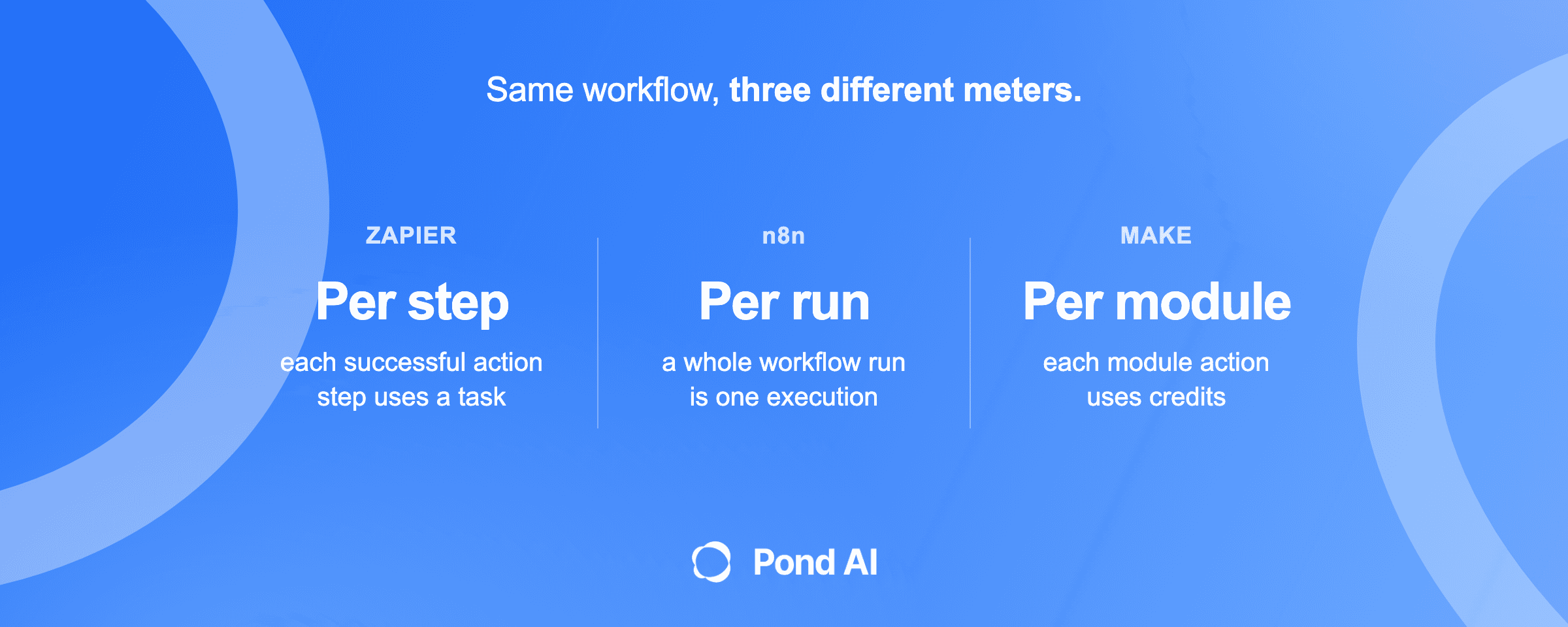
The bill grows with the number of steps. Zapier says it on its own pricing page: "Tasks are used when a Zap successfully moves data or completes an action for you automatically." Failed actions don't count, and built-in tools such as Filter, Formatter and Paths use no tasks. Every other successful action step does.
A Zap with five action steps that runs 1,000 times a month uses 5,000 tasks for its actions alone. On Zapier's monthly-billed grid, Professional costs $29.99 at the 750-task tier and $133.50 at the 5,000-task tier. The Free plan only runs two-step Zaps, so any multi-step flow means paying.
AI steps add a second multiplier. Zapier's task usage rates charge an AI by Zapier step 1 task on standard models, 3 tasks on advanced models and 5 tasks on premium models. Standard models cannot call tools. On advanced and premium models, each tool call the AI makes is billed again at the step's rate. A Zapier MCP tool call costs 2 tasks. The rates page puts it plainly: "The more reasoning a step requires, the more tasks it consumes."
Going over the limit costs more. Zapier's FAQ says pay-per-task usage "is charged at a higher per-task rate than your base subscription tasks." For accounts that joined after January 2024, pay-per-task is on by default and capped at 3 times the plan's task limit, after which Zaps stop.
One date to watch: Zapier's MCP page says the new type of Zap you can deploy from a supported AI client, now in early access, is free to run "until billing starts on Dec. 1, 2026." If you compare costs after that date, look at the page again.
Workflow or agent: decide which one you need first
Mixing these two up is how teams pay agent prices for a job a fixed workflow could do.
Anthropic draws the line in its guide to building effective agents. "Workflows are systems where LLMs and tools are orchestrated through predefined code paths." Agents are different: they "dynamically direct their own processes and tool usage, maintaining control over how they accomplish tasks." The same guide recommends "finding the simplest solution possible, and only increasing complexity when needed."
Zapier's rates page draws the same line: a deterministic workflow is "Every step fires in a fixed order. No AI, no branching." and an agentic one is "AI decides what happens next." Zapier's pricing page, in its Agents FAQ, warns that results vary from run to run "because of non-determinism."
A practical test: if you can write the steps down in order and they rarely change, you need a workflow tool. If someone currently has to decide what to do with each case (a free-text email, a lead that needs research, a support ticket), you need an agent.
Zapier alternatives for automation workflows
n8n: best for technical teams that want to self-host or pay per run
n8n charges per workflow run instead of per step. Its pricing FAQ says: "An execution is a single run of your entire workflow. It doesn't matter how many steps are in the workflow or how much data it processes." A ten-step run counts once.
For a US customer, per n8n's billing provider: Starter is $24 a month billed monthly or $240 a year billed annually, for 2,500 executions a month. Pro is $60 a month billed monthly or $600 a year billed annually, for 10,000 executions a month. n8n's pricing page shows euros to some visitors, with the same digits, so check which currency you are looking at.
The self-hosted Community Edition is free and on GitHub, under n8n's Sustainable Use License. n8n's docs say internal business use is fine, as long as you don't let your customers connect their own accounts and build workflows on it. For agents, n8n's AI Agent node lets you connect a chat model and one or more tools, and "the agent decides which tools to call to complete a task."
Not a fit for: a team with no one to run and update a server, or a product that wants to offer n8n workflows to its own customers. The license is source-available, not an OSI open-source license.
Make: best for visual scenarios with branches
Make bills in credits. Its pricing FAQ says "Every time a module in a scenario performs an action, it consumes credits." Router and error-handler modules use none. The Free plan includes 1,000 credits a month, and credits expire at the end of the term.
Make's plans vary by country. Per Make's US pricing data: Core is $16 a month billed monthly or $144 a year billed annually, for 10,000 credits a month.
The pricing table also lists Make AI Agents (in beta) and an MCP server, both included on the Free plan.
The catch is long scenarios. Make counts actions per module, closer to Zapier's per-step model than n8n's per-run model, so a busy ten-module scenario still uses credits at every step.
Activepieces: best free, open-source start
Activepieces publishes a free plan with no card: $0 for 1,000 credits a month, unlimited flows, up to 5 users. Plus is $20 flat per month for 10,000 credits a month, with overage at $0.007 a credit. The pricing page labels these as billed monthly, and every plan lists cloud or on-prem hosting.
Its repository license puts the code outside its enterprise directories under the MIT license. Features in the enterprise directory sit under a separate license.
Pipedream: best for developers adding connectors to their own agents
Pipedream's pricing page is now built for developers "adding connectors to their agents and apps." Free is $0 with every feature in development. Startup is $99 a month billed annually or $150 billed monthly, with 10,000 usage credits and 100 external users included, then $2 a month for each extra one. These are your app's end users; team members are unlimited. Running an action, an MCP tool call or a proxy request uses 1 credit per 30 seconds of compute, and serving real external users in production requires the Startup plan. It is the wrong pick for a non-developer who wants to swap out Zaps.
Power Automate: best for teams already on Microsoft's tools
Power Automate's US pricing page lists Premium at $15.00 per user a month, paid yearly. There is a 30-day free trial.
Agents cost extra. Microsoft sells them through Copilot Studio, with a pre-purchase plan of prepaid Copilot Credit Commit Units and pay-as-you-go coverage when those credits run out, and an Azure subscription is required to use agents. The $15.00 seat is the workflow price only.
Zapier alternatives for building AI agents
Start with the baseline you would be leaving. Zapier sells Zapier Agents apart from Zap plans, in activities. An activity covers "actions your agent takes in behaviors or in chat, browsing the web, or looking up information from attached knowledge." Agents Free gives 400 activities a month. Agents Pro is $50 a month billed monthly or $400 a year billed annually, for 1,500 activities a month. If your Zap task bill was the reason to leave, Agents adds a second meter on top of it.
Gumloop: best for teams building and sharing AI agents
Gumloop calls itself a builder of AI agents for work, with the line "Build, share, optimize & control agents." Its pricing has two plans. Pro starts at $37 a month with a 14-day free trial and includes 20k credits a month, an 8% orchestration fee and unlimited seats. The fee rises to 16% if you bring your own model API keys. Enterprise is custom.
Gumloop's FAQ says the 20,000 credits are 7,400 plus 12,600 bonus credits, that credits do not roll over, and that agents stop when credits run out unless pay-as-you-go is enabled. There is no free plan and no annual billing on the page.
Lindy: best for an AI employee that works inside your tools
Lindy sells itself as an AI employee, under the home page title "Lindy: Hire an AI Employee That Gets Work Done". Its free plan gives $50 in credits for 7 days, no card. Lindy's pricing page served two versions of the Team plan on November 6: from $29.99 a month per active user for 3,000 credits, with a slider for more, or $49.99 a month for 5,000 credits. Both say every active user in the workspace is billed, so the cost grows with headcount. Top-ups are $10 per 1,000 credits.
Relevance AI: best for enterprise agent programs
Relevance AI's home page is titled "Specialist AI Agents for Every Task." Its pricing page shows one Enterprise tier with "Talk to sales" and no self-serve price, so a small team that wants to start this week will have to book a call first.
What happened to Vellum
Vellum still appears in Zapier-alternative lists, and you should skip it. Vellum's shutdown notice says its Personal Assistant Platform "is being shut down on November 2nd, 2026," that any assistant hosted in Vellum's cloud "will cease to function" after that, that you will not be able to log in, and that your data "will be permanently deleted." The open-source assistant can still be self-hosted, but Vellum says it will no longer actively maintain the repository. Ignore the plans its pricing page still lists.
Keep Zapier, switch tools, or stop building it yourself
Keep Zapier
Your Zaps work, your task count sits inside a tier, and the people who built them are still around. Zapier also now reaches into ChatGPT and Claude: its MCP page says Zapier MCP "lets Claude, ChatGPT, Cursor, and any other AI client take real action in the apps that run your business," at two tasks per tool call. Switching tools costs a rebuild. Do it for a reason.
Switch to another builder
Switch when the bill grows with steps you cannot cut (n8n's per-run pricing is the direct answer) or when the job needs an agent instead of a fixed workflow (Gumloop, Lindy or n8n's AI Agent node). Either way, someone on your team still designs the logic and fixes what breaks. Our guide to connecting an agent to your stack covers what tends to break after the demo.
Stop building and have it built
This is the route when the person who would build it has no time, or does not exist.
Hire an engineer, if the agent is core to your product and you can keep someone on it.
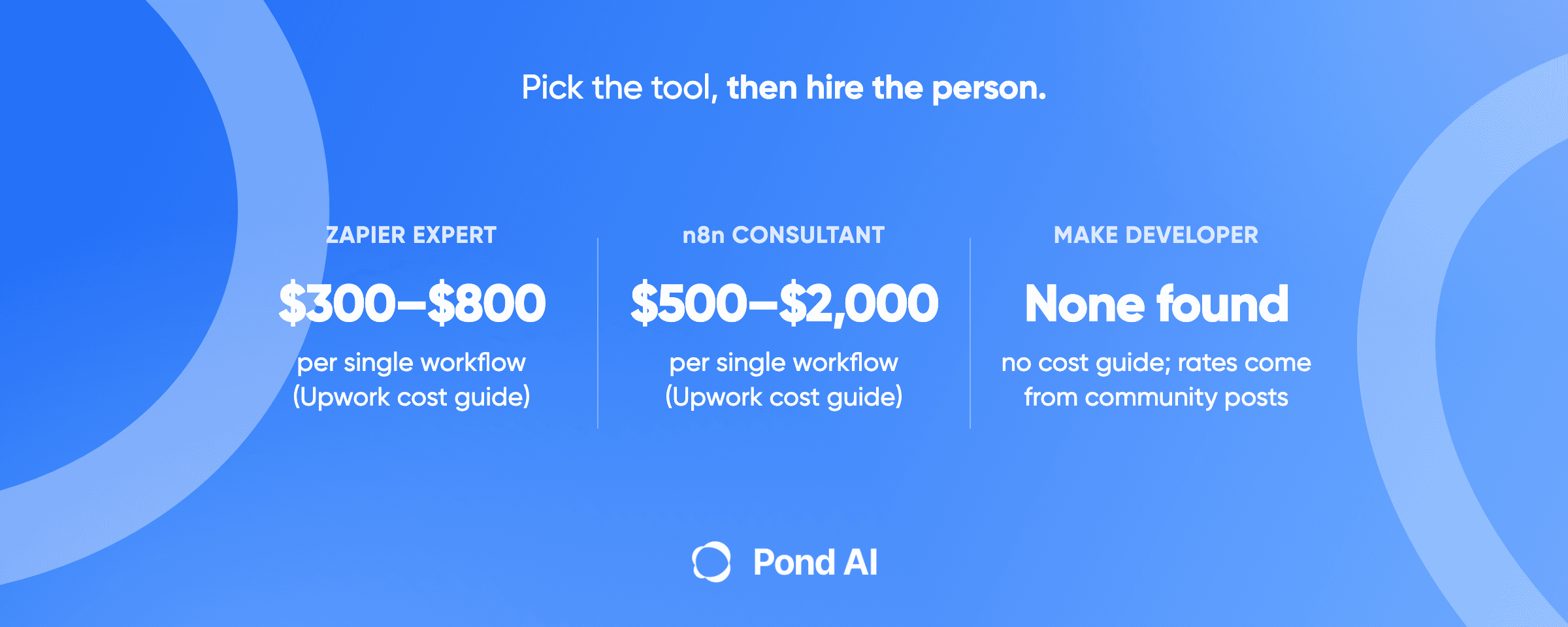
Hire a specialist for the tool you already use. Our guide to Zapier expert, n8n and Make developer costs covers rates and how to brief the build.
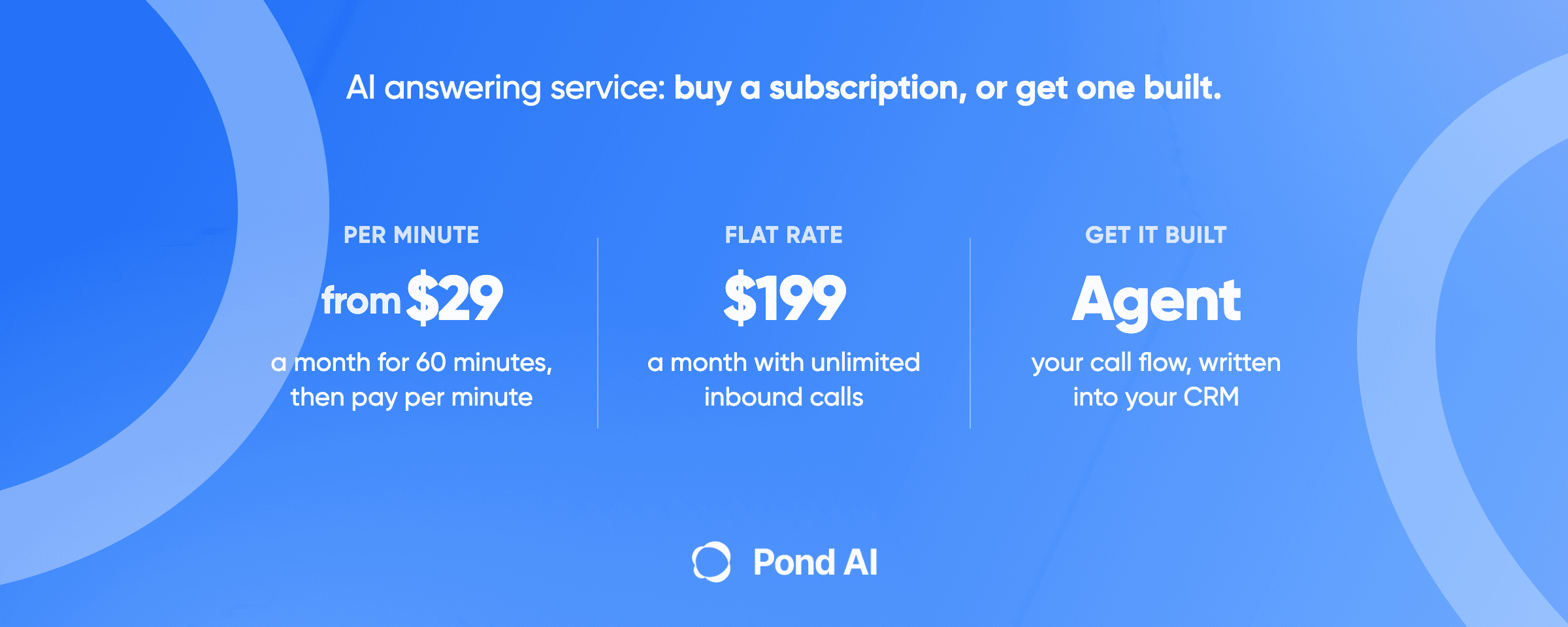
Or have Pond build it. Pond's home page calls it "your AI Engineer" and says Pond "builds, runs and maintains custom AI agents for businesses." Custom AI agent builds start from $1,000 and usually take 1 to 2 weeks, and the Pond team refunds a custom build within 7 days "if benchmarks aren't met." Once the agent is ready, you run it from the AI chatbot your team already uses, such as ChatGPT or Claude: connect Pond once, then ask in plain words. If you would rather build it yourself, Try Pond: describe what you need in plain language, and Pond helps turn it into AI agents, with ready-made tools like workflow templates, scrapers and data connections.
Running automations from ChatGPT or Claude is not a Pond-only feature: Zapier MCP, Make's MCP server and Pipedream all let an AI client call their tools. Pond's own FAQ describes the gap between connected and running: ChatGPT and Claude "aren't connected to your CRM, inbox or data, and they don't run your process every day on their own" out of the box. The connection is the easy half. The difference with Pond is that its team does the build and keeps the agent working. For a fuller comparison of the build routes, see build vs buy an AI agent, and for what a custom build involves, AI agent development on Pond.
Frequently asked questions
Are there free alternatives to Zapier?
Yes. n8n's Community Edition is free to self-host for internal business use. Activepieces has a free plan with 1,000 credits a month and core code under the MIT license. Make has a Free plan with 1,000 credits a month, and Pipedream's free plan covers development.
What is better, Zapier or Power Automate?
Power Automate fits teams already on Microsoft's tools, and its agents cost extra through Copilot Studio. Zapier fits teams whose apps sit outside Microsoft. Price both against your real task volume before deciding.
What is the best Zapier alternative for building AI agents?
For a technical team, n8n, because its AI Agent node runs inside workflows billed per execution and the Community Edition can be self-hosted. For a non-technical team, Gumloop or Lindy, which are built around agents from the start. For an enterprise program with a sales process, Relevance AI. If no one has time to build or maintain the agent, have it built.
How does n8n pricing differ from Zapier pricing?
Zapier counts each successful action step as a task, so a Zap with five action steps that runs once uses about five tasks. n8n counts a whole workflow run as one execution, regardless of steps. The gap widens as workflows get longer.
Can ChatGPT or Claude run my automations without another tool?
Partly. Claude supports custom connectors over remote MCP on every plan. ChatGPT connects to apps such as Google Drive or Slack, and eligible users can create a task in Work that runs when a supported connected app receives a matching event; which apps you get depends on your plan, region and workspace. Someone still has to build the steps and keep them running.
Should I hire a Zapier expert or have an AI agent built?
Hire a Zapier, n8n or Make specialist when the job fits the tool you already pay for and someone on your team can own it after handover. Have an agent built when the job needs judgment on each case and nobody internal can maintain it.
Build your own agent, or have one built
If your team wants to build its own agents, Try Pond and run them from ChatGPT or Claude. If you want Pond's team to build, run and maintain one for you, Get a custom AI agent.