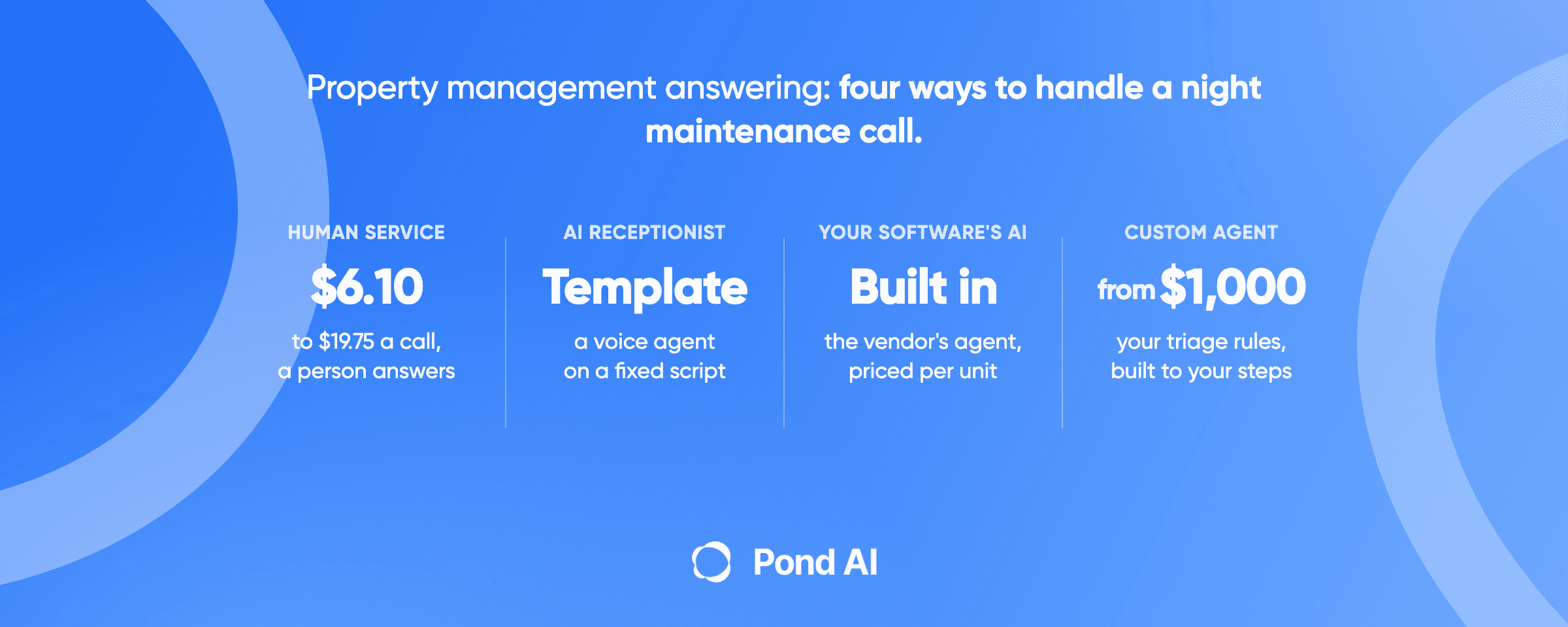
Short answer: A property management answering service picks up the tenant line when the office is closed, decides whether a maintenance call is an emergency, urgent until morning or routine, and leaves a record the office can act on. There are four ways to buy one in 2026: a live answering service, an AI receptionist product, the AI inside your property management software, or a custom agent built to your triage rules. Pick the cheapest route that leaves a complete work order by morning; a voicemail summary does not count.
We make Pond, which builds custom AI agents, including answering agents, so weigh our view of the build route accordingly. Every price below is the vendor's own US list price, read on the vendor's pricing page on November 12, 2026. Plan prices are monthly, with two exceptions: DoorLoop's figures are its default Yearly tab, and AppFolio's page names no billing period. Check the page again before you buy.
The four routes at a glance
| Route | Who answers | What 20 after-hours calls a month cost (3-minute calls) | What 60 calls a month cost | What lands in your property management software | Best for |
|---|---|---|---|---|---|
| Human answering service | A person follows your script | $121.90 to $395 a month, $6.10 to $19.75 a call | $250.50 to $720 a month, $4.18 to $12.00 a call | A message or ticket you carry over unless the service writes to your software; ask | shops that want a person on every call |
| AI receptionist product | A voice agent follows a template | $0 to $79 a month, $0 to $3.95 a call | $79 to $105 a month, $1.32 to $1.75 a call | What the product supports; ask which software it writes to | routine calls at steady volume |
| AI inside your property management software | The software vendor's agent | Priced per unit for the whole platform rather than per call: at 250 units, AppFolio Core starts at $372.50 a month with no phone-answering agent listed, and DoorLoop Connect starts at $1,000 on its Yearly tab | Same: the price does not move with call volume | The software's own records, if your plan includes the agent | shops already on a plan that includes it |
| Custom agent built by Pond | A voice agent built to your triage rules | Priced per build, from $1,000 (see Route 4); for scale, market voice-agent rates alone come to $4.20 to $18.60 a month, $0.21 to $0.93 a call | Priced per build (see Route 4); for scale, market voice-agent rates alone come to $12.60 to $55.80 a month, $0.21 to $0.93 a call | The fields you ask the build to log in your own system, as part of its scope | shops whose emergency rules or work-order fields no template holds |
The call figures come from the cost table further down, where every plan and assumption is shown. The 3-minute call is our assumption and no vendor publishes it. For the wider picture of what a manager can automate besides the phone, see our property management automation guide.
What a maintenance call has to do
A maintenance call after hours is one of three calls, and each ends differently.
- An emergency. A call-out is needed tonight. One virtual-office and live-receptionist firm's guide lists gas smell, active flooding, no heat in freezing conditions, fire or smoke, a security breach and a lockout in this tier. That is one firm's framework and no standard, and the lockout is the item operators argue about.
- Urgent, but it can wait until morning. No hot water, one broken appliance, a minor contained leak. The call needs a timestamp and a log entry, and a person sees it first thing.
- Routine. Rent, lease and package questions. Nobody needs to wake up for these.
Triage needs a duration question as well as a category. The same guide warns that a "minor contained leak" that has been running for six hours is no longer minor, so the script has to ask how long it has been going.
One call comes before all three. A caller who smells gas or has carbon monoxide symptoms is not a work order. Columbia Gas of Ohio tells that caller to "go outside and call 911 and then call us", and not to use anything that could cause a spark, such as a phone or light switch. The first line your service says on that call is get out and call 911. The ticket comes after. Each local gas utility publishes its own instruction, so write yours into the script word for word.
In Washington, the law sets the clock by what the defect takes away from the tenant. RCW 59.18.070 is Washington's landlord-tenant rule and no national one. It requires the landlord to begin remedial action within 24 hours when the defect deprives the tenant of hot or cold water, heat or electricity, or is imminently hazardous to life, and within 72 hours when it takes away a refrigerator, range and oven, or a major plumbing fixture the landlord supplies. In all other cases the limit is ten days. Other states and your own leases differ, so write the triage rule from your lease terms and local law.
Route 1: a human answering service
A live service puts a trained person on your line overnight. The person reads your script, takes the details and pages your on-call technician or vendor. Five services publish prices, and they bill in two ways.
- Per minute. PATLive's pay-as-you-go plan is $49 a month with no included minutes and $2.99 per additional minute; its 50-minute plan is $99, and it lists emergency dispatch among the features on every plan. MAP Communications starts at $49 a month with 0 minutes included and $1.37 per additional minute, and its Business plan is $179 for 125 minutes. Ruby charges $250 a month for 50 minutes and $1,725 for 500, and lists no overage rate. Abby Connect sells $164 a month for 50 Abby Minutes, where a human minute uses one and an AI minute uses half. Overage is billed at the plan's Abby Minute rate, which works out to $3.28 a minute on that 50-minute plan.
- Per call. Smith.ai's human receptionists cost $300 a month for 30 calls, $810 for 90 and $2,100 for 300. Night calls cost no more: "Calls at 2 pm and 2 am cost the same."
Three services that engines and Google rank for this search show no price. SignMore, AnswerConnect and Latchel put plans behind a form or offer an assessment instead, so none of them is in the cost table.
Be careful with any single "market rate". Goodcall, which sells AI answering, says a live answering service runs about $1.50 to $1.90 a minute. The live services' own pages disagree: PATLive's overage runs $1.79 to $2.99 a minute and MAP's $1.28 to $1.37, while Ruby's published plans work out to roughly $3.45 to $5.00 a minute.
What you pay for is judgment. A person can hear panic and ask a follow-up nobody scripted. What a live service does not do by default is write the work order in your software, so ask which system it writes to before you compare prices.
Route 2: an AI receptionist product
An AI receptionist answers with a voice agent, follows a script you fill in, and sends a summary. It costs a fraction of a person per call.
- Smith.ai AI Receptionist. Free for 25 calls a month, then $3.00 a call; Pro is $150 a month for 75 calls. Enterprise starts at $500 a month for 300 calls and adds custom prompting and unlimited custom integrations.
- Goodcall. $79 a month for 100 unique customers, then 79 cents each, where a customer is "One phone number, once a month." It states that it never meters minutes.
The limit of a product is its template. It asks the questions its form holds and transfers the way its plan allows. If your emergency rule is one transfer step and the product supports your software, that limit costs you nothing. For a product-by-product review, see our AI answering service comparison.
Route 3: the AI inside your property management software
Some property management platforms now sell an agent of their own, which can let a call end in a work order in the same system.
- AppFolio. The Core plan is listed as starting at $1.49 per unit per month with a 50-unit minimum, and the page names no billing period. That price is for the whole platform, and the page carries no published price for a maintenance AI.
- DoorLoop. On the default Yearly tab, One is from $2.50 per unit per month, "As low as $1.50 per unit above 100", and Connect is from $4.00. The page names a Receptionist Agent, which answers tenant texts, calls and portal messages around the clock; Multiply, from $5.00 and invite only, adds a Maintenance Ops Agent that runs maintenance from work order to bill. Every price carries a minimum spend and a units note.
- Yardi Breeze Premier. A paid add-on is headed "Win at customer service with a 24/7 maintenance call center". The page we read shows no price for it.
These prices cover the whole platform, and none of them is a price per call. At a 250-unit portfolio, which is our illustration and not a quote, DoorLoop Connect is $1,000 a month on the Yearly tab. DoorLoop One is at most $625 on the Yearly tab, and as low as $475 if its above-100 rate applies. AppFolio's $1.49 is $372.50 a month at 250 units for the Core platform alone. Minimums apply on all of them, so treat these as starting prices. This route makes sense if you are on that software and the plan with the agent is the one you would buy anyway. It does not help if you run a different system.
Route 4: a custom agent built by Pond
A custom agent is a voice agent built to your own triage rules and connected to the tools you already use. As a market example, Retell AI prices pay-as-you-go voice agents at $0.07 to $0.31 a minute. Whoever builds the agent still writes the call flow and the connection to other software, tests it, and keeps it working when your rules change. That work is the real cost.
It pays off when the night shift has rules a template does not hold:
- Your emergency list differs from the vendor's, for example a lockout is urgent at one building and an emergency at another.
- The agent has to ask a duration question before it classifies a leak.
- Your on-call vendor and spend ceiling change by property, so the agent can approve a call-out up to a set dollar limit without waking you.
- The ticket has to exist in your property management software by morning, with nothing retyped from a voicemail.
Pond builds this kind of agent. Pond "builds, runs and maintains custom AI agents for businesses," and it builds AI receptionists and answering services as custom agents. Custom AI agent builds start from $1,000, usually take 1 to 2 weeks, and come with a 7-day refund that applies only to custom builds. Pond's home page says an agent can work with your CRM, email, spreadsheets and other tools. For a property management system, ask the build to log the work order there as part of its scope, and get in writing which system it will write to. Pond does not publish a monthly running cost for a custom agent, and it has no published maintenance-triage customer result yet, so ask for both in writing before you buy. If you would rather build the agent yourself, Pond's AI agent development page lists a Free plan at $0 billed by usage, Build at $100 a month plus usage, and Scale at $200 a month plus usage.
What the call must write into your property management software
Whatever route you pick, the test is the record. A call has been handled when a work order exists with the fields below. This is our spec for a builder or a vendor, not a standard. The first three come from what Washington's statute requires in a tenant's notice, which is a useful minimum anywhere: the premises, the name of the owner if known, and the nature of the defective condition.
- The premises. Building and unit.
- The owner. The name of the owner, if the caller knows it.
- The nature of the defect. What is wrong, in the caller's words, and how long it has been going.
- The urgency tier. Emergency, urgent until morning, or routine, with the rule that set it.
- A callback number.
- A timestamp.
- What the service did. For an emergency: who was paged and at what spend ceiling.
Vendors that handle emergencies describe what they need from you in writing, and it is the same list a builder needs: an on-call rotation, a preferred vendor list with after-hours rates, a spend authorization ceiling, and a list of units with known issues. The same firm frames the ceiling as letting an agent approve a $400 emergency call-out without waking you for permission.
The next-morning check is simple. Open the software and ask three questions of last night's calls: does a ticket exist, is it on the right unit, and does it carry the right priority? A route that fails that check has answered the phone, not handled the call. For the phone mechanics behind it, see our guide to an after-hours answering service.
What 20 and 60 after-hours calls cost
The table prices the same workload on each published plan: 20 after-hours calls a month for a small portfolio, 60 for a busy one. We assume a 3-minute call and, for Goodcall, fewer than 100 distinct callers. Each row uses the cheapest published way to cover the volume, a plan alone or a plan plus its overage, on monthly billing, build fees excluded.
| Plan | 20 calls (60 minutes): month / per call | 60 calls (180 minutes): month / per call |
|---|---|---|
| PATLive (50-minute plan plus overage, then 200-minute plan) | $121.90 / $6.10 | $349 / $5.82 |
| Smith.ai human receptionists (Starter, then overage) | $300 / $15.00 | $645 / $10.75 |
| Ruby (100-minute plan, then 200-minute plan) | $395 / $19.75 | $720 / $12.00 |
| MAP Communications (pay as you go, then Business plus overage) | $131.20 / $6.56 | $250.50 / $4.18 |
| Abby Connect (50-minute plan plus overage at its $3.28 minute rate, human minutes) | $196.80 / $9.84 | $590.40 / $9.84 |
| Smith.ai AI Receptionist (free tier, then $3.00 a call over 25) | $0 / $0 | $105 / $1.75 |
| Goodcall Starter | $79 / $3.95 | $79 / $1.32 |
| Retell AI voice-agent usage only (a market example; no build included) | $4.20 to $18.60 / $0.21 to $0.93 | $12.60 to $55.80 / $0.21 to $0.93 |
What the table leaves out matters as much as what it shows:
- The build. The Retell row shows market rates for voice-agent usage alone. A Pond build is priced under Route 4, and Pond does not publish the monthly cost of running and maintaining a custom agent.
- The platform routes. AppFolio, DoorLoop and Yardi bill per unit for the whole platform, so they sit in the comparison above and not in this table.
- The services with no public price. SignMore, AnswerConnect and Latchel are not here.
- Your own mix of calls. We found no source for what share of after-hours calls are true emergencies, so we do not print one.
The billing unit changes the order. A per-minute service charges for every minute a stressed caller talks. A per-customer plan charges the same for a long call as a short one. At 20 calls, Goodcall's $79 plan is $3.95 a call; at 60 calls it is $1.32. The cheapest live plan at 60 calls is MAP at $4.18.
Which route fits which portfolio
- Choose a human answering service if your night calls are mostly emergencies, your tenants need a calm person, and a few hundred dollars a month is small next to one flood. Make the service tell you where it writes the ticket.
- Choose an AI receptionist product if most night calls are routine and your emergency rule fits in one transfer. Start on a free or low plan and read the summaries for two weeks.
- Choose the AI in your software if you are on that platform and the tier with the agent is one you would buy anyway.
- Get a custom agent built if your triage rules, spend ceilings or work-order fields do not fit any template, or if the ticket has to arrive in your software with nothing retyped. Expect a build fee and a running cost, and ask for both in writing.
You can mix routes: a person for the emergency tier and an agent for everything else.
Frequently asked questions
How much does a property management answering service cost?
On published plans read on November 12, 2026, a live service costs $121.90 to $395 a month at 20 after-hours calls, an AI receptionist product $0 to $79, and pay-as-you-go voice-agent usage on a platform such as Retell AI $4.20 to $18.60, before any build. A software vendor's agent is priced per unit for the whole platform. Several services, including SignMore, AnswerConnect and Latchel, publish no price.
Do answering services charge more at night?
Not on the plans we read. Smith.ai says "Calls at 2 pm and 2 am cost the same." Ruby states 24/7 coverage including after-hours, weekends and holidays, and MAP includes 24/7 coverage on every plan. PATLive and Abby Connect also list 24/7 coverage, and none of these five price pages shows a night surcharge. What moves the bill is volume and the billing unit, so work out the cost per call at your own volume.
What counts as a maintenance emergency?
It depends on your leases and local law. One live-receptionist firm's framework puts gas smell, active flooding, no heat in freezing conditions, fire or smoke, a security breach and a lockout in the emergency tier, and treats no hot water or one appliance as urgent until morning. Washington's rule, which is Washington's alone, sets 24 hours for loss of water, heat or electricity or an imminent hazard to life, and 72 hours for a refrigerator, range and oven or a major plumbing fixture. Write your own tiers.
What should the service do on a gas smell?
Tell the caller to leave the building and call 911 before anything else. Columbia Gas of Ohio's instruction is to "go outside and call 911 and then call us", and other utilities publish their own. Open the work order after that.
Can an AI answering service write the work order in my property management software?
It depends on the product. Platform vendors such as DoorLoop sell agents inside their own software, and some AI products connect to other tools. Ask any vendor which software it writes to and what fields it fills. Pond builds custom agents that work with your CRM, email, spreadsheets and other tools; for a property management system, ask the build to log the job there as part of its scope, and get in writing which system it will write to.
What does a custom agent add over a subscription?
Your own triage rules and your own record. A subscription asks the questions its template holds. A custom agent follows your emergency list, your duration question and your spend ceiling, and, if you scope it in, logs the job in your own system. It costs more up front. Custom AI agent builds start from $1,000, usually take 1 to 2 weeks, and come with a 7-day refund that applies only to custom builds.
Get a maintenance-triage agent built
If your night calls follow rules no template holds, Pond can build a custom agent that answers, sorts emergencies from routine, and, as part of the build scope you ask for, logs the work order in your own system. Custom AI agent builds start from $1,000, usually take 1 to 2 weeks, and come with a 7-day refund that applies only to custom builds.
If your team wants to build its own agent with ready-made tools, Try Pond. If you want Pond's team to build, run and maintain the agent for you, Get a custom AI agent.