A company of 5 to 50 people that opens a few roles a quarter usually has no recruiting team. When one of those roles gets a few hundred applications, a screened application should leave this in your applicant tracking system (ATS) before anyone reads it:
- A note saying which must-have requirements the application meets and which it does not, with the line in the resume that shows it
- The knockout answers, such as work authorization or location, as the candidate gave them
- A suggested stage, with a person making the actual move
- An interview link sent to the candidates a person approved
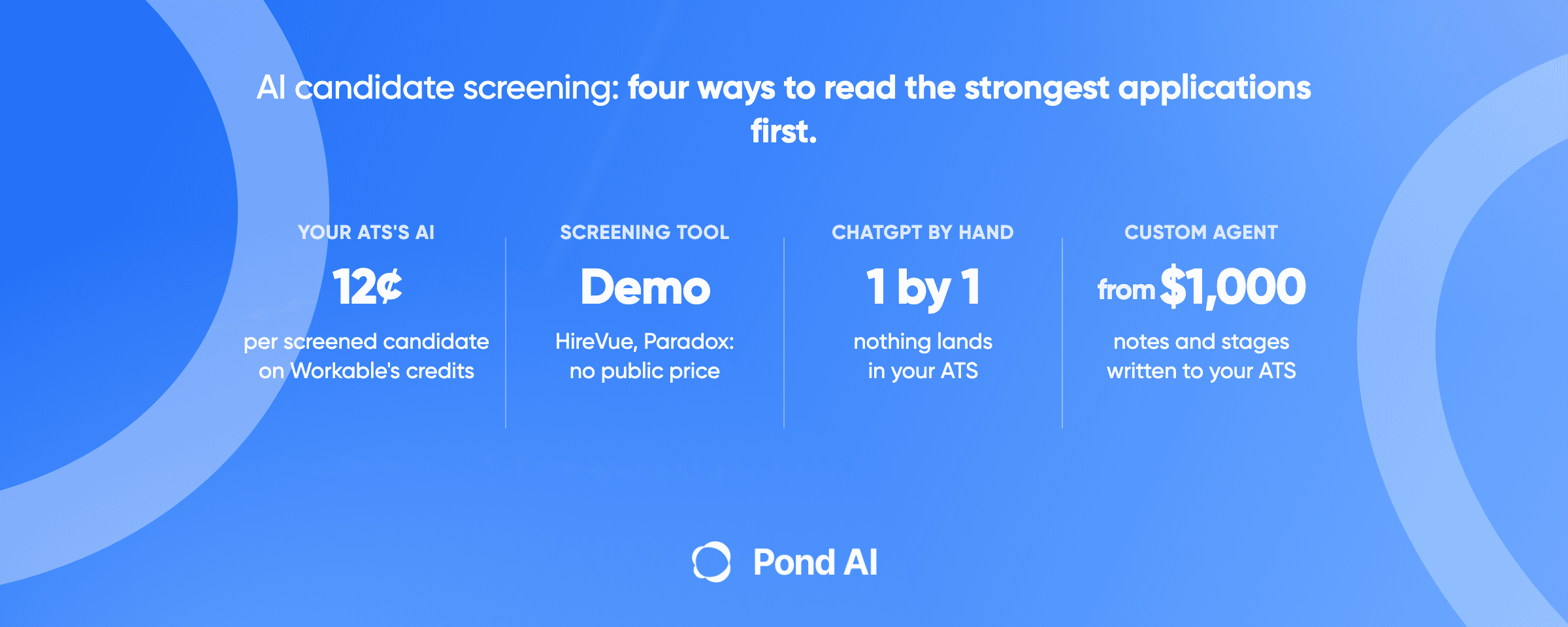
Short answer: AI candidate screening reads each application and scores or sorts it against the job's requirements, so a person reads the strongest ones first. In 2026 a small company has four ways to get it: the AI built into its ATS, a separate screening tool, pasting applications into ChatGPT or Claude by hand, or a custom agent built around its ATS. Check what your ATS already sells before buying anything else, and keep a person on every rejection.
Four routes to AI candidate screening, compared
| Route | What it does | What lands in your ATS | Published price | Who decides |
|---|---|---|---|---|
| Your ATS's own AI | Scores or screens applicants against criteria you set inside the ATS | Scores and stages on the candidate record | Workable: 1 AI credit per candidate screened, with 3,000 free credits to start; Breezy: from $30 per 100,000 credits; JazzHR: candidate matching from its $3,480-a-year Plus plan; Greenhouse and Lever: no public price | A person, inside the ATS |
| A separate screening tool | AI interviews, chat screening and scheduling, sold to recruiting teams | Whatever its ATS connector writes | HireVue, Paradox, Tenzo and Alex show no price, only demo requests | A person, after the tool's ranking |
| ChatGPT or Claude by hand | You paste a resume and the job description and ask for a verdict | Nothing: you copy the result across yourself | Your existing chat plan | You, one application at a time |
| A custom agent on your ATS | Reads each new application, writes a note and a suggested stage back, and sends interview links for the candidates you approve | A note, a suggested stage and a scheduling link on the record | From $1,000 to build, usually 1 to 2 weeks | A person, before any rejection or invite |
The per-applicant costs are our arithmetic from each vendor's own page. Workable's smallest credit pack costs $0.12 a credit, so a screened candidate costs about 12 cents once the starting credits run out, and less on its larger packs. Breezy says its 100,000-credit trial is enough to score about 200 applicants, which puts its $30 pack at about 15 cents an applicant.
What AI screening does, and where it stops
The pages that rank for this term all say the same two things: the software reads applications and scores them against the job's requirements, and the point is that nobody has to read every application by hand. Both are true. What they leave out matters more for a small company.
Screening is a sorting step. The hiring decision comes after it, and it belongs to a person. A score tells you which applications to read first. It does not tell you who to reject, and the rules below treat an automated rejection very differently from an automated reading order. Keep that line in the design from day one: the software suggests, a person moves the candidate.
A small company also has a different problem from the volume hirers most screening tools are built for. Three roles a quarter is not a pipeline that needs a chatbot interviewing candidates around the clock. It is a founder or an office manager who opens the ATS at the end of the week and finds a few hundred applications for one role. The useful job is a ranked list with reasons, not an AI interviewer.
Check your ATS's own AI first
Most of the ATSs we checked now ship some form of AI screening. Test the screening or scheduling your ATS already sells before buying a separate tool, because it writes into the system you already read.
Workable. Its pricing page lists a Screening Agent as an add-on that "Uses AI credits", at "1 AI credit each time a candidate is screened against your ideal candidate profile." "Every paid account starts with 3,000 free AI credits to try." Self-scheduled interviews and API access are listed in all plans.
Breezy HR. "Breezy Intelligence, the AI that scores and screens applicants, can be added to any plan starting at $30 per 100,000 credits." Plans start at $157 a month billed annually, with unlimited users and positions.
Ashby. Its pricing page lists "AI Assisted Application Review", which lets you "Define criteria for your jobs and use AI to analyze matches against that criteria across inbound applications." It also lists auto-reject rules based on application-form answers. Both are listed on all three plans, including Foundations, the plan for companies up to 100 employees, which is priced by company size.
JazzHR. "AI-Powered Candidate Matching" starts on the Plus plan at $3,480 a year. The $1,000-a-year Hero plan does not include it.
Greenhouse and Lever. Neither prints a price. Greenhouse's Core plan includes Scheduling and Talent Matching. Lever's core platform lists "AI-powered screening", and it sells "AI Screening by VONQ" as an add-on.
Manatal and Recruitee. Manatal starts at $15 per user a month billed annually and promotes an AI Interviewer with no price on the page. Recruitee's middle plan includes an AI-powered Screening Assistant capped at 100 credits a month, with full use on its top plan; it shows no prices.
BambooHR. Its pricing page shows no AI screening for the ATS. Its AI features are for HR data. The ATS is capped at 5, 25 or 50 open jobs depending on the plan.
Run a test before you commit. Take one closed role where you already know who you hired and who you should have hired, run its applications through the ATS's screening, and compare the ranking with your own.
Interview scheduling is usually already in the ATS
The scheduling half of this job is the easier half, and four of the ATSs above already cover it: Workable lists "Self-scheduled interviews" in all its plans, Greenhouse includes Scheduling in Core, Recruitee lists "Candidate self-scheduling", and Ashby sends candidates "a link to submit their availability". For a team hiring a few roles a quarter, a self-scheduling link sent after a person approves the candidate covers most of the need. A separate scheduling product earns its cost at volume, with panels of several interviewers across time zones.
What an agent can write into your ATS
If the ATS's own AI does not fit your process, the next question is whether an outside agent can work inside the same system. The public API docs say yes for the main ATSs, with differences that matter:
| ATS | Read applications and resumes | Add a note | Move a stage | Reject with a reason | Alert on a new application |
|---|---|---|---|---|---|
| Greenhouse | Yes; resumes are listed as attachments | Yes | Yes | Yes, and a rejection reason is required | Recruiting webhooks are documented |
| Lever | Yes, including resume downloads | Yes | Yes | Archive with a reason | Yes, an applicationCreated webhook |
| Workable | Yes, including candidate files | Yes, as a comment | Yes | Yes, disqualify with a reason | Yes, webhook subscriptions |
| Ashby | Yes | Yes | Yes | Through a stage change with an archive reason | Yes, an applicationSubmit webhook |
| BambooHR | Applications and details | Yes, as a comment | Yes, by status | No endpoint found | No applicant webhook found |
Two details change a build. Greenhouse's docs announced that "The Harvest v1/v2 API is deprecated and will be removed on August 31, 2026. Please migrate to Harvest v3", so a new build should start on v3. And in v3, naming the user behind each call is optional: the authentication request takes "The optional ID of the user to act on-behalf-of." If the build leaves it out, Greenhouse records an auto-generated service account instead, so name a user if you want every note and stage move the agent makes attributed to someone in Greenhouse. Our guide to AI agent integration covers the connection checks and tests to run when you connect an agent.
The rules depend on where you hire
A small company can be hiring under four sets of rules at once. Each one turns on where the job is, where the candidate lives, or both. None of them bans AI screening. They all care about the same two things: whether the software decides on its own, and whether it treats people differently by race, sex, age or another protected trait. Here is what each says, from the law or the regulator's own text. Take a specific setup to your lawyer before you switch it on.
New York City. Local Law 144 took effect on January 1, 2023, and enforcement began on July 5, 2023. It applies by job location: when the job is at an office in New York City, at least part time, or when the job is fully remote but the location tied to it is an office in the city. It covers an "automated employment decision tool", which the city's FAQ defines as a tool that "Uses machine learning, statistical modeling, data analytics, or artificial intelligence", helps make employment decisions, and "Substantially assists or replaces discretionary decision-making." The city's rules narrow that last part to three cases: relying solely on a score, tag or ranking; weighting that output more than any other criterion; or using it to overrule other factors, including a person's judgment. A tool in scope needs a bias audit by an independent auditor within the past year, a published summary of its selection rates and impact ratios, and a notice to candidates who live in the city: "Provide the notice 10 business days before using an AEDT."
That list is the design question for any screening setup. A score that a person must follow is in a different place from a note that a person reads before deciding.
Illinois. Since January 1, 2026, the state's Human Rights Act makes it a civil rights violation "for an employer to use artificial intelligence that has the effect of subjecting employees to discrimination on the basis of protected classes", or to use zip codes as a proxy for them. The test is the effect, and the provision lists recruitment and hiring among the decisions it covers. Failing to give notice that AI is used for these decisions is also a violation, and the statute directs the Illinois Department of Human Rights to adopt rules on that notice. A separate, older law covers video: before asking applicants for Illinois-based positions to record interviews that AI analyzes, an employer must tell them, explain how the AI works and what it looks for, and get their consent. It must delete a video within 30 days of the applicant's request.
California. Civil Rights Council regulations in force since October 1, 2025 make it unlawful to use an automated-decision system that discriminates on a protected basis. Evidence of anti-bias testing, or the lack of it, counts in a claim or a defense, judged on "the quality, efficacy, recency, and scope of such effort" and the results. Automated-decision system data is among the records an employer must keep for four years. And a vendor or other agent that screens on the employer's behalf, including through such a system, counts as an employer under the Act. Separately, the state privacy agency's rules on automated decisionmaking technology, meaning technology that replaces or substantially replaces human decisionmaking, cover significant decisions about employment; a business that already uses it for those decisions must comply by January 1, 2027.
Colorado. SB 26-189, approved May 14, 2026, replaced Colorado's 2024 AI Act. It takes effect January 1, 2027, and it covers job applicants who are Colorado residents and anyone evaluated for an opportunity in Colorado by a business doing business there. A business that uses covered technology to materially influence a hiring decision must give a clear and conspicuous notice first. After an adverse outcome, it must give the candidate a plain-language description of the decision and the role the technology played in it within 30 days. The candidate may then request "AN OPPORTUNITY FOR MEANINGFUL HUMAN REVIEW AND RECONSIDERATION", which the business must provide to the extent commercially reasonable. It must keep records for at least three years.
The courts. In Mobley v. Workday, a federal judge in California granted preliminary certification in May 2025 of a nationwide age-discrimination collective: applicants aged 40 and over who, since September 24, 2020, applied through Workday's job application platform and were denied employment recommendations. The order describes the claim as "the use of Workday’s AI recommendation system to score, sort," rank or screen applicants. The certification is preliminary. It shows that a screening vendor's ranking can be the subject of a claim.
Where AI screening goes wrong
The clearest public test is a University of Washington study. The researchers ran 554 resumes against 571 job descriptions across nine occupations, using three text-embedding models, in more than three million comparisons. Resumes with White-associated names were preferred in 85.1% of tests and those with Black names in 8.6%. Resumes with White male names were preferred over Black male names in 100% of tests. In August 2026 the authors published a correction: a bug inverted their results on gender, and the race and intersectional results were unaffected and were replicated by another team.
Two practical lessons follow for a small company. First, test any screening setup on a closed role before it touches a live one, and compare its ranking with the people you actually hired. Second, keep names and other details that signal a protected trait out of what the software scores. A screen built on your written must-haves gives a person something to check. A single fit score gives them nothing.
When a custom agent is the better route
The ATS's own AI is the right answer when its rules fit how you hire. A custom agent earns its build cost when they do not. Three signs point that way:
- Your must-haves are specific and written down, such as a license, a portfolio link that opens, or hours that overlap with yours, and you want each one checked and noted on its own instead of blended into one score.
- Your ATS has no AI screening, or prices it for a bigger team, but its API can read applications and write notes.
- You want the agent to do the follow-up too: send the interview link to the candidates you approve, chase the ones who have not booked, and leave the rejections for a person.
Pond is an AI engineer for businesses, and screening job applicants and scheduling interviews is one of the jobs its agents do. Custom builds start from $1,000, usually take 1 to 2 weeks, and come with a 7-day refund that applies only to custom builds. You book a call and agree the scope and the acceptance test with Pond. Bring your must-haves, a closed role to test against, and the rule that a person makes every rejection. If you would rather build it yourself, the Free plan on Pond starts at $0 plus usage. The trade-offs between the two routes are in our build vs buy guide, and our guide to testing an AI agent covers how to check one before it touches real candidates.
Picking a route by how you hire
- One or two roles a quarter, any ATS: turn on the ATS's self-scheduling and its screening, if it has one, and read the ranked list yourself.
- On Workable, Breezy or Ashby: test the built-in screening on a closed role before paying for anything else.
- On BambooHR, or no ATS yet: BambooHR shows no AI screening, so the choice is a different ATS or an agent that works through its API.
- Hiring for a job tied to a New York City office, or hiring in Illinois, California or Colorado: read the rules section above before switching on any automated screening.
- A process with specific must-haves and follow-up: a custom agent that writes notes and suggested stages into your ATS.
Frequently asked questions
What does AI screening do?
It reads each application and scores or sorts it against the job's requirements, so a person reads the strongest applications first. Some tools add chat or video interviews and interview scheduling. Screening sorts applications; it does not make the hiring decision, and the rules in New York City, Illinois, California and Colorado treat software that decides on its own very differently from software that helps a person decide.
Are employers using AI to screen applicants?
Yes. Most of the ATSs we checked now sell it: Workable has a Screening Agent, Breezy has Breezy Intelligence, Ashby has AI Assisted Application Review, JazzHR has AI-Powered Candidate Matching, and Lever lists AI-powered screening. New York City, Illinois, California and Colorado all have rules that apply to it.
What is the best AI for recruiting at a small company?
Start with the AI your ATS already sells, because it writes into the system you already use. Test it on one closed role against the people you actually hired. If it does not fit your process, or your ATS has none, a custom agent working through your ATS's API is the other route.
How much does AI candidate screening cost?
On the vendors' own pages, Workable charges 1 AI credit per candidate screened, and every paid account starts with 3,000 free credits; after those, its smallest credit pack costs $0.12 a credit. Breezy Intelligence starts at $30 per 100,000 credits, which its trial says scores about 200 applicants. JazzHR includes AI matching from its $3,480-a-year Plus plan. HireVue, Paradox, Greenhouse and Lever publish no price. A custom agent from Pond starts from $1,000 to build.
Can ChatGPT or Claude screen resumes?
They can read a resume you paste in and compare it with a job description. Out of the box they are not connected to your ATS, so nothing they say lands on the candidate record, and you repeat the work for every application. The University of Washington study found strong race bias in text-embedding models ranking resumes, which is a reason to score against written must-haves rather than ask for a single verdict.
Is AI candidate screening legal?
Yes, with conditions that depend on where you hire. For a job tied to a New York City office, the city requires an annual independent bias audit and a notice 10 business days before using a tool in scope. Illinois bars AI use that has a discriminatory effect and requires notice. California counts anti-bias testing in claims and requires four years of records. Colorado's law, from January 1, 2027, requires notice before use and, if a candidate asks after an adverse outcome, human review to the extent commercially reasonable.
Can AI schedule interviews automatically?
Yes, and several ATSs already include it: self-scheduled interviews on every Workable plan, Scheduling in Greenhouse's Core plan, candidate self-scheduling in Recruitee, and an availability link from Ashby. Send the link after a person approves the candidate.
Get a screening agent built
Bring a job description, your must-haves and one closed role to test against, and Pond will scope an agent that reads each new application, writes its reasons into your ATS, and books interviews for the candidates you approve, where your ATS's API allows it. Custom AI agent builds start from $1,000, usually take 1 to 2 weeks, and come with a 7-day refund that applies only to custom builds.
Get a custom AI agent or Try Pond to build your own.