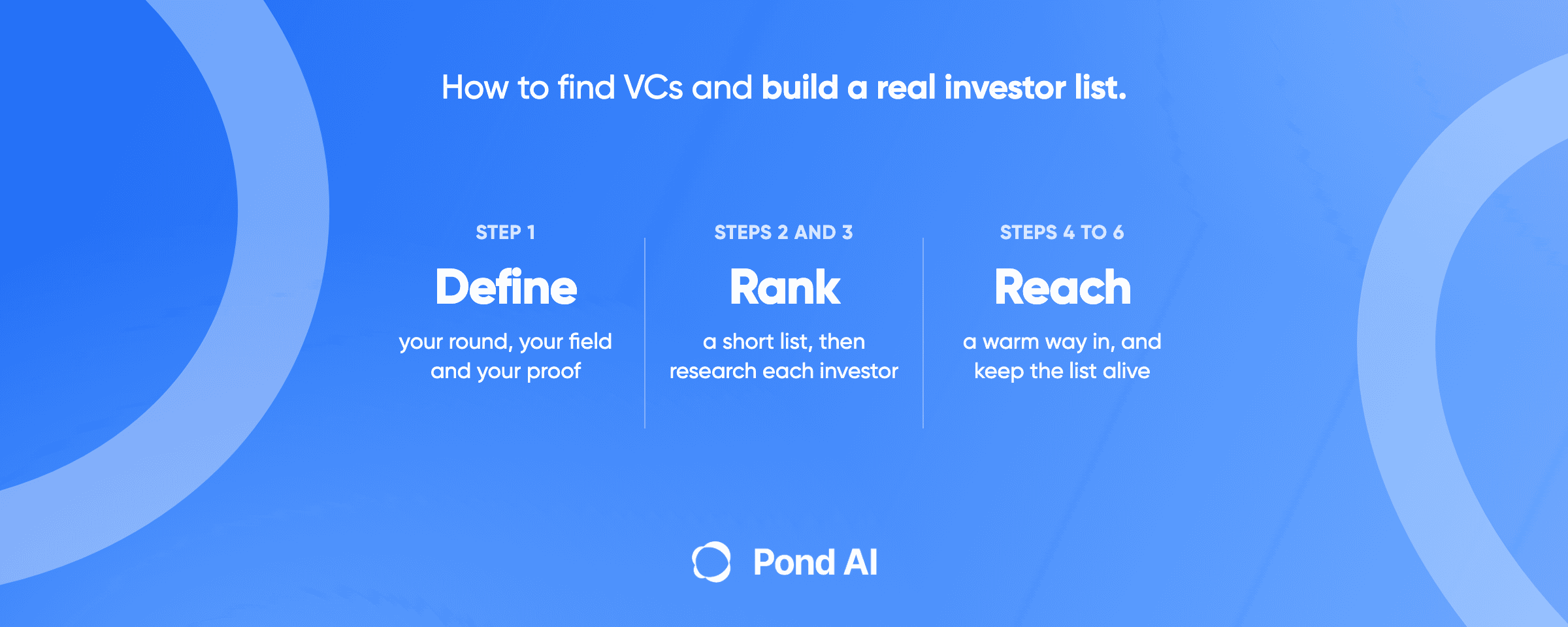
Short answer: To find VCs, start with fit and not with a database. Write down your round, your field and your proof, then keep only the investors whose stage, thesis and check size match all three. Rank them, research each one in their own words, find a warm way in, and build the kind of visible progress that gets investors to come to you. The template below holds every column a working investor list needs. The same method answers how to find venture capital and how to find investors for a startup, because the filter is the same.
Pond builds AI agents that run inside the AI you already use. One of them ranks investors who fit your company.
Why a list from a directory fails
Most founders start by searching for names. Elizabeth Yin of Hustle Fund described the pattern in 2019:
"...when founders create their list of investors they want to pitch to, they often draw from common directories." (Elizabeth Yin, May 22, 2019)
Yin adds that these lists "are a great place to start for sure," but that they "also narrow people's thinking." A directory is a start, and it gives you names that every other founder already has. It does not tell you which investor backs your stage, writes your check size, or has a reason to care about your field. The search results for this topic in 2026 follow the same pattern: they start from where to find names, such as investor databases, communities and events. None of the pages we reviewed offers a fit-first filter or a list template.
So the first step is not "find VCs." It is "find the VCs whose job is to look for a company like mine." Elad Gil put the second half of that plainly in 2011:
"Find the right partners at the right firms to talk to. I can not overemphasize this point enough." (Elad Gil, March 17, 2011)
Step 1: Write down your round, your field and your proof
Before you open a single firm's website, write three lines.
- Your round. Angel, pre-seed or seed, and how much you are raising.
- Your field. The sector and the problem you solve, in the words an investor would use.
- Your proof. What you can show today: users, revenue, partners, growth or a working product.
These three lines are your filter. An investor who does not back your stage or your field drops off the list, however famous the firm is. An investor who backed your closest competitor drops off the list too.
Step 2: Build a ranked list, not a long one
Now build the list, and keep it to investors you can write one honest sentence about. For each investor, you want to know five things:
- Do they invest at your stage?
- Do they back your field?
- Does their check size fit your round?
- Is this the person at the firm who makes the call?
- What does the firm say, in its own words, about what it backs?
Doing this by hand means reading a lot of firm websites. A general AI chat can help, but check every stage and check size it gives you against the firm's own page.
This is the job Pond's Investor Match was built for. The workflow is described on joinpond.ai as "Ranks 50 investors who fit your company, each with why." It asks for your website and your round (angel, pre-seed or seed), reads your site, shows you the profile it will search on, and then searches Pond's investor dataset for people who decide investments in your field and at your stage. You get up to 50 ranked investors in a CSV, each with one plain reason they fit and how their check range sits against yours. It never contacts anyone, drafts no messages, and never looks up phone numbers or personal email addresses.
Read each "why they fit" line before you act on it. A ranked list is where the work starts. If you only need the list, Investor Match runs on its own. Pond charges by usage. Today, each agent costs cents to run, and you pay only for what you use.
A free investor-list template
Copy this table into a spreadsheet. The columns are the ones that turn a list of names into something you can work from. The rows below are placeholders.
| Investor and partner | Firm | Stage | Check size | Thesis in their words (with link) | Portfolio conflict | Warm path | Status and next step | Last touch |
|---|---|---|---|---|---|---|---|---|
| [Partner name] | [Firm name] | [Pre-seed, seed or other] | [Range the firm states] | "[Quote from the firm's own page]" ([link]) | [Yes or no, and which company] | [Who knows both of you] | [Researching, intro asked, met, passed] | [Date] |
| [Partner name] | [Firm name] | [Stage] | [Range] | "[Quote]" ([link]) | [Yes or no] | [Connector] | [Status] | [Date] |
| [Partner name] | [Firm name] | [Stage] | [Range] | "[Quote]" ([link]) | [Yes or no] | [Connector] | [Status] | [Date] |
The "thesis in their words" column is the one most lists skip. If you cannot paste a real sentence from the firm's own page into it, you do not yet know why this investor would care.
Step 3: Research each investor before you reach out
A ranked list is a starting point, not a send list. Before you contact anyone, form a case for why this investor makes sense for your company.
- Read the thesis. What does the firm say it backs? Paste the sentence into the template.
- Scan the portfolio. Who have they backed in your space? An investor who backed your closest competitor drops off the list.
- Read their public views. Posts, essays, podcasts and talks show where they think your market is headed.
- Write one sentence on why you fit what they have already said they want.
If you cannot write that sentence, the investor is not ready for outreach.
Step 4: Find a warm way in
An introduction from someone the investor already trusts gives the investor a reason to read your note. "Get a warm intro" is vague, so here is the practical version.
- Take your top targets from Step 2.
- For each one, look for people and companies connected to both of you: shared customers, partners, portfolio companies and advisors.
- Pick the shortest, best-evidenced path.
- Ask the connector for the intro, with your one-sentence "why we fit" ready to forward.
Pond's Warm Intro Paths is described on its card as "Finds warm intro paths to 10 target accounts, every hop sourced." It finds paths to target accounts, which are companies, not to individual investors. Pond's "Meet investors who fit" bundle pairs Investor Match with Warm Intro Paths.
Step 5: Get investors to come to you
Instead of chasing investors, be visible, with real progress, where your target investors already pay attention. Post about what is actually moving. Reply usefully to what your target investors write. Go to events where they speak or judge, and know whom you want to meet before you walk in.
Dylan, Pond's founder, makes the same argument about his own raise. On X he wrote:
"I raised an $8M seed round as a solo founder and investors reached out to me. 99% of first-time founders think warm intros are the only way. Fundraising is about precise targeting and getting investors to come to you." (Dylan on X, November 12, 2026)
Six days later he added:
"When I raised our $8M seed round, I never cold-emailed VCs." (Dylan on X, November 18, 2026)
Dylan says the round was oversubscribed to $15M and investors in lead positions reached out first. One raise is a single example, but it shows what the method aims for.
Step 6: Keep the list alive while you raise
A raise runs for weeks or months, and your list should change as you learn.
- Move investors up or down when you get a signal: a reply, a post on your topic, an event they are speaking at.
- Drop investors who pass clearly or who back your closest competitor.
- Update the "last touch" and "next step" columns every time something happens.
- Rebuild the ranking when your story changes, for example after a big customer win.
Where Pond fits
Pond does not raise money for you, and no tool can promise a round. What it does is help you target the right investors and find better ways in, without contacting anyone on your behalf. Pond's "Meet investors who fit" bundle pairs Investor Match with Warm Intro Paths, and Pond's agents run inside Grok Bot, Claude, ChatGPT and other AI tools you already use. You can read more about the product in What is Pond.
Start with Pond, or ask for a custom agent built around your own process:
Frequently asked questions
How do I find investors for a startup?
Write down your round, field and proof first. Then keep only investors whose stage, thesis and check size match all three, rank them, and research each one on the firm's own pages. Fit matters more than the size of the list.
How many investors should be on my list?
There is no set number. Keep the list to investors you have researched, with one honest sentence on why each one fits, and rank them so you know whom to approach first. Pond's Investor Match returns up to 50 ranked investors in one run, each with a plain reason they fit and how their check range sits against yours.
Is a database enough to find venture capital?
A database gives you names. It does not tell you whether an investor backs your stage and field, how their check size sits against your round, or why they would care about you. You still need those answers for every name.
Should I cold email a VC?
Dylan says he never cold-emailed VCs when he raised his seed round. Whatever route you take, the test is the same: you should be able to quote the firm's own words on why you fit before you write. Pond never contacts investors for you and drafts no messages, so any outreach, cold or warm, stays in your hands.
Can Pond raise money for me?
No. Pond does not raise money for you, and no tool can promise a round. Pond helps you target the right investors and find better ways in. Investor Match returns a ranked CSV of investors who fit, each with a reason. It never contacts investors for you, drafts no messages, and never looks up phone numbers or personal email addresses.
How much does Pond cost?
Pond charges by usage. Today, each agent costs cents to run, and you pay only for what you use. You can run Investor Match on its own if you only need the ranked list. Each run returns a ranked CSV of investors who fit, and Pond never contacts anyone or looks up phone numbers or personal email addresses.
Which AI tools does Pond work with?
Pond can be connected in Grok Bot, Claude and ChatGPT, and you run its agents from the AI you already use. Investor Match, for example, asks for your website and your round, then returns a ranked CSV of investors who fit your company, each with a plain reason.